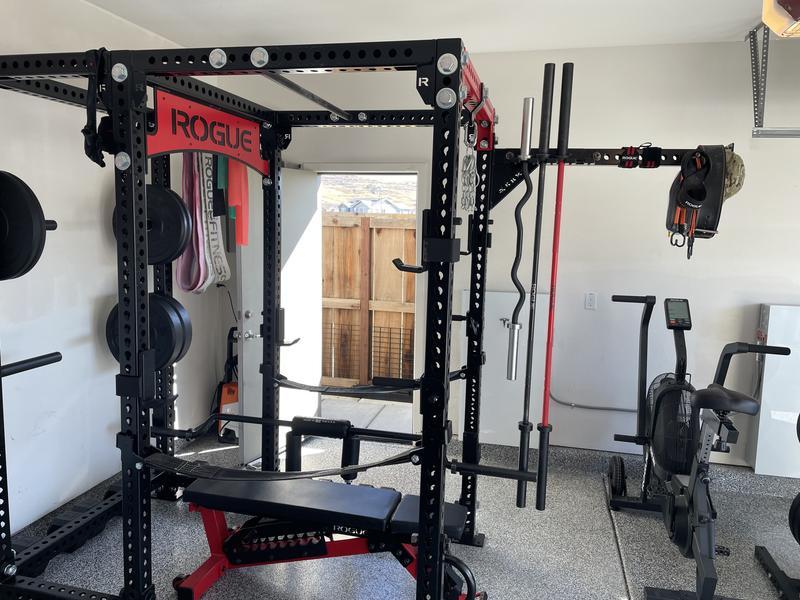
The right home gym attachments can turn a basic squat rack or power rack into a more versatile strength training station. Instead of purchasing several separate machines, you can add compatible attachments for squats, bench presses, dips, pull-ups, and other compound movements.
For lifters who train with heavier weights, choosing the right attachments is about more than exercise variety. Rack compatibility, secure installation, material quality, and published weight ratings all matter. This guide covers useful power rack and squat rack attachments, explains what they do, and helps you choose options that fit your home gym.
Quick Answer: Which Home Gym Attachments Are Most Useful?
For most strength-focused home gyms, start with compatible J-hooks and safety spotter arms. These are important for barbell training. A pull-up bar or dip attachment can expand your exercise options, while plate storage and landmine accessories can improve the overall setup.
- Most important safety accessory: Spotter arms or safety straps
- Best for barbell support: J-hooks
- Best for upper-body bodyweight training: Pull-up bar
- Best for dips: Rack-mounted dip attachment
- Best for organization: Weight plate storage pegs
8 Best Home Gym Attachments for Strength Training
1. Power Rack Safety Spotter Arms – Essential for Heavy Lifting
Safety spotter arms are among the most important attachments for a home power rack. They extend outward from the rack and provide a secondary support surface beneath the barbell during exercises such as squats and bench presses.
If you train alone, properly adjusted safety arms can help catch a barbell if you cannot complete a repetition. They should be positioned according to the exercise and your range of motion, without interfering with normal lifting technique.
What to check before buying
- Rack upright dimensions and hole spacing
- Attachment pin diameter and locking mechanism
- Published weight capacity for the specific model
- Arm length and usable support surface
- Protective material where the bar contacts the arms
2. J-Hooks – Best for Barbell Exercises
J-hooks hold a barbell at the desired starting height on a squat rack or power rack. They are used for squats, bench presses, overhead presses, and other barbell exercises.
Although J-hooks look simple, their dimensions and construction matter. A compatible pair should fit securely into the rack uprights and support the bar without excessive movement.
Some models include protective liners to reduce direct metal-to-metal contact and help protect the bar’s finish. Others use different shapes or locking designs. Check the product specifications carefully rather than assuming that all J-hooks are interchangeable.
J-hook buying checklist
- Match the rack’s upright size.
- Confirm hole diameter and spacing.
- Look for a secure pin or locking design.
- Check the hook depth and bar support area.
- Verify the manufacturer’s stated capacity.
3. Rack-Mounted Dip Bars – Best for Upper-Body Strength
Dip attachments allow you to perform bodyweight dips using a compatible power rack. They usually attach to the rack uprights and provide two parallel handles for supporting your body during the movement.
Dips primarily involve the chest, triceps, and shoulders. Depending on your body position and technique, you can emphasize different parts of the upper body.
For larger lifters, pay particular attention to handle spacing, grip comfort, attachment stability, and the published load rating. A narrow handle arrangement may feel uncomfortable, while a poorly secured attachment can move during exercise.
Features worth comparing
- Handle spacing and grip diameter
- Attachment style and rack compatibility
- Grip texture and surface finish
- Stability under controlled bodyweight movement
- Published maximum load rating
4. Power Rack Pull-Up Bars – Best for Bodyweight Training
A pull-up bar is a useful addition to a home power rack. It supports pull-ups, chin-ups, and other upper-body bodyweight exercises without requiring a separate pull-up station.
Some racks include a straight pull-up bar, while others offer multi-grip designs with angled or neutral-grip positions. A multi-grip design can provide more hand-position options, but it may require additional overhead clearance.
If you are buying a replacement or upgrade bar, check the rack’s mounting design and the bar’s installation requirements. Also consider ceiling height and available space above the rack.
Check Power Rack Pull-Up Bars on Amazon
5. Weight Plate Storage Pegs – Best for Rack Organization
Weight plate storage pegs attach to compatible rack uprights and provide designated locations for storing Olympic weight plates. They can help keep plates off the floor and make loading and unloading a barbell more convenient.
Different racks use different mounting systems, so check the upright dimensions, hole spacing, and attachment pin size. Also consider how the loaded plates will affect access to the rack and the surrounding training area.
For a home gym with limited floor space, rack-mounted plate storage can be especially useful. However, the rack must be suitable for the added storage load and installed according to its manufacturer’s instructions.
Check Weight Plate Storage Pegs on Amazon
6. Barbell Holders and Vertical Storage Attachments – Best for Saving Space
Barbell storage attachments help organize unused barbells in a home gym. Depending on the design, they may mount to a rack upright, wall, or dedicated storage structure.
Vertical holders can be useful when floor space is limited, while horizontal holders may make it easier to access frequently used bars. Before buying, check the barbell sleeve dimensions, storage orientation, mounting hardware, and available clearance.
Do not place a loaded or unsecured barbell in a holder unless the product is specifically designed for that use. Follow the manufacturer’s installation and storage instructions.
Check Barbell Storage Attachments on Amazon
7. Rack-Mounted Landmine Attachment – Best for More Barbell Variations
A landmine attachment secures one end of a barbell and allows the other end to move through an arc. It can be used for landmine rows, presses, squats, and other strength exercises.
It is a useful addition for people who want more exercise variety from a barbell setup. Some versions attach directly to a power rack, while others use a floor base or a different mounting arrangement.
Since this accessory is also covered in our guide to general gym attachments, this section focuses specifically on its role in a strength-training rack setup. Make sure the mounting point and barbell fit the attachment before purchasing.
Check Rack-Mounted Landmine Attachments on Amazon
8. Safety Straps – Best Alternative to Traditional Spotter Arms
Safety straps are designed to catch a barbell if a lift cannot be completed. They are commonly installed across the inside of a compatible power rack and can provide a different contact surface from rigid safety arms.
Some lifters prefer straps because they can offer a less rigid landing surface and may reduce direct contact between the bar and metal safety components. However, the exact setup and performance depend on the rack and strap design.
Check the installation method, strap length, rack compatibility, stitching, hardware, and stated capacity. Adjust the straps so they catch the bar safely without interfering with the intended range of motion.
Check Power Rack Safety Straps on Amazon
Home Gym Attachments Comparison
| Attachment | Main Purpose | Best For | Priority |
|---|---|---|---|
| Safety spotter arms | Catch the barbell | Solo barbell training | Essential |
| J-hooks | Hold the barbell | Squats and presses | Essential |
| Dip attachment | Bodyweight dips | Upper-body training | Useful |
| Pull-up bar | Pull-ups and chin-ups | Back and arm training | Useful |
| Plate storage pegs | Store weight plates | Home gym organization | Optional |
| Barbell holders | Store barbells | Space saving | Optional |
| Landmine attachment | Barbell movement variations | Strength training variety | Optional |
| Safety straps | Catch the barbell | Rack-based safety setup | Essential alternative |
How to Choose Attachments for Your Power Rack
1. Match the Rack Dimensions
Power rack attachments are not universally interchangeable. Check the rack upright dimensions, hole diameter, hole spacing, and attachment pin size. Even products that look similar may not fit the same rack.
2. Check the Weight Capacity
Look for a published capacity for each attachment, not just the rack itself. A power rack may have a high overall rating, but that does not automatically mean every compatible-looking accessory has the same capacity.
3. Consider the Attachment’s Intended Use
Some attachments are designed to support a barbell, others support bodyweight movements, and others are intended only for storage. Use each product for its stated purpose and do not modify it in ways that could compromise its security.
4. Evaluate Construction Quality
Look at welds, finish, pin design, protective liners, and the quality of the mounting hardware. For straps, inspect stitching and material condition. Customer photos and reviews can help identify practical fit or assembly issues.
5. Think About Space and Clearance
Attachments can increase the rack’s overall footprint. Dip bars, spotter arms, and plate storage pegs may extend into the surrounding area. Measure the space around your rack and make sure there is enough room to train without hitting walls, equipment, or other obstacles.
Important Safety Reminder
Safety arms and straps are not a substitute for correct setup and lifting technique. Install them according to the rack manufacturer’s instructions, check that pins and locks are fully engaged, and test the setup carefully before loading a heavy barbell. Never exceed the lowest applicable published capacity among the rack, attachment, and related hardware.
Best Attachment Setup for Different Home Gyms
Beginner Power Rack
- Compatible J-hooks
- Safety arms or straps
- Pull-up bar, if not included
Prioritize safe barbell setup before buying specialty accessories.
Strength-Focused Gym
- J-hooks
- Safety arms or straps
- Dip attachment
- Plate storage pegs
A practical combination for barbell and bodyweight exercises.
Advanced Home Gym
- Multiple rack attachments
- Specialty pull-up bar
- Landmine attachment
- Dedicated barbell storage
Expand based on available space and training requirements.
Common Home Gym Attachment Buying Mistakes
- Assuming all rack attachments are universal: Always check dimensions and mounting specifications.
- Ignoring safety equipment: Do not prioritize optional accessories over a suitable barbell support and safety setup.
- Confusing rack capacity with attachment capacity: Check the rating of each component separately.
- Buying accessories without measuring: Check the rack’s surrounding clearance and available floor space.
- Choosing based only on price: Compare construction, mounting security, fit, and published specifications.
Frequently Asked Questions
Are power rack attachments universal?
No. Power rack attachments vary in upright size, hole diameter, hole spacing, pin dimensions, and mounting style. Check the exact compatibility requirements for your rack before ordering.
What attachments should I buy first for a home gym?
If you use a power rack for barbell training, start with compatible J-hooks and a suitable safety system, such as spotter arms or safety straps. A pull-up bar is another useful addition if your rack does not already include one.
Are safety straps better than spotter arms?
Neither is automatically better for every rack or lifter. They have different designs and installation requirements. Compare compatibility, capacity, adjustment options, and the type of training you perform.
Can I add dip bars to any squat rack?
No. Dip attachments need compatible mounting points and must be designed for the rack’s dimensions and intended use. Check the attachment specifications and the rack manufacturer’s guidance.
Do I need a landmine attachment for strength training?
No. A landmine attachment is optional. It adds barbell exercise variations, but a basic strength-training setup can be effective without one.
How do I know if a rack attachment is strong enough?
Check the manufacturer’s stated load rating and installation instructions. Do not estimate capacity based on appearance, metal thickness, or the rack’s overall rating. If a product does not provide clear capacity information, contact the manufacturer before using it for demanding training.
Final Verdict: Build a Safer and More Versatile Strength Training Setup
The best home gym attachments are the ones that improve your training without creating compatibility or safety problems. For most power rack owners, J-hooks and a suitable safety system should come first. Pull-up bars and dip attachments add useful bodyweight exercises, while storage accessories help keep the training area organized.
If you lift heavy weights or need a setup that accommodates a larger frame, pay close attention to fit, stability, installation, and verified load ratings. Start with essential rack attachments and add specialty accessories only when they match your equipment and training goals.
Explore More Home Gym Guides
As an Amazon Associate, HeavyDutyChoice earns from qualifying purchases. This article may contain affiliate links, which means we may earn a commission if you purchase through them, at no additional cost to you.