
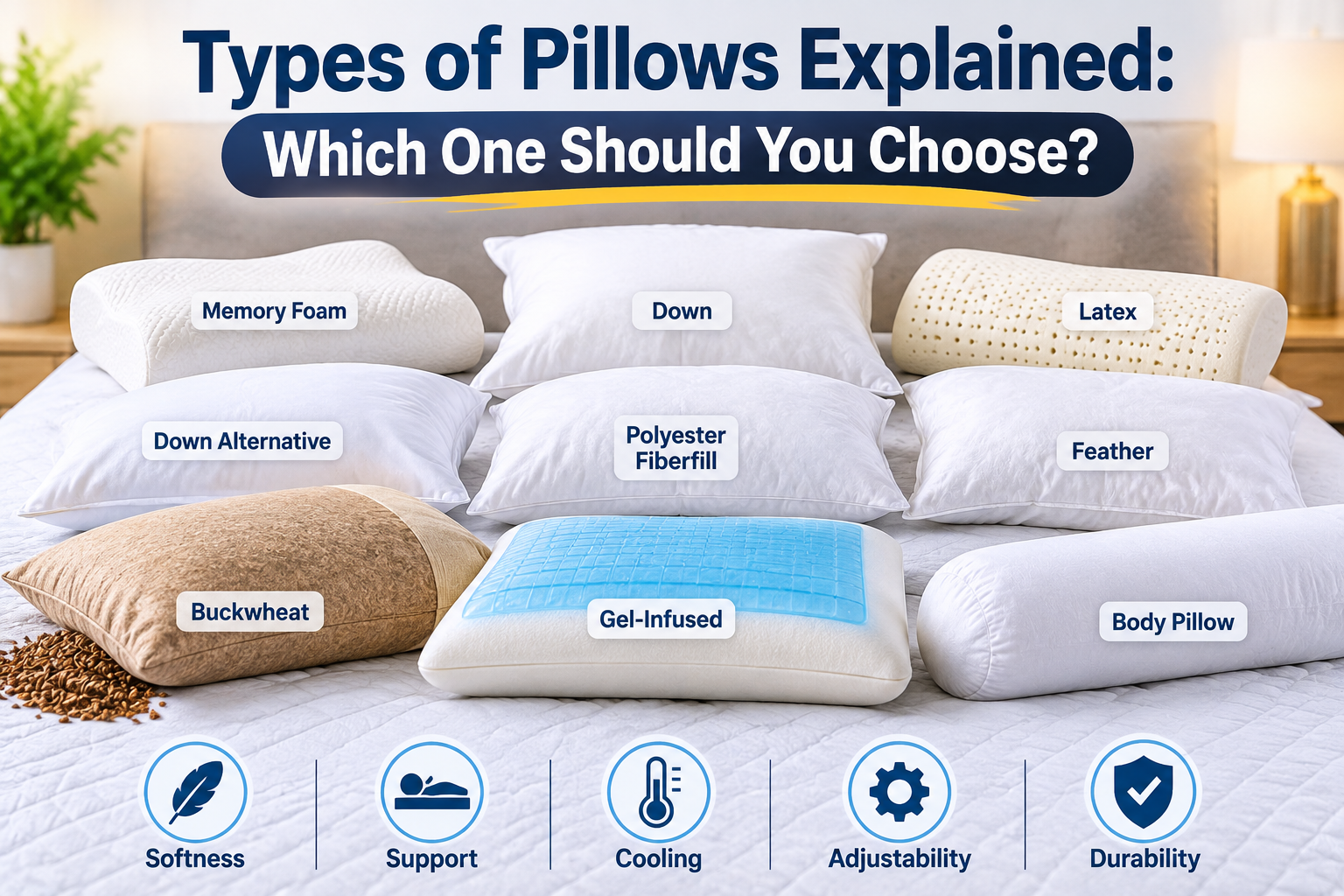
Choosing a pillow can be more complicated than it first appears. There are many types of pillows, and they differ in filling material, firmness, loft, shape, temperature regulation, and support. Some pillows are soft and moldable, while others provide a firmer surface designed to maintain a more consistent shape throughout the night.
The right choice depends on how you sleep, what kind of support you prefer, whether you tend to sleep hot, and how much maintenance you are comfortable with. This guide explains the most common pillow types, their advantages and disadvantages, and how to narrow down your options.
Quick Answer: What Type of Pillow Should You Choose?
Memory foam and latex pillows are worth considering if you prefer structured support. Down and down alternative pillows offer a softer, more traditional feel. Shredded foam provides adjustable comfort, while buckwheat pillows offer a firmer, more shapeable surface. Your sleeping position and preferred pillow height should guide the final decision.
Types of Pillows: Understanding the Main Categories
Pillows can be classified in two main ways: by their filling material and by their shape or intended use. The filling affects how a pillow feels and responds to pressure, while the shape determines how it is designed to support your head, neck, or body.
Here are the most common pillow types you will encounter when shopping.
1. Memory Foam Pillows
Memory foam pillows are made from viscoelastic foam that responds to body heat and pressure. The material gradually conforms to the shape of your head and neck rather than behaving like a traditional loose-fill pillow.
Memory foam pillows are available in solid molded designs and shredded-fill versions. Solid foam models generally maintain a more consistent shape, while shredded foam models can often be adjusted by adding or removing filling.
Potential advantages
- Can provide a more structured sleeping surface.
- Conforms to pressure from the head and neck.
- Available in different shapes, heights, and firmness levels.
- Shredded versions may offer adjustable loft.
Potential disadvantages
- Some solid foam designs may feel too firm or restrictive.
- Traditional foam can retain heat, depending on its construction.
- Some models have an initial manufacturing odor.
- Many foam cores cannot be machine washed.
Who may prefer it: People who want a more structured pillow and prefer a surface that conforms to their head rather than shifting freely.
Explore our related guides:
Shop Memory Foam Pillows on Amazon
2. Down Pillows
Down pillows are filled with the soft clusters found beneath the outer feathers of ducks or geese. These clusters are lightweight and fluffy, creating a plush, compressible sleeping surface.
Down pillows are often associated with a luxurious hotel-style feel. They can be reshaped and fluffed, but their support and loft may change as the filling compresses during use.
Potential advantages:
- Soft, lightweight, and easy to fluff.
- Can be molded into different shapes.
- Often provide a traditional plush pillow feel.
- Some designs are available in different down-to-feather ratios.
Potential disadvantages:
- May require regular fluffing to maintain loft.
- Can compress more than structured foam pillows.
- Usually more expensive than many synthetic alternatives.
- Not suitable for people who prefer to avoid animal-derived filling.
Who may prefer it: Sleepers who enjoy a soft, moldable pillow and do not need a highly structured feel.
3. Down Alternative Pillows
Down alternative pillows use synthetic filling designed to imitate the softness and loft of natural down. Common fillings include polyester fibers and other manufactured fiber blends.
They are available in a wide range of firmness levels and prices. Some are fluffy and compressible, while others use denser filling to provide a more supportive feel.
Potential advantages:
- Do not use natural down filling.
- Available at many price points.
- Often easy to find in standard pillow sizes.
- Some models are machine washable, depending on the care label.
Potential disadvantages:
- Quality and durability vary considerably.
- Some models lose loft or become lumpy over time.
- May not provide the same feel as higher-quality natural down.
Who may prefer it: People who want a soft, traditional pillow feel without natural down filling.
Related guide: Best Down Alternative Pillows.
Shop Down Alternative Pillows on Amazon
4. Latex Pillows
Latex pillows are made with natural latex, synthetic latex, or a blend, depending on the product. Latex typically has a more responsive and springy feel than memory foam. It tends to regain its shape relatively quickly after pressure is removed.
Latex pillows may use a solid molded core or a shredded latex filling. Some designs include ventilation holes to allow air to move through the material.
Potential advantages:
- Responsive feel rather than slow compression.
- Can maintain a relatively consistent shape.
- Available in solid and shredded designs.
- Some models have ventilated constructions.
Potential disadvantages:
- Can feel too springy or firm for some sleepers.
- Often costs more than basic polyester pillows.
- Latex allergies are a consideration for some individuals.
- Solid latex cores generally require specific cleaning care.
Who may prefer it: Sleepers who want a resilient pillow that does not feel as slow to respond as traditional memory foam.
5. Polyester Fiberfill Pillows
Polyester fiberfill pillows are among the most common and affordable pillow types. They use synthetic fibers to create a soft filling that can resemble the feel of down or other traditional pillow materials.
These pillows are widely available in different sizes, thicknesses, and firmness levels. However, the quality of the fiberfill can make a significant difference in how well a pillow maintains its shape.
Potential advantages:
- Generally affordable and widely available.
- Lightweight and easy to handle.
- Available in many loft and firmness options.
- Some models are machine washable.
Potential disadvantages:
- Lower-quality filling may flatten or clump.
- May require frequent replacement compared with more durable materials.
- Support can become inconsistent as the filling wears down.
Who may prefer it: People looking for an inexpensive everyday pillow or a simple option for guest rooms.
Shop Polyester Pillows on Amazon
6. Feather Pillows
Feather pillows use the outer feathers of ducks or geese rather than the soft down clusters used in down pillows. The feathers have a different structure and can create a firmer, more structured feel.
Some pillows combine down and feathers to balance softness with additional structure. When comparing products, check the filling description carefully because a down pillow and a feather pillow are not the same thing.
Potential advantages:
- Can provide a moldable, traditional pillow feel.
- Often easier to reshape than solid foam pillows.
- Available in different down-and-feather blends.
Potential disadvantages:
- May need regular fluffing.
- Some sleepers notice feather quills or a firmer texture.
- Filling may shift during the night.
- Uses animal-derived materials.
Who may prefer it: People who like traditional feather bedding and want a pillow they can reshape.
Shop Feather Pillows on Amazon
7. Buckwheat Pillows
Buckwheat pillows are filled with buckwheat hulls, the hard outer shells surrounding buckwheat seeds. Unlike soft fiberfill or foam, the hulls move independently and can be adjusted to create a customized shape.
These pillows usually feel firm and have a distinctive texture. They may also make rustling sounds when the filling shifts.
Potential advantages:
- Filling can often be added or removed to adjust loft.
- Hulls shift to accommodate different head positions.
- Does not rely on conventional foam or polyester filling.
- Can maintain a relatively firm structure.
Potential disadvantages:
- Usually much firmer than conventional pillows.
- Can be heavy compared with fiberfill pillows.
- May produce noticeable rustling sounds.
- Requires care to keep the hull filling dry and clean.
Who may prefer it: People who like a firm, adjustable pillow and do not mind a more textured sleeping surface.
Shop Buckwheat Pillows on Amazon
8. Gel-Infused and Cooling Pillows
Gel-infused pillows are designed to change the feel or thermal behavior of a pillow. Some use gel-infused foam, while others include gel layers, cooling covers, or other temperature-management features.
It is important to understand that the word “cooling” does not guarantee that a pillow will remain cold throughout the night. The actual experience depends on the materials, construction, room temperature, bedding, and individual preferences.
Potential advantages:
- Available in several foam and fiber constructions.
- Some designs combine cooling covers with supportive filling.
- Can offer an alternative to traditional dense foam pillows.
Potential disadvantages:
- Cooling performance varies by design.
- Gel does not automatically make a pillow breathable.
- Some models cost more than basic alternatives.
Who may prefer it: People who sleep hot and want to explore pillows with cooling-oriented materials or covers.
Related guides:
- Best Cooling Pillows for Hot Sleepers
- Best Bamboo Cooling Pillows for Hot Sleepers
- Best Cool Gel Memory Foam Pillows
Shop Cooling Pillows on Amazon
9. Water Pillows
Water pillows use a sealed water chamber, sometimes combined with a layer of fiber or other cushioning material. The amount of water can often be adjusted to change the pillow’s overall feel and height.
Because the filling is liquid, the pillow behaves differently from foam, down, or fiberfill designs. It may feel heavier and can require more setup before use.
Potential advantages:
- Some designs allow adjustment by changing the water level.
- Can combine a water chamber with a softer outer layer.
- Offers a different feel from conventional pillow filling.
Potential disadvantages:
- Heavier and more complicated to set up.
- Requires careful inspection of the water chamber and seals.
- May not appeal to people who prefer a traditional pillow feel.
Who may prefer it: People interested in an adjustable water-based pillow design.
10. Body Pillows
Body pillows are longer than standard bed pillows and are designed to support more than just the head. Depending on their size and shape, they can be positioned alongside the torso, between the knees, or around the body.
Common body pillow designs include straight rectangular pillows, U-shaped pillows, and C-shaped pillows. Their size and intended use can vary considerably.
Potential advantages:
- Provide a larger surface for positioning and support.
- Can be placed between the knees or alongside the torso.
- Available in different shapes and filling materials.
Potential disadvantages:
- Take up more bed space than standard pillows.
- Some designs are difficult to wash because of their size.
- Large pillows may be inconvenient to move or store.
Who may prefer it: People who want additional body positioning support or a larger pillow to hold while sleeping.
11. Wedge Pillows
Wedge pillows have a triangular or sloped shape rather than the flat rectangular design of a conventional bed pillow. They are commonly used to elevate part of the upper body or legs, depending on the product’s shape and intended purpose.
Some wedge pillows are designed for use behind the back, while others are smaller leg or knee wedges. These products should not be confused with ordinary head pillows.
Potential advantages:
- Provide an angled support surface.
- Available in different heights and slopes.
- Can be used for specific positioning preferences.
Potential disadvantages:
- May take up considerable bed space.
- Can feel too steep or firm for some users.
- Not a direct replacement for a conventional head pillow.
Who may prefer it: People who specifically want an inclined support surface rather than a standard sleeping pillow.
12. Cervical and Contour Pillows
Cervical pillows, sometimes called contour pillows, are shaped to provide different levels of support around the head and neck. Many have a curved profile, raised edges, or a central area designed to accommodate the head.
They are available in memory foam, latex, and other materials. The shape and height vary by model, so a contour pillow that works well for one person may feel uncomfortable to another.
Potential advantages:
- Offer a shaped alternative to a flat pillow.
- Available in different heights and contour designs.
- Can be useful for sleepers who prefer a defined head-and-neck support area.
Potential disadvantages:
- May take time to get used to.
- Incorrect height can feel uncomfortable.
- Not every contour shape suits every sleeping position.
Who may prefer it: People who want a shaped pillow rather than a traditional flat design.
Related guide: Best Ergonomic Pillows.
Shop Cervical Pillows on Amazon
Pillow Types Compared: Which Material Is Right for You?
The following table summarizes the main differences between common pillow fillings. These are general characteristics; individual products can vary depending on construction, filling quality, and design.
| Pillow Type | Typical Feel | Adjustability | Main Consideration | Memory Foam | Contouring, structured | Low to high, depending on design | Heat retention and firmness | Down | Very soft, fluffy | Shapeable | Loft maintenance and animal-derived filling | Down Alternative | Soft, fluffy | Varies by model | Filling quality and durability | Latex | Responsive, springy | Low to medium | Firmness and latex sensitivity | Polyester Fiberfill | Soft, lightweight | Varies by model | Flattening and clumping | Feather | Moldable, structured | Shapeable | Quills and regular fluffing | Buckwheat | Firm, textured | Often high | Weight and rustling noise | Gel-Infused | Varies by base material | Depends on construction | Actual cooling performance |
|---|
How to Choose a Pillow Based on Your Sleeping Position
Filling material is only one part of the decision. Pillow height, also called loft, and how much the pillow compresses under your head can be equally important.
For Side Sleepers
Side sleepers often need enough pillow height to fill the space between the head and mattress. A pillow that is too low may allow the head to tilt downward, while one that is too high may push it upward.
Structured memory foam, latex, and adjustable shredded foam pillows are options worth comparing. The correct height depends partly on shoulder width, mattress firmness, and how deeply the shoulder sinks into the mattress.
Read: Best Pillows for Side Sleepers.
For Back Sleepers
Back sleepers often prefer a medium or lower loft that supports the head without pushing the chin excessively toward the chest. A pillow with a moderate amount of contouring may be worth considering.
Memory foam, latex, and some adjustable-fill pillows offer different ways to achieve this feel.
Read: Best Pillows for Back Sleepers.
For Stomach Sleepers
Stomach sleepers often prefer a relatively low, soft pillow because a thick pillow can place the head at an uncomfortable angle. Some may find a thin down alternative or low-loft fiberfill pillow easier to position.
Read: Best Pillows for Stomach and Side Sleepers.
For Combination Sleepers
Combination sleepers change positions during the night. An adjustable pillow can be useful because its filling may be modified to achieve a preferred height and feel. A pillow that is easy to reposition may also be more convenient.
Read: Best Pillows for Combination Sleepers.
How to Choose a Pillow for a Larger Body Frame
People with larger body frames may have different pillow preferences because shoulder width, mattress compression, and sleeping position can influence the distance between the head and mattress.
However, body weight alone does not determine the correct pillow. A person’s shoulder width, neck position, mattress type, and preferred sleeping posture are also important.
When comparing pillows, consider these factors:
- Loft: Choose a height that fills the gap between your head and mattress without forcing your neck into an awkward angle.
- Support: Consider whether the pillow maintains enough height after your head settles into it.
- Adjustability: Removable filling can make it easier to fine-tune the pillow’s height.
- Size: A standard, queen, or king pillow may offer different amounts of surface area.
- Durability: Check the filling construction, warranty, and care instructions rather than relying on marketing descriptions alone.
For more targeted recommendations, see Best Pillows for Heavy People.
Other Features to Consider When Buying a Pillow
Pillow Loft and Firmness
Loft refers to the pillow’s height, while firmness describes how resistant it feels when compressed. They are related but not interchangeable. A high-loft pillow can still feel soft, and a relatively low pillow can be firm.
Breathability and Temperature
If you tend to sleep hot, look beyond labels such as “cooling” or “gel.” Consider the cover fabric, filling construction, ventilation, and whether the pillow traps heat. A breathable cover may improve comfort, but it does not guarantee a cool sleeping experience.
Cleaning and Maintenance
Check whether the entire pillow is washable or only its outer cover. Many solid foam and latex pillows should not be machine washed. A removable, washable cover or a separate pillow protector can make routine care easier.
Related guide: Best Pillow Protectors: Waterproof and Hypoallergenic Options.
Pillow Size
Standard, queen, and king pillows differ in width. Larger pillows may provide more room to reposition, but they also require appropriately sized pillowcases and may take up more bed space.
Frequently Asked Questions About Different Types of Pillows
What are the most common types of pillows?
The most common types include memory foam, down, down alternative, polyester fiberfill, latex, and feather pillows. Specialty options include buckwheat, water, body, wedge, and cervical contour pillows.
Which type of pillow is best for everyday use?
There is no single best pillow for everyone. Memory foam, latex, down alternative, and polyester pillows are all common everyday options. The right choice depends on your sleeping position, preferred firmness, pillow height, and maintenance preferences.
What is the difference between memory foam and latex pillows?
Memory foam generally responds slowly to pressure and conforms to the shape of the head. Latex usually feels more responsive and springy, returning to its original shape more quickly. Both materials are available in different shapes and firmness levels.
Are down pillows better than down alternative pillows?
Neither is automatically better. Down pillows use natural filling and often have a soft, lightweight feel. Down alternative pillows use synthetic fibers and can provide a similar general feel without natural down. Compare loft, construction, care instructions, and personal preferences.
What type of pillow is best for hot sleepers?
Hot sleepers may want to compare breathable covers, ventilated latex, shredded foam, and cooling-oriented pillow designs. However, no material guarantees that a pillow will stay cool throughout the night.
How often should you replace a pillow?
There is no universal replacement schedule for every pillow type. Replace a pillow when it no longer maintains a comfortable shape, becomes permanently lumpy or flat, develops persistent odors, or shows signs of damage that cannot be cleaned or repaired. Follow the manufacturer’s care guidance.
Are adjustable pillows worth considering?
Adjustable pillows can be useful for people who are unsure about their ideal loft. Models with removable shredded filling allow users to add or remove material until the height and feel are more comfortable.
Final Thoughts: Which Type of Pillow Should You Choose?
The best pillow type depends on the feel and support you want rather than simply choosing the most expensive or heavily advertised material.
- Choose memory foam if you prefer a more contouring, structured feel.
- Choose latex if you prefer a responsive, springy surface.
- Choose down if you enjoy a soft, moldable pillow.
- Choose down alternative if you want a synthetic option with a traditional fluffy feel.
- Choose shredded foam if adjustable filling and loft are priorities.
- Choose buckwheat if you prefer a firm, shapeable pillow.
- Choose a body or wedge pillow if you need a specialized shape rather than a conventional head pillow.
Before buying, compare pillow height, firmness, filling, dimensions, care requirements, and return policies. A pillow that matches your sleeping position and personal comfort preferences is usually a better starting point than choosing based on material labels alone.
Explore More Pillow Guides
Disclosure: HeavyDutyChoice may earn a commission when you purchase through qualifying Amazon links. This does not affect the price you pay. Product features and availability can change, so check the current listing before purchasing.