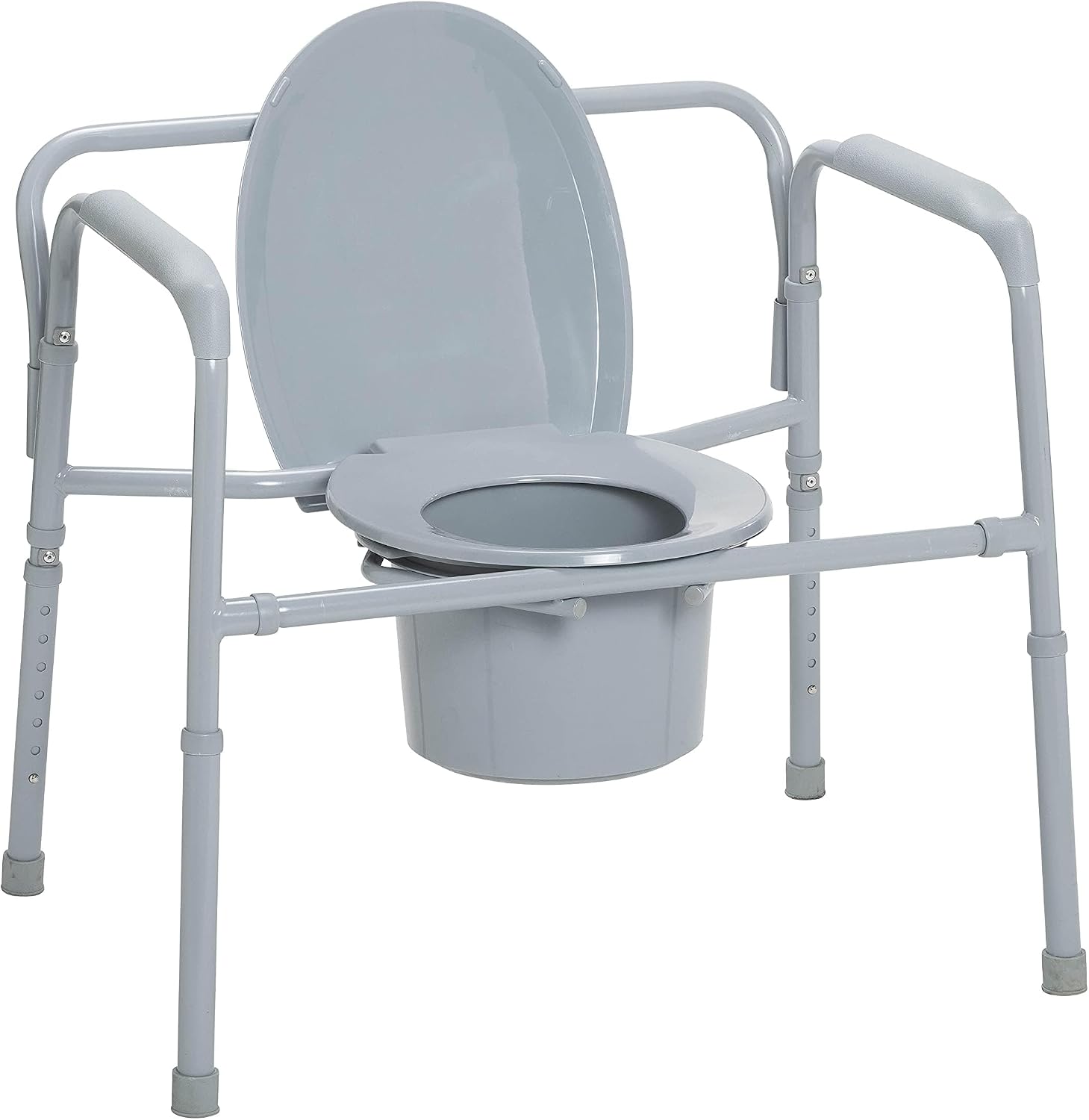
A practical guide to choosing a bedside commode that fits the user’s mobility, body size, bedroom layout, and daily care routine.
Stable Support
Easy Cleaning
For older adults who have difficulty walking to the bathroom, especially at night, bedside commodes for seniors can make toileting more convenient and reduce the need to cross a dark or unfamiliar room. The right model should provide a stable place to sit, a suitable seat height, and enough space for the user to sit down and stand up safely.
However, not every bedside commode is right for every senior. Some people need a simple folding chair for temporary recovery, while others benefit from a 3-in-1 design that can also fit over a regular toilet. Users who need extra room or cannot transfer over fixed armrests may require a different design altogether.
For many seniors who can stand and pivot with support, a height-adjustable folding commode is a practical starting point. A 3-in-1 model offers more flexibility, while a bariatric commode may be more appropriate when a wider seat or higher weight capacity is required.
- Best everyday option: Drive Medical 11148-1 Folding Steel Bedside Commode
- Best 3-in-1 alternative: Medline G1-200X1 Folding Commode
- Best for a higher weight capacity: Drive Medical 11117N-1 Bariatric Folding Commode
- Best for temporary recovery: A folding commode that is easy for a caregiver to set up and store
These are starting points, not a substitute for checking fit and transfer needs. Confirm the current product specifications and weight rating before purchasing.
Best Bedside Commodes for Seniors at a Glance
| Model | Best For | Main Advantage | Consider Before Buying |
|---|---|---|---|
| Drive Medical 11148-1 | Everyday bedside use | Folding steel frame and adjustable legs | Seat width and fixed-arm access |
| Medline G1-200X1 | Flexible home use | 3-in-1 design | Confirm toilet compatibility and dimensions |
| Drive Medical 11117N-1 | Users needing a higher capacity | Bariatric-style frame | Larger footprint; measure the room |
| Folding 3-in-1 commode | Temporary recovery or storage | Can be folded away when suitable | Check folding mechanism and setup |
1. Drive Medical 11148-1 Folding Steel Bedside Commode
2. Medline G1-200X1 3-in-1 Folding Commode
3. Drive Medical 11117N-1 Bariatric Folding Commode
4. A Folding 3-in-1 Commode for Temporary Recovery
How to Choose the Right Bedside Commode for an Older Adult
The best bedside commode is the one that fits the person’s body, mobility, and living space. Use the following checklist before ordering.
Seat Height
The seat should allow the user to sit down and rise with the appropriate support. Check the adjustment range and the user’s leg length.
Weight Capacity
Choose a model whose rated capacity safely exceeds the user’s weight. Never rely on appearance or a general product-category description.
Seat Width
Check the usable seat dimensions and the space between the armrests. A seat that is too narrow can make positioning uncomfortable.
Transfer Method
If the user cannot stand and pivot safely, fixed armrests may be unsuitable. Ask a healthcare professional about an appropriate transfer setup.
Cleaning
Look for a removable bucket and surfaces that can be cleaned according to the product instructions. Consider who will handle daily care.
Room Layout
Measure the available floor space and leave room for the user, walker, wheelchair, or caregiver to move safely.
Fixed Arms vs. Drop Arms: Which Is Safer?
Fixed-arm commodes may work for users who can stand and pivot safely. However, the armrests can become an obstacle for someone who needs to slide sideways from a wheelchair or requires a different transfer technique.
Drop-arm models allow one or both armrests to move out of the way. They can make certain transfers easier, but the correct choice depends on the user’s mobility and the caregiver’s technique. The arms must be securely locked whenever they are intended to provide support.
If side transfers are an important requirement, read our guide to Best Drop-Arm Bedside Commodes before deciding.
Bedside Commode Safety Tips for Seniors
- Place it on a stable surface. Follow the manufacturer’s instructions about flooring, assembly, and placement.
- Check the frame before use. Make sure the legs are adjusted evenly, the fasteners are secure, and any locking components are engaged.
- Keep the route clear. Move loose rugs, electrical cords, and other trip hazards away from the bed and commode.
- Provide appropriate lighting. A clear, illuminated route helps the user and caregiver see the transfer area.
- Do not use the armrests as a lifting aid unless the product is designed for that use. Follow the product instructions and seek professional guidance if transfers are difficult.
- Ask for help when needed. If the user has recently fallen, is unusually weak, or cannot transfer safely, consult a healthcare professional or occupational therapist about the right equipment and assistance.
A bedside commode is not a substitute for an individualized mobility or fall-prevention plan. The setup should match the senior’s actual abilities, not just the product description.
Frequently Asked Questions
What is the best bedside commode for seniors?
For a senior who can safely sit and stand with the appropriate support, a height-adjustable folding commode may be a practical option. A 3-in-1 design adds flexibility, while a bariatric model may be needed for a higher weight capacity or a wider seating area. The best choice depends on fit and transfer ability.
Can a bedside commode be used over a regular toilet?
Some 3-in-1 commodes are designed for use over a toilet when configured according to their instructions. Confirm the exact model’s compatibility, height, width, and clearance before using it this way.
Is a padded commode seat better for an elderly person?
A padded seat may be more comfortable for some people, especially when sitting is uncomfortable. However, padding can require more careful cleaning. Compare the seat material and cleaning instructions with the user’s comfort and care needs.
How do I know what weight capacity to choose?
Check the rated capacity for the exact model and make sure it is appropriate for the user’s weight. Also consider seat width, frame dimensions, and whether the user can sit and stand without placing unexpected loads on the equipment.
Will Medicare cover a bedside commode?
Coverage may be available when Medicare’s durable medical equipment requirements are met, including applicable medical-necessity and documentation rules. Eligibility depends on the individual’s circumstances and the specific equipment. Check current Medicare guidance and confirm coverage with the supplier and treating provider before purchasing.
Final Verdict
For many older adults, a straightforward folding commode is a reasonable place to start. The Drive Medical 11148-1 is worth comparing for everyday bedside use, while the Medline G1-200X1 offers a 3-in-1 format for people who need more flexibility. If a higher weight capacity or wider seating area is required, compare bariatric models such as the Drive Medical 11117N-1.
Before choosing, prioritize the user’s transfer ability, the fit of the seat, the rated capacity, and the available room. If the senior cannot transfer safely without substantial help, ask a healthcare professional or occupational therapist to assess the setup before buying.
Explore More Bathroom Safety Guides
Drop-Arm Bedside Commodes Explore options for side transfers →
Shower Chairs Compare seating for bathing support →
Toilet Seats & Safety Explore bathroom seating options →
Weight Capacity Guide Understand load ratings before buying →