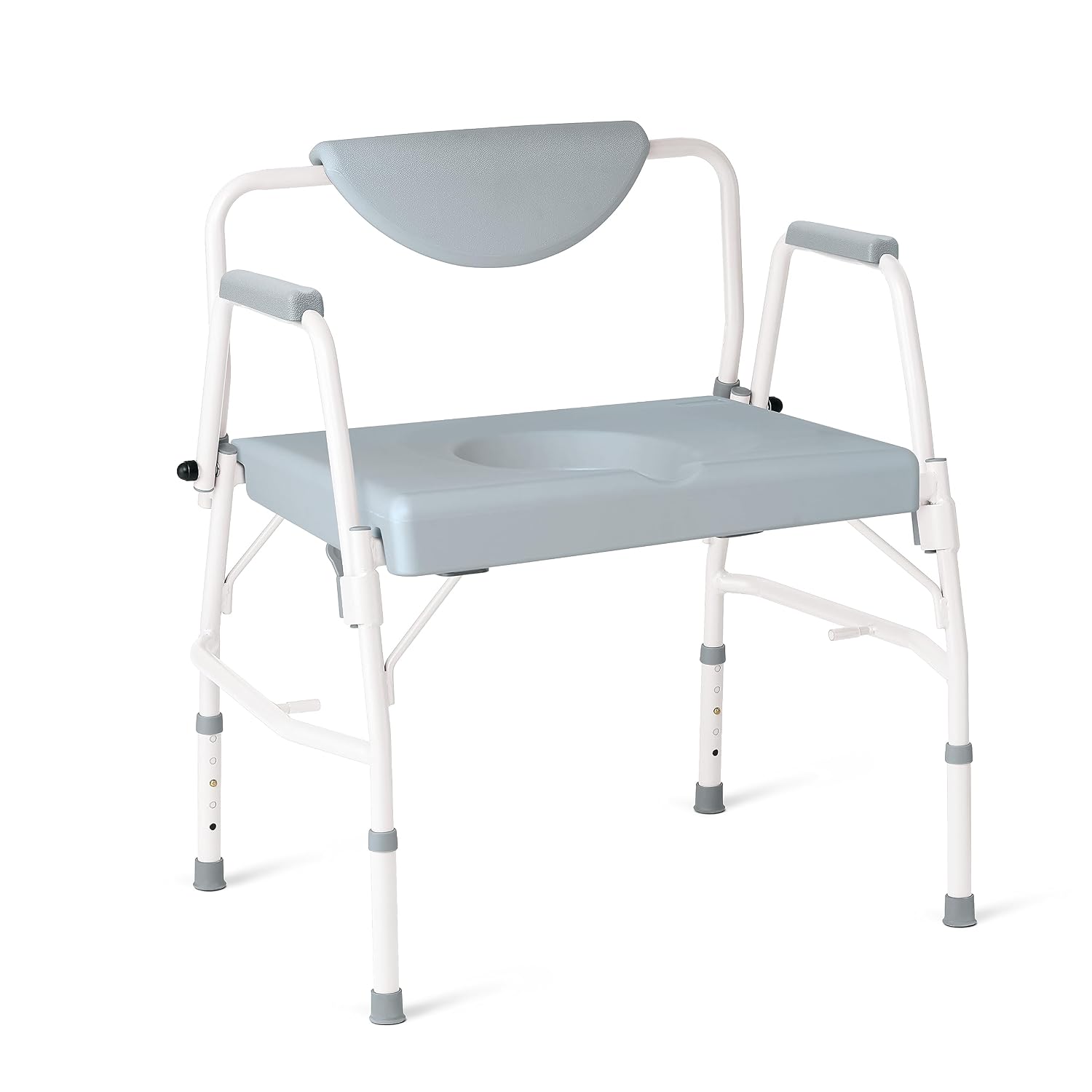
Find a bedside commode with the right weight rating, seat width, frame design, and height adjustment for safer, more comfortable toileting at home.
Wider Seating
Home Care
A heavy duty bedside commode can be a practical option for people who need a toilet close to the bed and require a sturdier frame, a wider seat, or a higher weight capacity than a standard commode provides. It can be especially useful when walking to the bathroom is difficult or when a caregiver needs to make nighttime toileting more manageable.
However, the label “heavy duty” does not guarantee that a product will fit every user. Weight capacity, usable seat width, frame dimensions, height adjustment, and transfer access all matter. A commode that meets the user’s weight requirement but is too narrow or difficult to transfer onto may still be the wrong choice.
For larger adults, start by comparing bariatric commodes with a clearly documented weight capacity and sufficient seat width. A folding model may be convenient for home storage, while a drop-arm design may be more suitable when side transfers are needed.
- First option to investigate: Drive Medical 11135-1 bariatric drop-arm commode
- Alternative bariatric model: Medline G1-400BDX1
- For users needing side-transfer access: Compare drop-arm designs carefully
- Before purchasing: Confirm the exact model’s weight rating, seat width, and overall dimensions
Best Heavy Duty Bedside Commodes at a Glance
| Model | Best For | What to Compare | Important Consideration |
|---|---|---|---|
| Drive Medical 11135-1 | Bariatric needs with side-transfer access | Arm design and usable seat width | Check the arm-locking mechanism and current capacity |
| Medline G1-400BDX1 | Heavy-duty steel commode comparison | Frame width and capacity rating | Verify exact model specifications |
| Drive Medical 11117N-1 | Bariatric folding-style option | Foldability and seat dimensions | Confirm the exact configuration and rated load |
| Medline Guardian G98204 | Alternative commode to compare | Seat style and frame configuration | Check that the listing matches the intended use |
Product availability and model configurations can change. The models below are candidates for comparison, not a guarantee that every model meets every heavy-duty requirement. Verify specifications on the exact Amazon listing before purchasing.
1. Drive Medical 11135-1 Bariatric Drop-Arm Commode
2. Medline G1-400BDX1 Bariatric Drop-Arm Commode
3. Drive Medical 11117N-1 Bariatric Folding Commode
4. Medline Guardian G98204 Commode
How to Choose a Heavy Duty Bedside Commode
Before purchasing a heavy duty bedside commode chair, evaluate the following features in order of importance.
Rated Weight Capacity
Confirm the exact model’s maximum rated capacity. Select a product that is appropriate for the user’s weight and intended use.
Usable Seat Width
Measure the seating surface and the space between the armrests. Overall frame width is not the same as usable seat width.
Frame Stability
Check frame construction, leg adjustment, locking parts, and the manufacturer’s assembly and inspection instructions.
Transfer Access
Fixed arms may work for some users, while drop arms may help with certain side transfers. Match the design to the user’s abilities.
Seat Height
The user’s feet and sitting position should be appropriate for the transfer. Check the manufacturer’s seat-height range before buying.
Room and Cleaning
Measure the bedside area and leave room for a caregiver or mobility aid. Consider bucket removal and cleaning access.
Heavy Duty vs. Standard Bedside Commodes
| Feature | Standard Commode | Heavy-Duty/Bariatric Model |
|---|---|---|
| Weight capacity | Depends on model | Look for a clearly documented higher rating when needed |
| Seat dimensions | May suit average-size users | Compare wider seating where needed |
| Room required | Often more compact | May require more clearance |
| Best selection method | Match fit and capacity | Verify rating, seat width, frame, and transfer needs |
The term “heavy duty” is not a universal weight rating. Always compare the exact product specifications rather than assuming that a model is suitable simply because the title includes “bariatric” or “heavy duty.”
Safety Tips for Using a Heavy Duty Bedside Commode
- Follow the assembly instructions. Check that legs, fasteners, and locking mechanisms are properly secured.
- Place the commode on a level, stable surface. Avoid unstable rugs and uneven flooring.
- Keep the transfer area clear. Leave enough room for the user, caregiver, walker, or wheelchair.
- Use the armrests as directed. Do not assume that a commode is designed to support every type of pulling or lifting movement.
- Inspect it regularly. Stop using the equipment if a frame component is bent, damaged, loose, or fails to lock properly.
- Seek transfer guidance if needed. A healthcare professional or occupational therapist can help determine whether a fixed-arm, drop-arm, or different toileting setup is appropriate.
Frequently Asked Questions
What is a heavy duty bedside commode?
It is a bedside toileting chair intended to meet specific capacity, frame, or seating requirements. The term alone does not establish a particular weight limit, so buyers should check the manufacturer’s rating and dimensions for the exact model.
Is a bariatric bedside commode always wider?
Not necessarily. Dimensions vary by model. Compare usable seat width, clearance between the armrests, overall frame width, and the space available in the room.
Should I choose a folding or fixed-frame commode?
A folding model may help with storage or temporary use. A fixed-frame model may be suitable when it better matches the user’s support and transfer needs. Compare the manufacturer’s stability guidance and the exact frame design before deciding.
When should I choose a drop-arm bedside commode?
A drop-arm design may be useful for certain side transfers when fixed armrests get in the way. The right setup depends on the user’s mobility and transfer technique, and the armrests must be secured according to the instructions whenever they are used for support.
How do I check if a commode is suitable for my weight?
Find the rated weight capacity in the exact model’s product documentation and make sure it is appropriate for the intended user. If the rating is unclear or the listing appears inconsistent, choose a product with specifications that can be verified.
Final Verdict
When comparing heavy duty bedside commodes, start with the user’s required weight capacity and usable seat width. Then consider transfer access, height adjustment, room dimensions, and ease of cleaning.
The Drive Medical 11135-1 and Medline G1-400BDX1 are candidates to investigate for bariatric drop-arm configurations. The Drive Medical 11117N-1 is another model to compare when a folding-style design is preferred. Confirm the exact product specifications before making a final choice.
Explore More Bathroom Safety Guides
Drop-Arm Bedside Commodes Compare options for side transfers →
Shower Chairs Explore bathing support options →
Toilet Seats & Safety Compare bathroom safety products →
Weight Capacity Guide Understand rated load limits →