
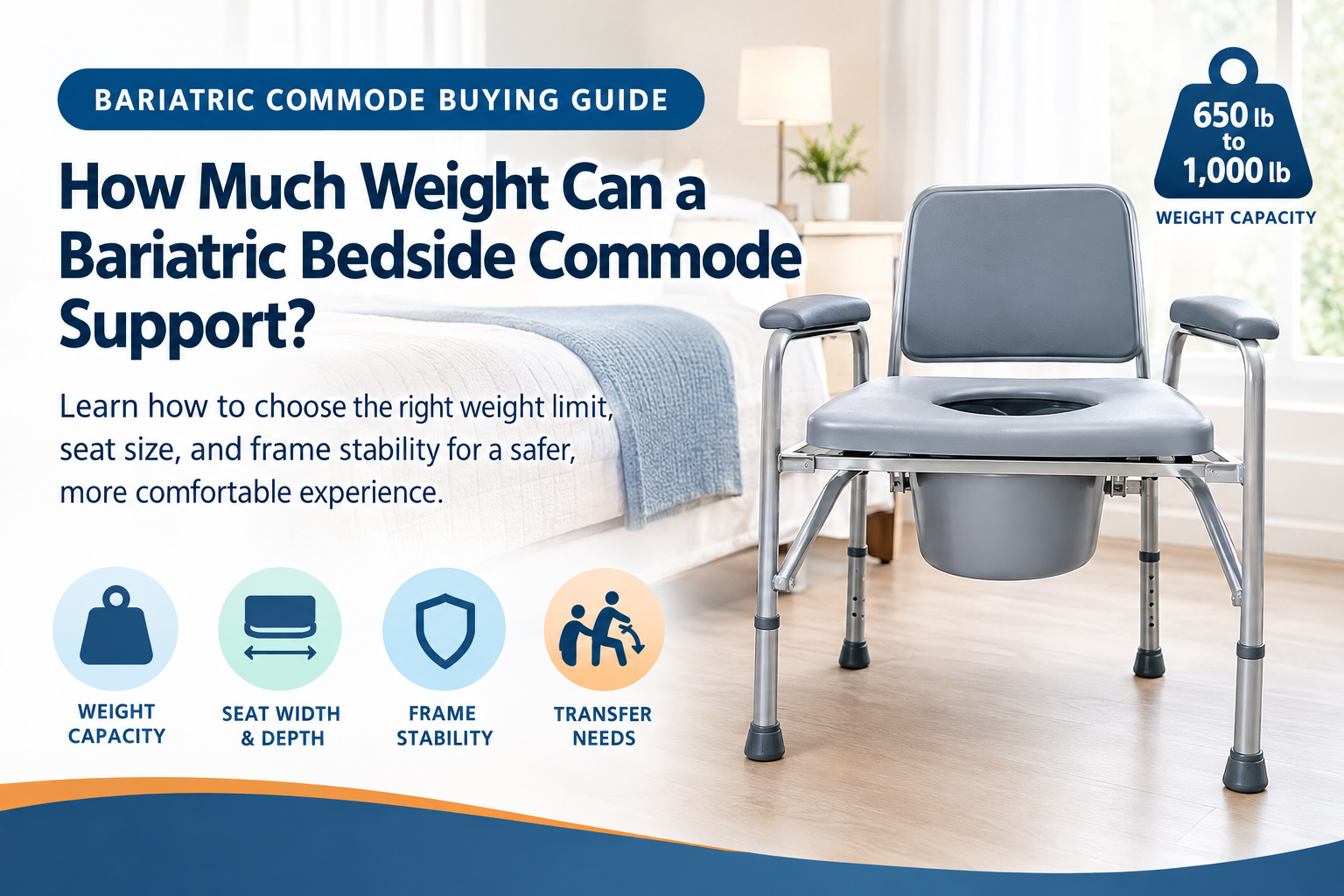
Bariatric Commode Buying Guide
How Much Weight Can a Bariatric Bedside Commode Support?
Choosing a bariatric bedside commode means looking beyond the advertised weight limit. The right model must also provide enough seat space, a stable frame, suitable arm support, and a safe way to sit down and stand up.
Quick Answer
Choose a bedside commode whose manufacturer-rated weight capacity meets or exceeds the user’s weight, and confirm that the seat width, frame dimensions, and transfer design are appropriate. Some bariatric models are rated for 650 lb, while certain heavy-duty models are rated for 1,000 lb. These ratings apply to specific models—not every commode sold under the same brand.
When shopping for a bariatric bedside commode, weight capacity is one of the first specifications to check. However, a high weight rating alone does not guarantee a good fit or safe everyday use.
A commode that is too narrow may be uncomfortable, while one with unsuitable armrests or an unstable setup may make transfers more difficult. This guide explains how to evaluate weight limits, compare heavy-duty models, and check the specifications that matter before purchasing.
In This Guide
1. Understanding Bedside Commode Weight Capacity
A commode’s weight capacity is the maximum user weight specified by the manufacturer for that particular product. It should not be confused with the weight of the commode itself or the capacity of its removable bucket.
350 lb
Standard-duty example
Some conventional commodes have a 350 lb maximum user-weight rating. Check the exact model rather than assuming this applies to every standard commode.
650 lb
Heavy-duty example
Certain bariatric folding models are designed for higher weight limits, including models rated at 650 lb.
1,000 lb
Higher-capacity example
Some reinforced bariatric commodes have a 1,000 lb rating, but their dimensions and transfer features must still suit the user.
These figures are examples of available product ratings, not recommendations for a particular person. Always verify the current documentation for the exact model and configuration you intend to buy.
2. How to Choose the Right Weight Limit
Step 1: Confirm the user’s current weight
Start with the user’s current weight, not an estimate based on clothing size or appearance. Compare that figure with the manufacturer’s maximum user-weight rating.
The commode should meet or exceed the user’s weight limit. Do not choose a model that is rated below the user’s weight, and do not assume a product can safely support extra weight beyond its published rating.
Step 2: Check the exact model number
Products from the same brand can have very different weight limits. A standard folding commode, a bariatric folding commode, and a fixed-frame drop-arm commode are not interchangeable simply because their names are similar.
Before ordering, compare the model number on the listing with the manufacturer’s product documentation. Verify the weight rating, seat dimensions, frame configuration, and included components.
Step 3: Consider how the user transfers
Think about whether the user can sit down and stand up independently, needs assistance, or transfers sideways from a wheelchair. These needs can affect which design is appropriate.
- Independent transfers: Check seat height, armrest position, and whether the user can reach the armrests comfortably.
- Assisted transfers: Consider whether the caregiver has enough space to help safely.
- Wheelchair transfers: A drop-arm design may make lateral transfers easier when the specific product and transfer method are appropriate.
If the user needs substantial assistance, has difficulty bearing weight, or requires a specialized transfer method, ask a qualified healthcare professional or equipment specialist to help select and set up the commode.
Step 4: Check the space around the commode
Measure the intended location before buying. A larger commode may offer a wider seat but can be difficult to position in a small bedroom or bathroom.
Measure the doorway, the available floor space, and the room needed for the user’s legs and any caregiver assistance. Also check whether the legs can sit flat on the floor without rocking or obstruction.
3. Examples of Heavy-Duty Bedside Commodes
The following models illustrate two different approaches to higher-capacity commode design. Confirm the current listing and specifications before buying, as sellers may offer different configurations.
Option 1: Drive Medical Bariatric Folding Commode
Model 11117N-1 · Folding design
This model is listed in Drive Medical’s product catalog with a 650 lb weight capacity. Its folding design may be useful when storage or transport is an important consideration.
- Published weight capacity: 650 lb
- Folding frame for storage and transport
- Check the assembled dimensions and seat fit before purchase
Amazon search link for the model number. Confirm that the listing matches model 11117N-1 and verify the specifications before ordering.
Option 2: Drive Medical Deluxe Bariatric Drop-Arm Commode
Model 11135-1 · Fixed-frame, drop-arm design
This model has a published 1,000 lb weight capacity and a wide seat measuring approximately 23.25 inches across by 18.5 inches deep. Its drop arms are designed to facilitate lateral transfers when appropriate.
- Published weight capacity: 1,000 lb
- Wide seat and padded armrests
- Drop-arm mechanism for easier lateral transfers
- Check room clearance and the transfer method before use
Amazon search link for the model number. Confirm the exact model, dimensions, and weight rating shown on the listing.
Important: Higher capacity is not the only deciding factor
A 1,000 lb rating does not automatically make a commode the best choice for every user. Seat fit, transfer accessibility, stability, installation, and the user’s mobility needs remain essential. Select a model based on the complete set of requirements.
For more product comparisons, see our guide to bedside and bariatric commodes and our article on heavy-duty bedside commodes. Confirm that the second URL matches the published article on your site before using it.
4. Why Seat Width and Frame Size Matter
Weight capacity tells you how much user weight the product is designed to support. It does not tell you whether the commode will fit the user’s body or the room.
Seat width
Check the actual usable seat width and opening, not only the outside width of the frame. The user should fit comfortably without being squeezed by the seat or armrests.
Seat depth
The seat should provide suitable support without forcing the user into an uncomfortable position. Compare the published depth with the user’s needs.
Armrest clearance
Measure the space between the arms and the overall frame width. These measurements can differ substantially.
Seat height
Check the available height range and whether the user’s feet can be positioned appropriately when seated. Follow the manufacturer’s setup instructions.
Do not rely on the word “bariatric” alone. Compare the listed dimensions with actual measurements and consider professional fitting advice when the user has significant mobility or transfer limitations.
5. Fixed-Frame vs. Folding Bariatric Commodes
| Feature | Folding model | Fixed-frame model |
|---|---|---|
| Storage | May fold for storage or transport | Typically needs more permanent space |
| Transfer features | Depends on the model | Some models offer drop arms |
| Weight capacity | Varies by model | Varies by model |
| Best selection criteria | Storage needs, dimensions, and rated capacity | Transfer needs, clearance, dimensions, and rated capacity |
Neither design is automatically safer for every user. The appropriate choice depends on the exact product, its instructions, and the person’s mobility and transfer needs.
6. Safety Checks Before Using a Bariatric Commode
Before first use, check the commode and its setup against the manufacturer’s instructions.
- Inspect the frame: Look for bent tubing, cracks, loose fasteners, or other visible damage.
- Check the feet: Ensure all contact points are installed correctly and rest securely on a level floor.
- Verify assembly: Follow the model-specific instructions and confirm that adjustment pins and locking mechanisms are engaged.
- Check the seat and arms: Make sure the seat is properly attached and any movable arms lock as instructed.
- Keep the surrounding area clear: Remove rugs, clutter, and other obstacles that could interfere with transfers.
- Do not exceed the rating: Never assume that the commode can safely support more than its published maximum user weight.
- Recheck after moving or folding: If the product is portable, inspect its assembly and locking points each time it is set up.
If the commode rocks, shifts, or shows damage, stop using it until the problem is corrected. If the user cannot transfer safely, obtain appropriate assistance rather than relying on the commode’s weight rating alone.
Frequently Asked Questions
What weight capacity should I look for in a bariatric bedside commode?
Choose a model with a manufacturer-rated capacity that meets or exceeds the user’s weight. Then check seat dimensions, frame size, transfer needs, and setup requirements. There is no single capacity that is right for everyone.
Is a 650 lb commode suitable for someone who weighs 600 lb?
The published rating is above that user’s stated weight, but that alone does not establish suitability. Confirm the exact model, its current instructions, seat fit, stability, and the user’s transfer requirements before use.
Does a 1,000 lb weight rating mean the commode is wider?
Not necessarily. Weight capacity and dimensions are separate specifications. Check the actual seat width, seat depth, space between the arms, and overall frame measurements.
Are folding bariatric commodes safe?
A folding commode can be appropriate when used within its rated capacity and assembled and locked according to the instructions. Check the exact model’s rating and locking mechanisms before every use after folding or moving it.
Should I choose the highest weight capacity available?
Not automatically. A higher rating may be useful, but the commode also needs to fit the user, fit the room, and support safe transfers. Compare all relevant specifications rather than choosing by capacity alone.
Final Recommendation
When choosing a bariatric bedside commode, start with the user’s weight and the manufacturer’s maximum user-weight rating. Then compare seat width, seat depth, frame dimensions, armrest design, and transfer requirements.
A folding model may be a practical option when storage matters. A fixed-frame drop-arm model may be worth considering when lateral transfers are part of the user’s care routine. In either case, verify the exact model specifications and follow the manufacturer’s setup and safety instructions.
Continue Your Research
Disclosure: This article contains Amazon affiliate links. As an Amazon Associate, this site may earn from qualifying purchases, at no additional cost to you. Product specifications and availability may change; verify the exact model and current manufacturer documentation before purchasing.