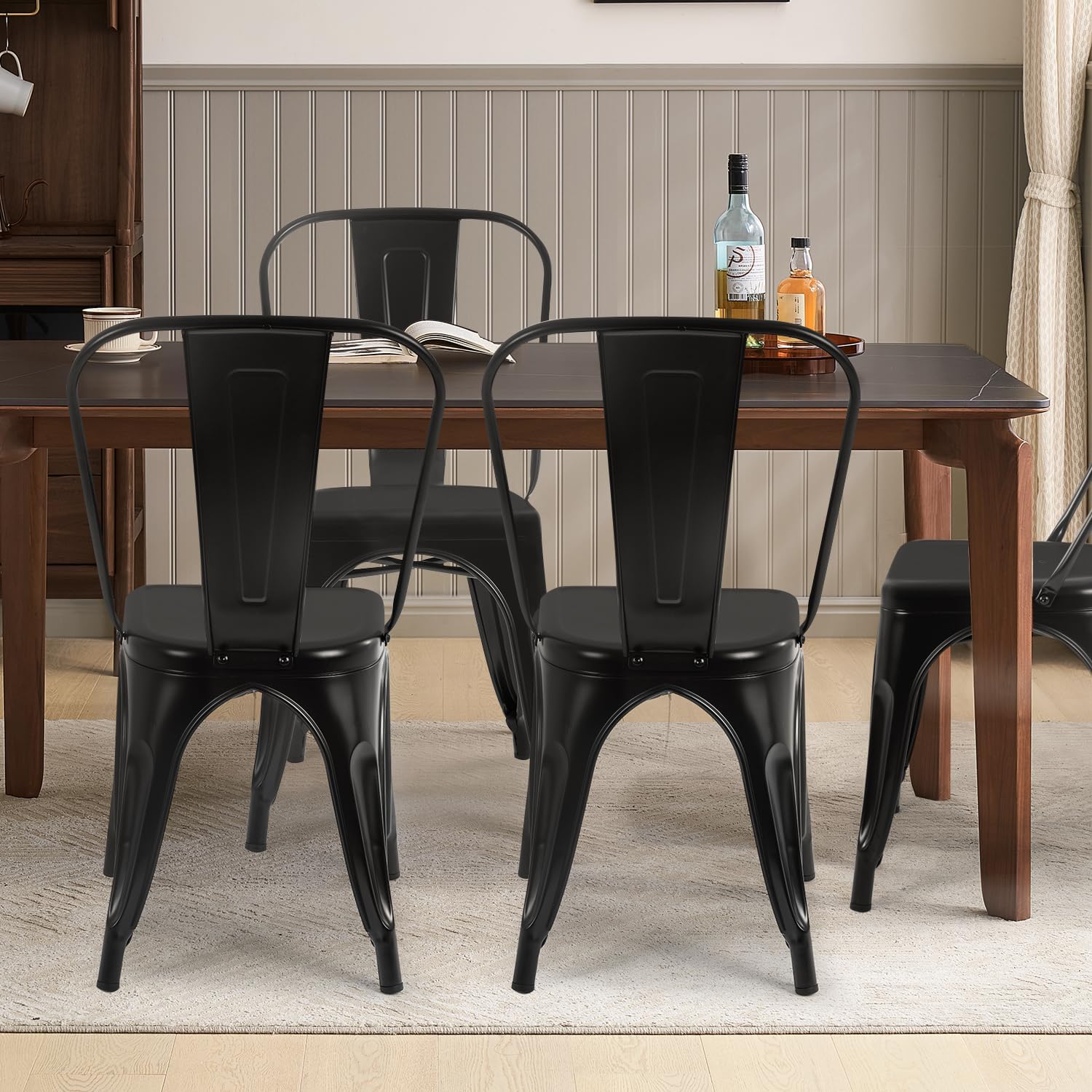
Finding the best chairs for small dining spaces is about more than choosing the narrowest seat. You also need enough room to sit comfortably, a frame that can handle everyday use, and a design that fits neatly around your dining table. For bigger and taller users, the challenge is finding compact dining chairs without sacrificing seat width, stability, or a clearly stated weight capacity.
The good news is that a small dining room does not automatically require flimsy or uncomfortable seating. Armless chairs, stackable designs, and compact commercial-style chairs can make better use of limited floor space while offering practical everyday support. This guide explains what to measure, which chair styles to compare, and how to choose seating that fits both your room and your needs.
Quick buying advice
- Choose armless chairs if you need to fit more seats along a table.
- Measure overall width and depth, not just the seat dimensions.
- Check the manufacturer’s stated weight capacity for each chair.
- Look for reinforced frames and stable joints rather than relying on appearance alone.
- Consider stackable or folding chairs if you only need extra seats occasionally.
What Are the Best Chairs for Small Dining Spaces?
The best option depends on how you use your dining area. A narrow breakfast nook has different requirements from a small dining room used for long family meals. For a household that needs heavy-duty seating, the goal is to balance a compact footprint with enough usable seat space and a suitable published weight rating.
| Chair type | Best for | What to check |
|---|---|---|
| Armless dining chairs | Fitting seats close together | Seat width, frame strength, and overall depth |
| Heavy-duty metal chairs | Frequent use and easy cleaning | Published capacity, frame construction, and seat comfort |
| Compact upholstered chairs | More cushioning for everyday meals | Usable seat width, padding, and upholstery durability |
| Stackable dining chairs | Storing spare seats when not in use | Stacking instructions, stability, and capacity per chair |
| Folding dining chairs | Occasional guests and flexible layouts | Locking mechanism, frame condition, and rated capacity |
There is no single chair style that works for every small dining room. Start by measuring the available space, then narrow your options based on seat fit, frame construction, and the way you plan to use the chairs.
1. Armless Dining Chairs: Best for Tight Spaces
Armless chairs are often the simplest choice when every inch of table space matters. Without armrests extending beyond the seat, they can usually sit closer together and slide under the table more easily than bulky armchairs.
However, armless does not automatically mean narrow. Some upholstered side chairs have wide seats or legs that extend well beyond the cushion. Check the manufacturer’s overall width and depth before deciding whether a particular model will fit.
What to look for
- A compact overall footprint that fits the measured space.
- A seat wide enough for the intended user to sit comfortably.
- A frame with clearly described construction and a stated weight capacity.
- Legs positioned so the chair can slide under the table without hitting its apron.
- Floor glides or feet suitable for your flooring.
For bigger and taller users, avoid choosing an extremely narrow chair simply because it fits the room. The usable seat width and the shape of the seat edges matter just as much as the external dimensions.
Shop Armless Dining Chairs on Amazon
2. Heavy-Duty Metal Dining Chairs: Best for Everyday Use
Metal dining chairs can be practical for kitchens, breakfast nooks, and compact dining rooms that see frequent use. Many commercial-style designs have straightforward frames and surfaces that are relatively easy to wipe clean.
Some metal chairs are designed to stack, which can be useful when you need to store extra seats. Others have fixed frames and padded or upholstered seats. These differences affect comfort, storage, and how easily the chair fits your room.
Do not assume that a metal frame is automatically stronger than a wood frame. Construction quality, joints, fasteners, materials, and the manufacturer’s load rating all matter. Choose a chair with a published weight capacity appropriate for the person who will use it.
Advantages and trade-offs
Potential advantages
- Simple, easy-to-clean surfaces
- Some models can be stacked
- Commercial-style designs are available
- Can suit modern or industrial interiors
Possible drawbacks
- Unpadded seats may feel hard
- Metal can feel cold to the touch
- Some frames are bulky despite their slim appearance
- Floor protection may be necessary
For long meals, consider a model with a padded seat or a separate cushion that stays securely in place. Always check the chair’s capacity and seat dimensions before buying.
Shop Heavy-Duty Metal Dining Chairs
3. Compact Upholstered Dining Chairs: Best for Comfort
If your dining table doubles as a place for homework, working on a laptop, or spending time with family, a padded chair may be more comfortable than a bare metal or wood seat.
The challenge is finding upholstery without adding too much bulk. Thick arms, oversized backs, and wide padded sides can make a compact chair difficult to fit around a small table. An armless upholstered design may provide a useful balance between cushioning and space efficiency.
How to choose an upholstered chair
- Seat width: Check the actual usable width rather than relying on the product photo.
- Seat depth: Make sure the cushion supports your thighs without pressing uncomfortably behind your knees.
- Padding: Look for a seat that feels supportive rather than excessively soft or easily compressed.
- Frame: Review the manufacturer’s construction details and weight rating.
- Cleaning: Check the fabric care instructions, particularly if the chairs will be used for daily family meals.
For larger users, a chair can have a generous overall width but a much smaller usable seat once the sides curve inward. Check the product’s seat dimensions where available and read the capacity information carefully.
Shop Compact Upholstered Dining Chairs
4. Stackable Dining Chairs: Best for Flexible Seating
Stackable chairs are useful when your dining area serves more than one purpose. You can keep a few chairs around the table for daily meals and store the rest when you need more open floor space.
Commercial-style stackable chairs are available in metal, resin, and upholstered designs. Some are built for restaurants, event venues, or other high-use settings, but the exact specifications vary considerably between models.
Check these details before buying
- The manufacturer’s maximum stacking height and storage instructions.
- The individual chair’s weight capacity, not just the capacity of the set or packaging.
- Whether the chair’s width and depth work around your dining table.
- Whether the seat is comfortable enough for your typical meal length.
- Whether stacked chairs can be stored safely without damaging the frame or upholstery.
Stackable seating is not always the most attractive option for a formal dining room, but it can be highly practical for small homes that need occasional extra seating.
5. Folding Dining Chairs: Best for Occasional Guests
Folding chairs can help when your dining space needs to serve different purposes throughout the week. They can be stored in a closet or another designated area when you are not using them, leaving more room for everyday activities.
However, folding chairs vary in seat size, comfort, locking mechanisms, and weight capacity. A chair that folds neatly is not necessarily suitable for every user or for long periods of sitting.
Before buying, check the manufacturer’s instructions for opening, locking, folding, and storing the chair. Inspect the hinges and locking parts regularly, and stop using a chair if any structural component becomes loose or damaged.
If you need a folding chair for a larger adult, confirm the exact model’s stated weight rating and usable seat width. Avoid inferring capacity from the chair’s appearance or from the general reputation of its brand.
Shop Heavy-Duty Folding Chairs
How to Measure Dining Chairs for a Small Space
Even a well-built chair can be the wrong choice if it blocks a walkway or will not slide under the table. Measure your room before comparing models, and use the product’s listed dimensions rather than estimating from pictures.
Measure the table and surrounding space
- Measure the table: Record the length, width, or diameter, along with the height and any apron or support structure underneath.
- Measure the available floor area: Note nearby walls, cabinets, doorways, and the main route people use to walk through the room.
- Check chair width: Use overall chair width to estimate how many seats can fit along each side.
- Check chair depth: Confirm the chair can be pulled out for sitting and pushed back in without blocking important paths.
- Check seat height: Compare the seat height with the table height and the clearance underneath the tabletop.
- Mark the footprint: Use removable tape on the floor to outline the chair and table positions before buying.
As a practical planning guideline, roughly 36 inches of clearance from the table edge to a wall or other obstacle can provide useful space for pulling out a chair and moving around it. Actual needs vary with the chair, the person using it, and whether the area behind the chair is a major walkway. A very tight dining nook may need a different layout rather than simply narrower chairs.
Do not measure seat width alone
Product listings may show overall width, seat width, seat depth, and overall depth as separate measurements. Each one answers a different question:
- Overall width: Helps determine how many chairs can fit around the table.
- Usable seat width: Helps determine whether the chair is comfortable for the intended user.
- Overall depth: Helps estimate how much floor space the chair occupies.
- Seat depth: Affects how the seat supports the user’s thighs.
- Seat height: Determines how the chair fits with the table and the user’s legs.
For larger adults, pay particular attention to usable seat width, the shape of the seat edges, and the chair’s rated capacity. A compact frame should not force the user into a cramped or unstable sitting position.
How to Choose a Small Dining Chair with the Right Weight Capacity
Weight capacity is an important part of buying heavy-duty dining chairs. The published rating gives you a specification to compare, but it should always be checked for the exact model and used according to the manufacturer’s instructions.
When comparing chairs, look for the following:
- A clearly stated capacity: Do not assume all chairs from one brand or product family have the same rating.
- Frame construction: Review the materials, joints, fasteners, and any reinforcement described by the manufacturer.
- Stable leg design: Look for a chair that sits evenly on the floor and is not prone to rocking when assembled correctly.
- Appropriate seat dimensions: Capacity alone does not guarantee that the chair will fit the user comfortably.
- Clear use instructions: Follow restrictions on stacking, folding, outdoor use, and other operating conditions.
A chair marketed as heavy-duty is not automatically rated for a specific load. If you need a higher capacity, verify the number on the product documentation or manufacturer’s listing before purchasing.
For more options organized around load ratings, visit our Weight Capacity Guide.
What About the Dining Table?
The best chairs for small dining spaces will not solve every layout problem if the table itself is too large. If you are furnishing a small dining area from scratch, evaluate the table and chairs together instead of purchasing them separately without checking their dimensions.
- Round tables: Can work well in compact dining nooks because they have no corners, but check the base and leg placement to ensure chairs fit comfortably.
- Rectangular tables: Can work well in narrow rooms when the long side aligns with the available space.
- Pedestal tables: May provide more flexibility for chair placement, depending on the base design.
- Extendable tables: Offer flexibility for guests, but make sure there is enough room to use the table in its expanded position.
When planning a round-table setup, our guide to choosing dining chairs for a round table can help you compare chair dimensions, legroom, and seating arrangements.
If you need both a table and chairs, measure the complete arrangement—including the space required to pull out the chairs—before committing to a set.
How to Make a Small Dining Room Feel Less Crowded
You do not need to sacrifice seating quality to make a compact dining area feel more open. A few practical choices can reduce visual clutter and make the room easier to use.
Choose open or visually light designs
Open backs, slim legs, and simpler silhouettes can make the room feel less crowded than oversized chairs with thick arms and bulky backs. Visual lightness is useful, but it should never replace checking the chair’s construction and dimensions.
Push chairs fully under the table
Before purchasing, check whether the chair can slide under the table without its back, arms, or legs hitting the tabletop or apron. Chairs that tuck away neatly can free up useful floor space between meals.
Keep spare seating out of the way
If you only need extra chairs for guests, stackable or folding options may be more practical than keeping every chair around the table all day. Store them in a location where they can be retrieved safely without blocking an exit or walkway.
Avoid overcrowding the table
Adding another chair is not helpful if everyone has too little room to sit comfortably. Plan for the actual overall width of each chair and leave sufficient space for people to sit down, stand up, and use the table without bumping into one another.
Common Mistakes to Avoid
Buying based on photos alone
A chair can look small online while having a deep seat or wide legs. Always check the published overall dimensions.
Choosing the narrowest chair available
A very narrow seat may not provide enough usable space for the intended user. Balance compact dimensions with comfort and fit.
Assuming all metal chairs are heavy-duty
Materials alone do not establish a chair’s weight capacity. Confirm the rating for the exact model.
Ignoring table clearance
A chair may fit around the table but still fail to slide underneath it. Check the seat height, table apron, armrests, and leg positions.
Forgetting comfort during longer meals
A firm seat may work for a quick breakfast but feel uncomfortable during a long dinner. Consider padding, back support, seat depth, and the user’s needs.
Frequently Asked Questions
What are the best chairs for small dining spaces?
Armless chairs are a useful starting point because they can fit closer together and often slide under tables more easily. If you need heavy-duty seating, compare the usable seat width, overall dimensions, frame construction, and manufacturer’s stated weight capacity before choosing a model.
Are armless dining chairs better for small spaces?
Often, yes. Removing armrests can reduce the space each chair occupies and make it easier to tuck chairs under the table. However, compare the full chair dimensions because an armless model can still have a wide or deep frame.
Can heavy-duty dining chairs fit in a small dining room?
Yes. Heavy-duty chairs come in different styles and sizes, including compact armless and commercial-style designs. Check the exact product dimensions and weight rating rather than assuming that every heavy-duty chair is oversized.
What is the most space-saving dining chair?
The best option depends on your layout. Armless chairs can fit around a table efficiently, while stackable and folding chairs are useful when seats need to be stored between uses. Choose the design that fits the room and provides suitable support for the intended user.
How wide should dining chairs be for a small space?
There is no single ideal width for every table and user. Measure the available table edge and divide the usable length by the overall width of the chairs you are considering. Then check that the usable seat width is comfortable and that the chairs can be pulled out without obstructing the room.
Are stackable chairs comfortable enough for everyday dining?
Some are, while others are designed mainly for occasional or commercial use. Check the seat design, padding, back support, and dimensions. If possible, try the chair before buying it for everyday meals.
Should I buy a dining table and chairs as a set?
A set can simplify matching the style and proportions, but you should still verify the dimensions and weight capacity of the chairs. Buying separately may provide more flexibility if you need a particular seat width, a heavy-duty frame, or chairs that can be stored when not in use.
Final Thoughts
The best chairs for small dining spaces balance three things: a footprint that fits the room, comfortable seating for the intended user, and construction that suits everyday use. Armless chairs are a practical place to start, metal and commercial-style designs may offer useful durability options, and stackable or folding chairs can help when storage is a priority.
For HeavyDutyChoice readers, the most important rule is not to trade away seat fit or weight capacity just to save a few inches. Measure your room, compare the manufacturer’s specifications, and choose a chair that is compact enough for your layout while still meeting the user’s comfort and support needs.
Explore more dining chair guides
Visit the Dining Chairs Hub for more guidance on selecting practical dining seating, comparing chair dimensions, and choosing the right setup for your home.
Disclosure: As an Amazon Associate, HeavyDutyChoice may earn from qualifying purchases. Product specifications, prices, and availability may change. Verify the current manufacturer’s listing before buying, especially for weight capacity and dimensions.