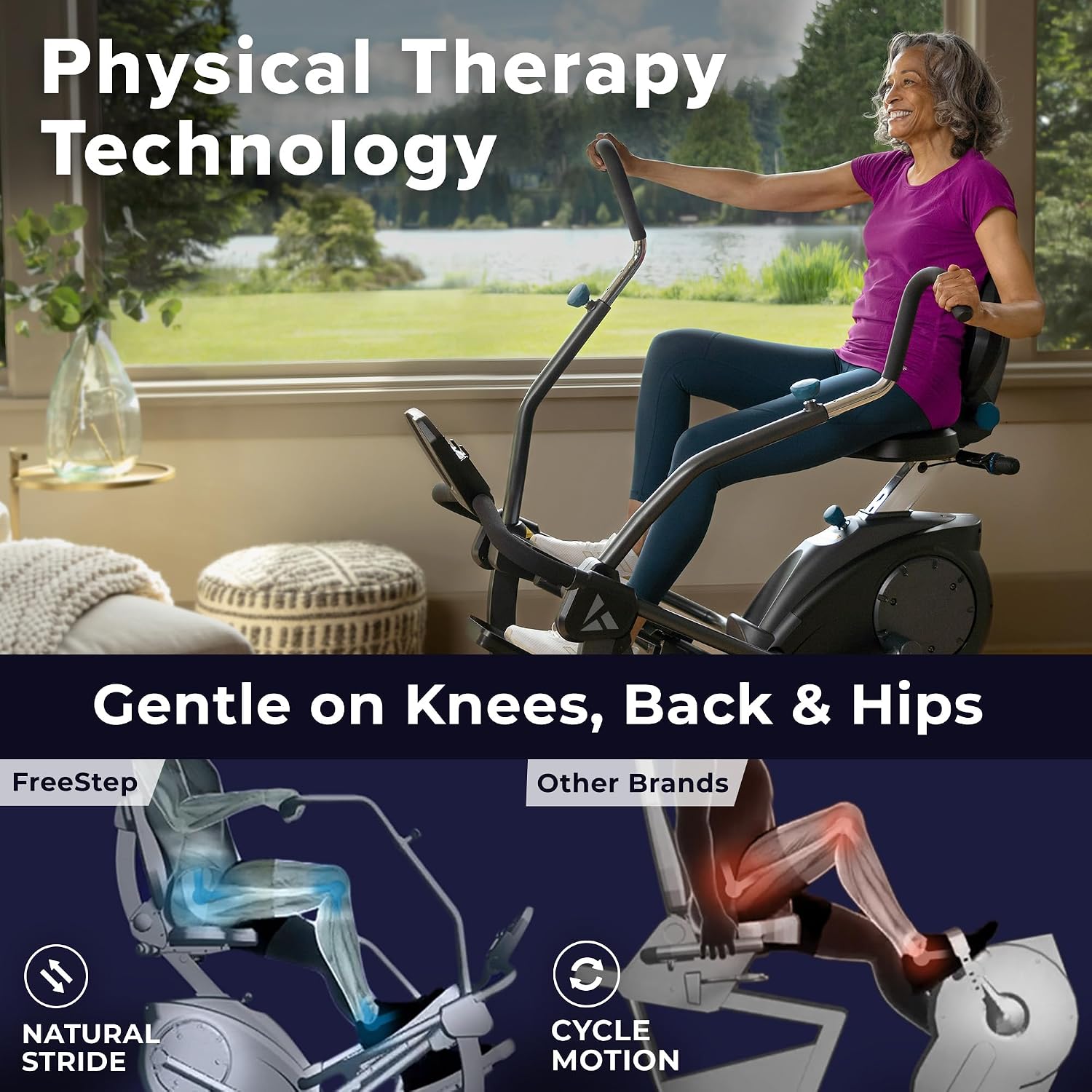
Finding the best elliptical machines for seniors means looking beyond resistance levels, workout programs, and touchscreen features. Older adults may need a machine that is easy to step onto, feels stable during exercise, has comfortable pedals, and offers simple controls.
Some seniors are comfortable using a traditional standing elliptical, while others may prefer a seated cross trainer that allows them to exercise without balancing on moving pedals. The right choice depends on mobility, balance, fitness level, available space, and personal comfort.
In this guide, we compare four elliptical machines and explain what older adults and caregivers should check before buying. We also cover the differences between seated and standing models, important safety features, and common purchasing mistakes.
Quick Picks: Best Ellipticals for Seniors
- Best Seated Cross Trainer: Teeter FreeStep LT3
- Best Sturdy Standing Elliptical: SOLE E25
- Best Beginner-Friendly Standing Option: Horizon EX-59
- Best Budget Standing Option: Sunny Health & Fitness SF-E3912
These are different types of exercise machines, not direct substitutes. Choose according to the user’s ability to stand, balance, and get on and off safely.
Best Elliptical Machines for Seniors: Comparison
Use this comparison as a starting point. A seated cross trainer offers a different exercise position from a conventional elliptical, so the most suitable model depends on the user’s mobility and preferred workout style.
| Model | Type | Main Advantage | Best For |
| Teeter FreeStep LT3 | Seated cross trainer | Supported seated exercise | Users who prefer not to exercise standing |
| SOLE E25 | Standing elliptical | Substantial frame and feature set | Seniors comfortable with standing exercise |
| Horizon EX-59 | Standing elliptical | Simple controls and 18-inch stride | Beginners who can safely mount a standing machine |
| Sunny SF-E3912 | Standing elliptical | More affordable full-size option | Budget-conscious buyers |
1. Teeter FreeStep LT3 – Best Seated Cross Trainer for Seniors
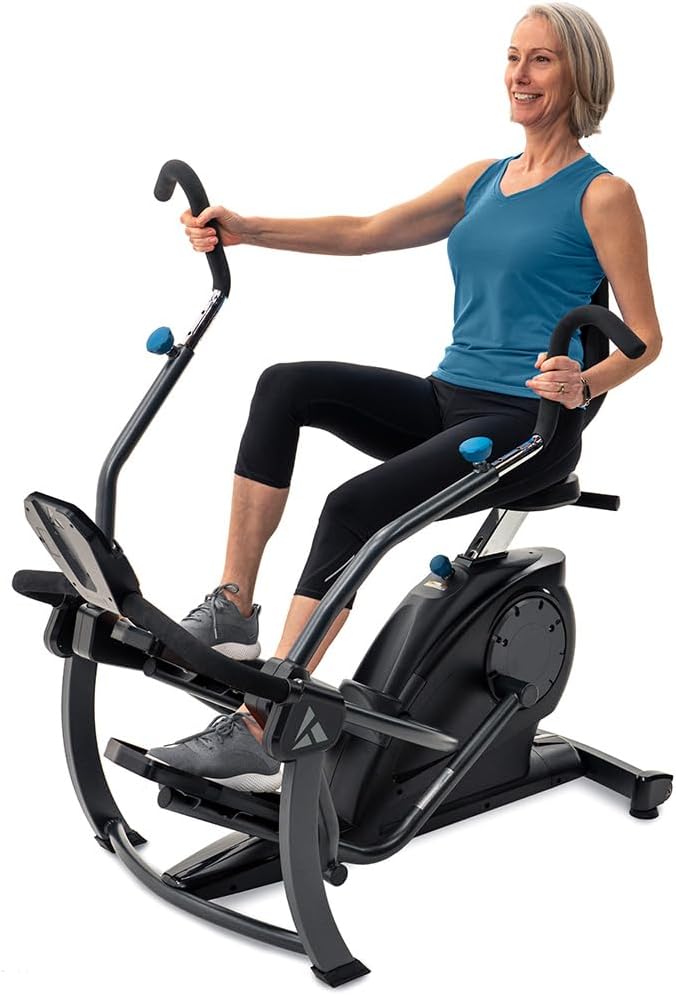
The Teeter FreeStep LT3 Recumbent Cross Trainer is worth considering for older adults who prefer exercising from a seated position. Unlike a conventional standing elliptical, it combines a supported seat with coordinated upper- and lower-body movement.
The seated design means users do not need to maintain standing balance while pedaling. This can make it a more comfortable format for people who are not confident using elevated moving pedals. However, users still need to be able to transfer into and out of the seat safely.
Why Consider the FreeStep LT3?
- Seated exercise position
- Recumbent-style support
- Upper- and lower-body movement
- Adjustable resistance for different workout intensities
- A different option from conventional standing ellipticals
Potential drawbacks: This is a substantial piece of equipment, not a compact under-desk pedal exerciser. Check the assembled dimensions, seat access, adjustment range, and delivery route before ordering.
Best for: Seniors who prefer seated exercise and can safely get into and out of the machine.
Check Teeter FreeStep LT3 on Amazon
2. SOLE E25 – Best Sturdy Standing Elliptical
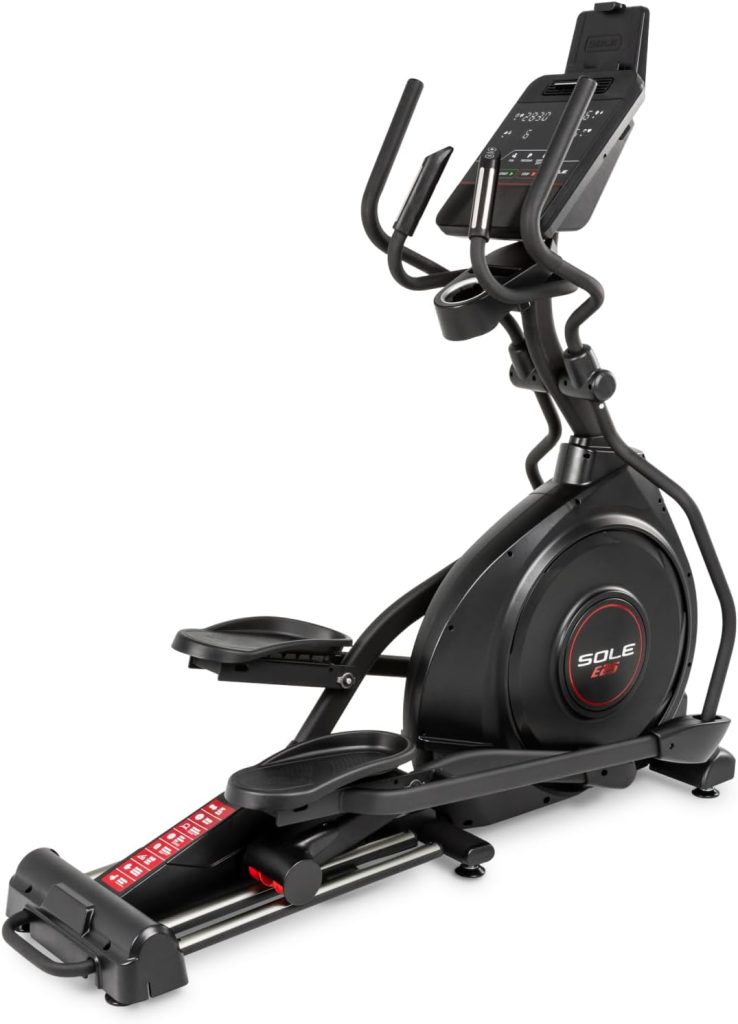
The SOLE E25 Elliptical is a conventional standing machine designed for home cardio workouts. It is worth considering for seniors who can comfortably stand, step onto the pedals, and maintain balance during exercise.
One of its main attractions is its substantial construction. The E25 is commonly listed with a 350-pound user weight capacity and a 20-inch stride length. Its resistance and incline adjustments also give users options for changing workout difficulty.
Key Features to Check
- 20-inch stride length
- 350-pound maximum user weight on the referenced model specification
- Multiple resistance settings
- Adjustable incline features
- Large pedals and fixed handle positions
Why seniors may like it: The substantial frame and range of adjustments can appeal to users who want a full-size home elliptical rather than a compact pedal device.
Potential drawbacks: The E25 is heavy and takes up considerable floor space. A substantial frame does not automatically make a machine easy to mount. Check the step-on height and make sure the user can safely access the pedals.
Best for: Seniors who are comfortable standing and want a more substantial home elliptical.
3. Horizon EX-59 – Best Beginner-Friendly Standing Elliptical
The Horizon Fitness EX-59 is a straightforward home elliptical with a relatively simple control layout. Its 18-inch stride length and 300-pound maximum user weight make it a model worth comparing for seniors who want a conventional standing workout.
The EX-59 has both stationary and moving handlebars. The fixed handlebars are particularly useful to consider because they provide a hand position that does not move with the pedals.
Key Features to Check
- 18-inch stride length
- 300-pound maximum user weight on the referenced model specification
- 10 resistance levels
- Stationary and moving handlebars
- Five built-in workout programs
- Step-on height reported at approximately 10.75 inches in product comparisons
Why seniors may like it: Its relatively simple console and fixed handlebars can make it easier to understand than machines with complicated screens and extensive programming.
Potential drawbacks: The 10.75-inch step-on height is still a substantial step for some users. The EX-59 is a standing elliptical and requires balance and coordination. It is not appropriate simply because its step-on height is lower than that of some competitors.
Best for: Older adults who are new to elliptical workouts but can safely mount and use a standing machine.
4. Sunny Health & Fitness SF-E3912 – Best Budget Standing Elliptical
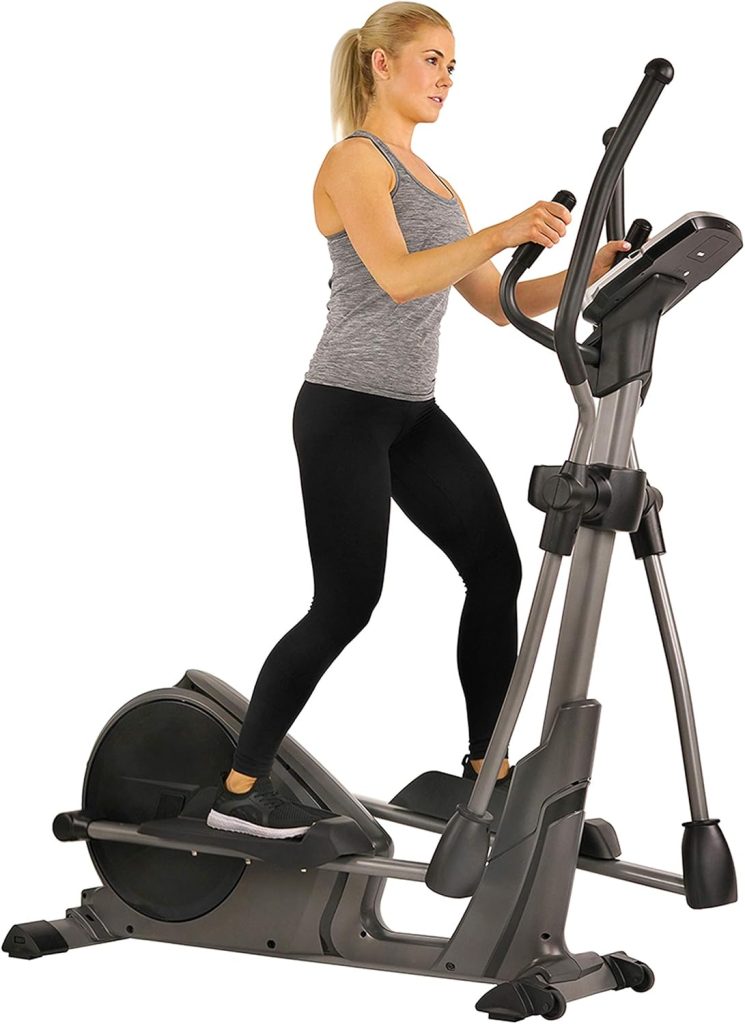
The Sunny Health & Fitness SF-E3912 is a more budget-oriented standing elliptical. It offers magnetic resistance and a relatively compact footprint compared with many larger home ellipticals.
Published specifications for this model include a 15.5-inch stride length and a 330-pound maximum user weight. Its shorter stride may suit some shorter users, although comfort depends on individual leg length and movement preferences.
Key Features to Check
- 15.5-inch stride length
- 330-pound maximum user weight on the referenced model specification
- Magnetic resistance
- Textured foot platforms
- Contact pulse sensors on the fixed handlebars
- Compact design compared with larger elliptical trainers
Why seniors may like it: It offers a simpler and potentially more affordable route into full-size elliptical exercise without paying for premium screens or connected workout subscriptions.
Potential drawbacks: Its 15.5-inch stride may feel short for taller users. It is also a standing machine, so users must be comfortable stepping onto the pedals and maintaining balance.
Best for: Budget-conscious buyers who want a conventional standing elliptical and can use one safely.
Check Sunny SF-E3912 on Amazon
Seated vs. Standing Elliptical: Which Is Better for Seniors?
This is one of the most important decisions when choosing an elliptical machine for seniors. The two designs offer different exercise positions and different access requirements.
A seated cross trainer may be a better format for someone who does not feel stable standing on moving pedals. However, it does not eliminate all mobility challenges. The user must still be able to transfer into the seat and operate the machine comfortably.
What to Look for in an Elliptical Machine for Seniors
1. Easy Step-On Height
Step-on height is the vertical distance from the floor to the pedal in the machine’s entry position. A lower step can make mounting easier, but it is not the only factor to consider.
Check the pedal position, distance between pedals, access from the side, and whether the user can hold a fixed handle while stepping on. If possible, let the intended user try the machine before purchasing.
2. Fixed Handlebars
Many ellipticals include both moving and stationary handlebars. Fixed handlebars provide a place to hold without needing to coordinate arm movement with the pedals.
Look for comfortable grips that are easy to reach from a natural standing position. The user should not have to lean forward or stretch to hold them.
3. Stable Frame and Wide Base
A machine should remain steady during normal operation. Check its frame construction, floor contact points, leveling feet, and overall weight.
A heavier machine may feel more substantial, but it can also be difficult to move. Plan its final location before delivery and assembly.
4. Comfortable Pedals and Stride Length
Large, textured pedals can provide more room for foot placement. The stride should feel natural rather than forcing the user to take unusually long or short steps.
Stride length is not a simple measure of quality. The user’s height, leg length, mobility, and preferred movement pattern all affect comfort.
5. Simple Resistance Controls
More resistance levels do not automatically make a machine better for seniors. Easy-to-understand controls and small, predictable adjustments may be more useful than complicated workout programs.
Look for clearly labeled buttons, readable displays, and a manual mode that allows the user to control the pace.
6. Easy-to-Read Display
A clear console can make it easier to check workout time, speed, distance, and resistance. Large numbers and simple navigation are useful features for users who do not want to deal with complicated touchscreen menus.
How to Choose the Right Elliptical Based on Mobility
Comfortable Standing and Walking
A traditional elliptical with fixed handlebars, a suitable step-on height, and a stable frame may be worth considering.
Difficulty Balancing
Consider a seated cross trainer if the user can safely transfer into and out of its seat.
Limited Space
Measure the room and access path. A compact pedal exerciser may be easier to store, but it is not equivalent to a full-size elliptical.
Higher Body Weight
Check the maximum user weight, frame stability, pedal dimensions, and seat capacity where applicable.
Safety Tips for Seniors Using an Elliptical
- Check the equipment first. Make sure the machine is assembled correctly, placed on a level surface, and does not wobble.
- Use fixed handles when mounting. Do not step onto moving pedals while holding only the moving handlebars.
- Start with a comfortable setting. Use low resistance and a slow pace rather than trying to complete a demanding workout.
- Wear appropriate footwear. Use secure athletic shoes with good traction. Avoid slippers or loose footwear.
- Keep the surrounding area clear. Leave enough room around the machine and keep rugs, cords, pets, and other obstacles away.
- Stop if concerning symptoms develop. Stop exercising if there is chest discomfort, unusual shortness of breath, dizziness, faintness, or unexpected pain. Seek appropriate medical help when symptoms are concerning.
Caregiver reminder: Do not assume that a senior can safely use a machine just because it has handrails or a low step. If supervision is needed, make sure someone is available during mounting, dismounting, and early exercise sessions.
Common Buying Mistakes to Avoid
- Choosing by the number of features: A large touchscreen and dozens of programs do not compensate for difficult access or poor stability.
- Ignoring step-on height: A machine may be comfortable during exercise but difficult to mount.
- Confusing a mini pedal exerciser with a full elliptical: Under-desk pedal devices offer a different movement and exercise experience.
- Buying without checking dimensions: Measure the room, doorway, hallway, and delivery route before ordering.
- Ignoring the user’s preferences: The best machine is one the user can operate comfortably and is willing to use consistently.
- Overlooking assembly and delivery: Large ellipticals can be heavy and difficult to assemble. Check delivery options and whether professional assembly is available.
Frequently Asked Questions
What is the best elliptical machine for seniors?
The best option depends on mobility and balance. The Teeter FreeStep LT3 is worth considering for users who prefer seated exercise. The SOLE E25, Horizon EX-59, and Sunny SF-E3912 are standing options for users who can safely mount and operate a conventional elliptical.
Are elliptical machines good for seniors?
An elliptical can provide low-impact cardiovascular exercise for some older adults. However, standing models still require balance and coordination. The user’s mobility, fitness level, and health status should guide the decision.
Is a seated elliptical better for seniors?
A seated cross trainer may be more comfortable for someone who does not feel stable standing on moving pedals. However, the user still needs to transfer into and out of the seat safely. It is not automatically suitable for every mobility limitation.
What is a good step-on height for an elliptical for seniors?
There is no single ideal measurement for everyone. A lower step-on height can make access easier, but pedal position, handle placement, balance, and the user’s ability to lift each leg also matter. Try the machine whenever possible.
Can seniors use an elliptical every day?
Some older adults may be able to exercise regularly, but frequency and duration should match their current fitness and health status. Start conservatively and follow individualized guidance if there are medical or mobility concerns.
Are under-desk ellipticals suitable for seniors?
They can provide light seated pedaling for some users, but they do not offer the same standing movement, stride, or upper-body involvement as a full-size elliptical. Check pedal resistance, stability, and whether the device stays in place during use.
Should seniors use an elliptical if they have knee pain?
Not necessarily. Although elliptical exercise is generally low-impact, the movement can still aggravate some knee problems. Anyone with persistent or unexplained knee pain should seek appropriate advice before starting and stop if exercise increases pain.
Final Verdict: Which Elliptical Should Seniors Choose?
The best elliptical machines for seniors are not necessarily the most expensive or technologically advanced models. Accessibility, stability, comfort, and ease of use should come first.
- Choose the Teeter FreeStep LT3 if a seated cross trainer is more appropriate and the user can safely access its seat.
- Consider the SOLE E25 if the user can comfortably stand and wants a substantial full-size elliptical.
- Consider the Horizon EX-59 if the user prefers a simpler standing machine with fixed handlebars and straightforward controls.
- Consider the Sunny SF-E3912 if budget is a priority and the user is comfortable with its stride and step-on requirements.
Before purchasing, verify the current model specifications, user weight limit, assembled dimensions, step-on height, delivery arrangements, and return policy. If possible, let the intended user try the machine before making a decision.
Explore More Elliptical Buying Guides
Affiliate Disclosure: As an Amazon Associate, HeavyDutyChoice may earn from qualifying purchases. This does not affect the price you pay.