
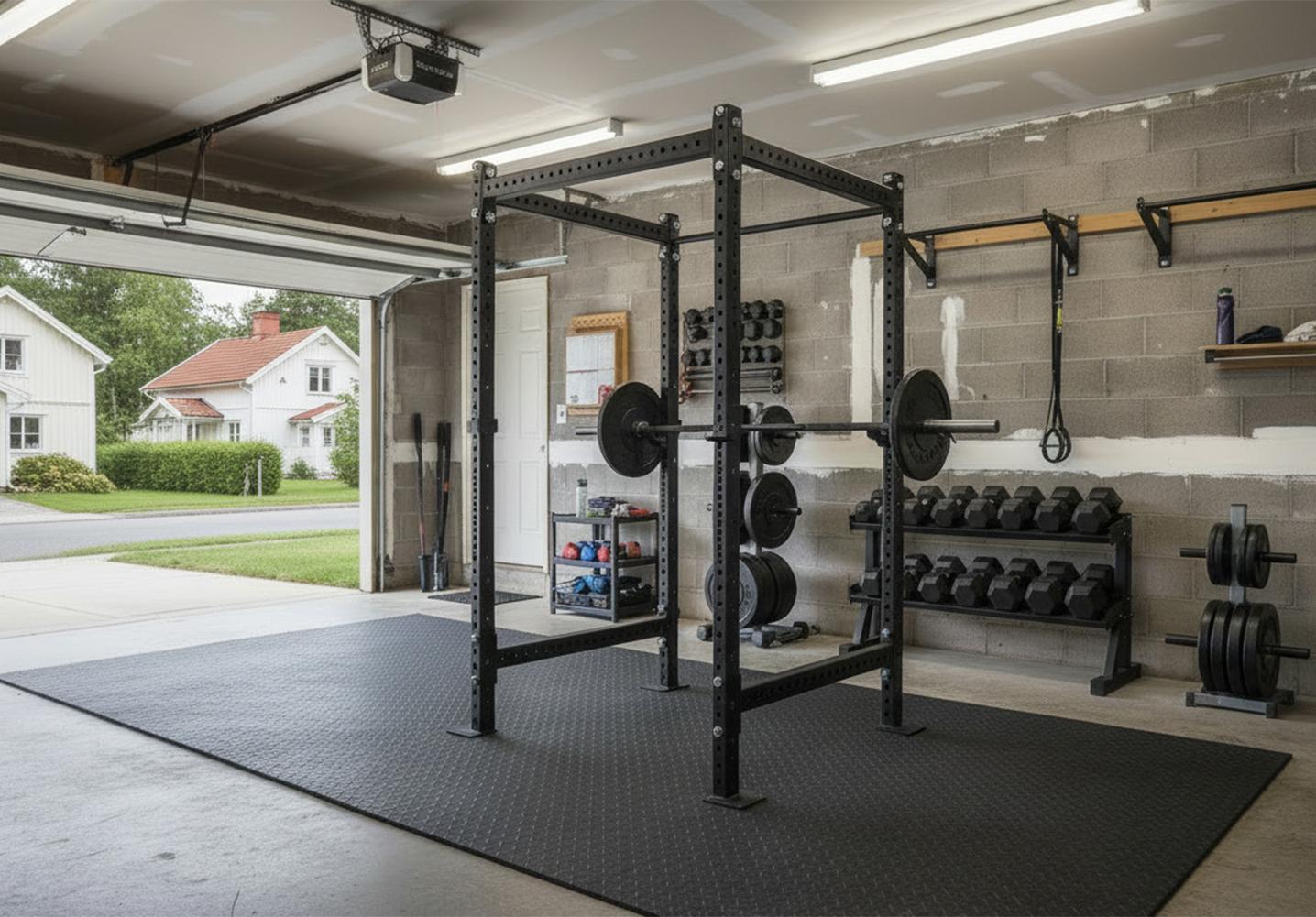
Building a garage gym is about more than buying a power rack, barbell, and weight plates. The right garage gym accessories can make your workout space safer, more organized, and much more versatile without requiring another expensive machine.
From heavy-duty gym flooring and weight storage racks to resistance bands, lifting straps, and cable attachments, small additions can make a significant difference in how you train. They can also help protect your equipment, reduce clutter, and make your home gym easier to use consistently.
For larger athletes and anyone building a heavy-duty home gym, choosing the right accessories is especially important. Stable storage, durable materials, secure attachments, and appropriate weight ratings should all be part of the buying decision.
Quick Answer: Which Garage Gym Accessories Do You Need?
The most useful garage gym accessories depend on your equipment and training goals, but most home gyms benefit from these essentials:
- Heavy-duty rubber gym flooring for floor protection.
- Weight plate and dumbbell storage racks for organization.
- Resistance bands for warm-ups and accessory exercises.
- Barbell collars to keep weight plates secure.
- Lifting straps and wrist wraps for additional lifting support.
- Cable machine attachments for more exercise variations.
- Gym mats and recovery tools for floor workouts and mobility.
Our recommendation: Start with flooring, secure storage, and basic lifting accessories before spending money on specialized training gadgets.
Best Garage Gym Accessories to Upgrade Your Home Gym
Here are 15 useful accessories worth considering when building or upgrading a garage gym. Rather than treating every item as essential, we have grouped them by their practical purpose so you can prioritize purchases based on your current setup.
Heavy-duty rubber gym flooring
Weight plate and dumbbell racks
Resistance bands and cable attachments
Lifting straps and wrist wraps
1. Heavy-Duty Rubber Gym Flooring
Gym flooring should be one of the first purchases when setting up a garage workout space. Concrete floors are hard, unforgiving, and can become slippery during exercise. They can also be damaged by dropped weights and repeated equipment movement.
Heavy-duty rubber flooring provides a more suitable surface for strength training, dumbbell workouts, and general exercise. Rubber rolls, interlocking rubber tiles, and individual gym mats are common options.
What to look for:
- Appropriate thickness for your training style and equipment.
- Dense rubber construction rather than thin decorative foam.
- Non-slip surface texture.
- Easy installation and cleaning.
- Enough coverage for your rack, bench, and lifting area.
2. Weight Plate Storage Rack
Weight plates can quickly clutter a garage gym, especially if you own several pairs of Olympic plates. Leaving them stacked on the floor creates unnecessary obstacles and makes loading and unloading a barbell less convenient.
A dedicated plate storage rack keeps plates organized and makes it easier to find the right weight during a workout.
Important features:
- Steel construction with a stable base.
- Storage pegs compatible with your plate diameter.
- A clearly stated total weight capacity.
- Protective sleeves or coating to reduce plate damage.
- A footprint that fits your available floor space.
For heavier home gyms, do not judge a storage rack by appearance alone. Check its stated capacity and distribute plates according to the manufacturer’s loading instructions.
3. Dumbbell Storage Rack
Dumbbells are among the most versatile pieces of home gym equipment, but they take up considerable space when you own multiple pairs.
A dumbbell rack provides a dedicated place to store your weights and helps prevent them from rolling around the workout area.
Popular designs include A-frame racks, horizontal racks, and multi-tier storage stands.
Buying considerations:
- Check the total weight capacity rather than just the number of dumbbells it holds.
- Make sure the rack accommodates your dumbbell shape and dimensions.
- Look for a wide, stable base and strong steel construction.
- Choose a design that allows you to lift weights out without awkward bending.
For larger dumbbell collections, a horizontal rack may offer easier access than a compact A-frame design.
Check Dumbbell Racks on Amazon
4. Resistance Bands
Resistance bands are inexpensive, versatile accessories that can add more training options to almost any home gym.
They work well for warm-ups, shoulder activation, mobility exercises, assisted pull-ups, and accessory strength training.
There are two common styles:
- Loop resistance bands: Useful for pull-up assistance, stretching, glute activation, and mobility exercises.
- Tube resistance bands: Often include handles and door anchors for presses, rows, curls, and other movements.
Choose a set with clearly labeled resistance levels. Inspect bands regularly for cracks, tears, or other signs of wear, particularly if you use them for heavy resistance training.
5. Barbell Collars and Clamps
Barbell collars are small accessories that play an important role in weightlifting safety. They help keep weight plates in position during squats, bench presses, deadlifts, and other barbell movements.
Common designs include spring collars, lock-jaw collars, and quick-release locking collars.
Look for:
- Compatibility with your barbell sleeve diameter.
- A secure locking mechanism.
- Durable materials that can handle frequent use.
- Easy installation and removal between sets.
For most home gym owners, a quality pair of locking collars is a practical upgrade over basic spring clips.
6. Lifting Straps
Lifting straps help reduce the amount of grip strength needed to hold a barbell or dumbbell during pulling exercises.
They are particularly useful for heavy deadlifts, barbell rows, and other pulling movements where grip fatigue may become a limiting factor.
Common options include traditional cotton straps, padded straps, and figure-eight straps.
Before buying, consider:
- Material durability and stitching quality.
- Wrist padding and overall comfort.
- Strap length and wrapping style.
- Ease of use during repeated sets.
Remember that lifting straps do not replace grip training. Use them when appropriate rather than relying on them for every exercise.
7. Wrist Wraps
Wrist wraps are commonly used during pressing exercises such as bench presses, overhead presses, and heavy dumbbell presses.
They provide adjustable external support around the wrist and can help lifters maintain a more comfortable wrist position during demanding sets.
Look for adjustable fastening, durable stitching, and a length that provides the level of support you prefer.
Wrist wraps should not be used to ignore pain or compensate for poor lifting technique. If an exercise causes persistent discomfort, reassess your technique and seek appropriate guidance.
8. Cable Machine Attachments
If your garage gym includes a functional trainer or cable pulley system, additional attachments can significantly expand your exercise selection.
Different handles and bars allow you to perform a wider range of movements without purchasing another machine.
Useful options include:
- Triceps rope: For cable pushdowns and other arm exercises.
- Lat pulldown bar: For pulldowns and other upper-body pulling movements.
- Close-grip row handle: For seated cable rows.
- Single D-handles: For unilateral cable exercises.
- Ankle straps: For cable kickbacks and leg movements.
Check the connector type, attachment hardware, and manufacturer’s weight rating before purchasing. A handle that fits your cable machine is not automatically suitable for every load.
Shop Cable Machine Attachments
9. Landmine Attachment
A landmine attachment turns one end of a barbell into a pivot point, allowing you to perform several different exercises with a relatively simple piece of equipment.
Common landmine exercises include landmine presses, rows, squats, and rotational movements.
There are several designs, including floor-mounted units, rack-mounted attachments, and portable landmine bases.
Check these details:
- Compatibility with your barbell sleeve diameter.
- Whether it attaches to your power rack or sits independently.
- Stability during rotational and pressing movements.
- Construction quality and stated load limits.
A rack-mounted model can be a good choice if your garage gym already has a compatible power rack.
10. Gym Storage Hooks and Wall Organizers
Resistance bands, jump ropes, lifting belts, cable handles, and other accessories can quickly become scattered around a garage gym.
Wall-mounted hooks and multi-purpose gym organizers help keep smaller accessories off the floor and within easy reach.
Look for steel construction, suitable hook spacing, and mounting hardware appropriate for your wall type.
Always mount organizers into suitable structural support and follow the installation instructions. Do not assume that drywall anchors alone can support heavy gym equipment.
11. Weightlifting Belt
A weightlifting belt is a useful accessory for people who perform heavy squats, deadlifts, and other demanding strength exercises.
It provides a surface against which you can brace your abdominal muscles during lifting. However, a belt does not replace proper bracing technique or good movement mechanics.
When choosing a belt, consider:
- Material, such as leather or reinforced nylon.
- Width and thickness.
- Buckle or lever closure design.
- Fit around your waist.
- Comfort during squats and deadlifts.
A belt should fit securely without restricting normal breathing or causing discomfort.
12. Gym Timer
A dedicated interval timer can make home workouts easier to manage, especially if you follow structured strength or conditioning programs.
It can help track rest periods, circuit intervals, Tabata sessions, and EMOM workouts.
Useful features include a large display, adjustable interval settings, audible alerts, and easy-to-use controls.
A simple timer is often enough for most garage gyms. You do not necessarily need an expensive connected fitness device.
13. Foam Roller
A foam roller is a simple recovery and mobility accessory that can be useful after strength training or longer cardio sessions.
It allows you to apply pressure to different muscle groups and incorporate self-massage into your post-workout routine.
Common options include smooth foam rollers, textured rollers, and high-density models.
For most people, a standard high-density foam roller is a reasonable starting point. Choose a firmness level that feels comfortable rather than assuming the hardest option is best.
14. Adjustable Workout Bench Accessories
A quality adjustable bench is already a valuable part of many home gyms, but a few additional accessories can make your workout area more practical.
Consider accessories such as:
- Replacement bench upholstery or protective covers.
- Non-slip bench pads.
- Compatible leg hold-down attachments, where supported.
- Floor protection underneath the bench.
Before purchasing an attachment, confirm that it is designed for your exact bench model. Universal compatibility should never be assumed, particularly for accessories that support body weight.
15. Exercise Mat and Mobility Accessories
An exercise mat provides a more comfortable surface for stretching, floor exercises, core training, and mobility work.
It is particularly useful if your garage gym has a concrete floor or rubber flooring that is too firm for certain floor-based movements.
Useful features include:
- Non-slip top and bottom surfaces.
- Enough length and width for your exercises.
- Comfortable cushioning.
- Easy-to-clean materials.
- Convenient storage when not in use.
If you regularly perform floor exercises, a dedicated exercise mat is a relatively inexpensive addition to your home gym.
Garage Gym Accessories Comparison Table
Not every accessory deserves the same purchase priority. Use this table to compare the main benefits and decide what your gym needs first.
| Accessory | Main Purpose | Priority | Best For |
|---|---|---|---|
| Rubber flooring | Floor protection | High | All garage gyms |
| Plate storage rack | Weight organization | High | Barbell training |
| Dumbbell rack | Weight storage | High | Dumbbell workouts |
| Resistance bands | Versatile resistance | High | Warm-ups and accessory work |
| Barbell collars | Plate security | High | Barbell lifting |
| Lifting straps | Grip assistance | Medium | Heavy pulling exercises |
| Wrist wraps | Wrist support | Medium | Pressing movements |
| Cable attachments | Exercise variety | Medium | Cable machine owners |
| Landmine attachment | Training versatility | Medium | Barbell training |
| Gym wall organizer | Accessory storage | Medium | Small garage gyms |
| Weightlifting belt | Lifting support | Medium | Heavy strength training |
| Gym timer | Workout timing | Low | Structured workouts |
| Foam roller | Recovery and mobility | Low | Post-workout recovery |
| Bench accessories | Bench functionality | Low | Adjustable bench owners |
| Exercise mat | Floor comfort | Medium | Stretching and core work |
How to Choose Garage Gym Accessories for Heavy-Duty Use
If you are building a home gym for larger athletes or planning to use heavy weights regularly, ordinary consumer-grade accessories may not always be the best choice.
Here are five important factors to evaluate before purchasing.
1. Check Weight Capacity
For storage racks, benches, and equipment attachments, look for clearly stated weight limits. Pay attention to whether the advertised capacity refers to the total unit or an individual storage point.
Never assume that a product is suitable for heavy-duty use simply because it has a thick metal frame.
2. Prioritize Stable Construction
Storage stands and racks should have a stable base and appropriate structural support. Wider bases, quality welds, and suitable steel construction can all contribute to stability.
For wall-mounted products, verify that the mounting hardware and wall structure can support the intended load.
3. Choose Accessories That Fit Your Equipment
Not every accessory is universal. Cable attachments, barbell collars, landmine units, and bench attachments may have specific compatibility requirements.
Check dimensions, connection types, and manufacturer compatibility information before ordering.
4. Consider Long-Term Durability
Garage gyms can experience temperature changes, humidity, dust, and repeated equipment handling. Durable finishes, quality stitching, reinforced connection points, and corrosion-resistant materials are worth considering.
5. Make Accessibility Part of Your Setup
Place frequently used equipment where it can be accessed without awkward bending, twisting, or reaching. Keep heavy items on stable storage surfaces and avoid placing weights where they can fall into walking or lifting areas.
Special Considerations for Big and Tall Lifters
For larger athletes, gym accessories should be selected with fit, stability, and usable space in mind.
- Choose lifting belts in sizes that fit your actual waist measurement.
- Check bench dimensions and weight capacity before buying attachments.
- Look for storage racks with sufficient capacity for your existing weight collection.
- Choose flooring appropriate for the equipment and loads used in your gym.
- Check resistance band condition and follow the manufacturer’s resistance and usage guidance.
How to Build a Garage Gym Accessory Kit on a Budget
You do not need to purchase all 15 accessories at once. A more practical approach is to buy the items that solve the biggest problems in your current setup.
For beginners
- Exercise mat
- Resistance bands
- Barbell collars
- Basic storage hooks
Focus: Basic functionality
For regular lifters
- Rubber gym flooring
- Plate storage rack
- Dumbbell rack
- Lifting straps
- Wrist wraps
Focus: Safety and organization
For experienced lifters
- Cable attachments
- Landmine attachment
- Wall-mounted organizers
- Weightlifting belt
- Gym timer
Focus: More training options
The best strategy is to upgrade gradually. Start with the equipment you use most often, then add accessories that address specific limitations in your training space.
Common Garage Gym Accessory Buying Mistakes
Even relatively inexpensive accessories can become wasted purchases if they do not match your equipment or training needs.
- Buying too many accessories at once: Start with practical essentials rather than filling your gym with gadgets you rarely use.
- Ignoring compatibility: Check barbell diameter, cable connections, rack dimensions, and bench models.
- Choosing storage based on appearance: Verify load capacity and stability before buying a rack.
- Using thin foam flooring for heavy lifting: Choose flooring appropriate for the equipment and impact involved.
- Ignoring maintenance: Inspect straps, bands, collars, and attachment connections regularly.
- Overlooking available space: Make sure storage equipment does not interfere with lifting movements or walking paths.
Frequently Asked Questions
What are the most important garage gym accessories?
The most useful starting accessories include rubber gym flooring, weight storage racks, resistance bands, barbell collars, and basic lifting accessories. These items improve organization, equipment usability, and everyday workout convenience.
What accessories should I buy first for a home gym?
Start with flooring and basic safety and organization equipment. After that, consider resistance bands, barbell collars, and storage racks based on the equipment you already own.
Are garage gym accessories worth buying?
Yes, when they solve a specific training or organization problem. Accessories such as cable handles, resistance bands, storage racks, and lifting straps can add functionality without requiring another large machine.
What are the best accessories for a small garage gym?
Resistance bands, wall-mounted storage hooks, compact dumbbell racks, adjustable accessories, and foldable exercise mats are useful choices for limited spaces. Prioritize equipment that can serve multiple purposes.
What gym accessories are best for heavy lifters?
Heavy lifters should prioritize appropriately rated flooring, stable weight storage racks, secure barbell collars, durable lifting straps, and compatible cable attachments. Always verify the manufacturer’s stated capacity and compatibility.
How much should I spend on garage gym accessories?
There is no fixed budget. A basic setup can start with a few inexpensive accessories, while a fully equipped strength-training space may require more investment in flooring, storage, and specialized attachments. Buy according to your training needs rather than a predetermined shopping list.
Do I need special flooring for a garage gym?
Dedicated gym flooring is recommended for most garage gyms. The appropriate type and thickness depend on whether you primarily perform bodyweight exercises, use dumbbells, or regularly lift heavy barbells. Flooring should be selected for the actual load and impact involved.
Final Verdict: Build a More Functional Garage Gym
The best garage gym accessories are not necessarily the most expensive or complicated products. They are the items that make your existing equipment safer, easier to use, and more versatile.
For most home gym owners, flooring, storage racks, resistance bands, and barbell collars are excellent places to start. As your training setup develops, cable attachments, landmine accessories, lifting straps, and other specialized equipment can add more options.
If you are building a gym for heavier strength training, pay particular attention to weight ratings, stability, material quality, and equipment compatibility. A well-organized and properly equipped garage gym can provide a much better training experience without taking up unnecessary space.
Explore More Heavy-Duty Home Gym Guides
Affiliate Disclosure: As an Amazon Associate, HeavyDutyChoice earns from qualifying purchases. This means we may earn a commission when you purchase through links on this page, at no additional cost to you.