Heavy-Duty Fitness Guide
The best recumbent exercise bike for a heavy person should offer an appropriate weight capacity, a comfortable seat and backrest, a frame that feels stable during normal use, and enough adjustment range for your legs. This guide compares specific models and explains what to check before buying.
Disclosure: As an Amazon Associate, HeavyDutyChoice earns from qualifying purchases. This article may contain affiliate links, which means we may earn a commission at no additional cost to you.
Shopping for a recumbent exercise bike for heavy people takes more than choosing the model with the most resistance levels or the lowest price. Many home exercise bikes have maximum user-weight limits of 250 to 300 pounds, which may not provide the capacity some larger riders need.
A recumbent bike offers a seated riding position with a backrest, which some people find more comfortable than a traditional upright exercise bike. However, the right choice still depends on your body weight, leg length, available floor space, mobility and workout goals.
Below, we compare options for heavier riders, including higher-capacity models and a mainstream alternative for people whose weight falls within a lower published limit.
Quick Picks
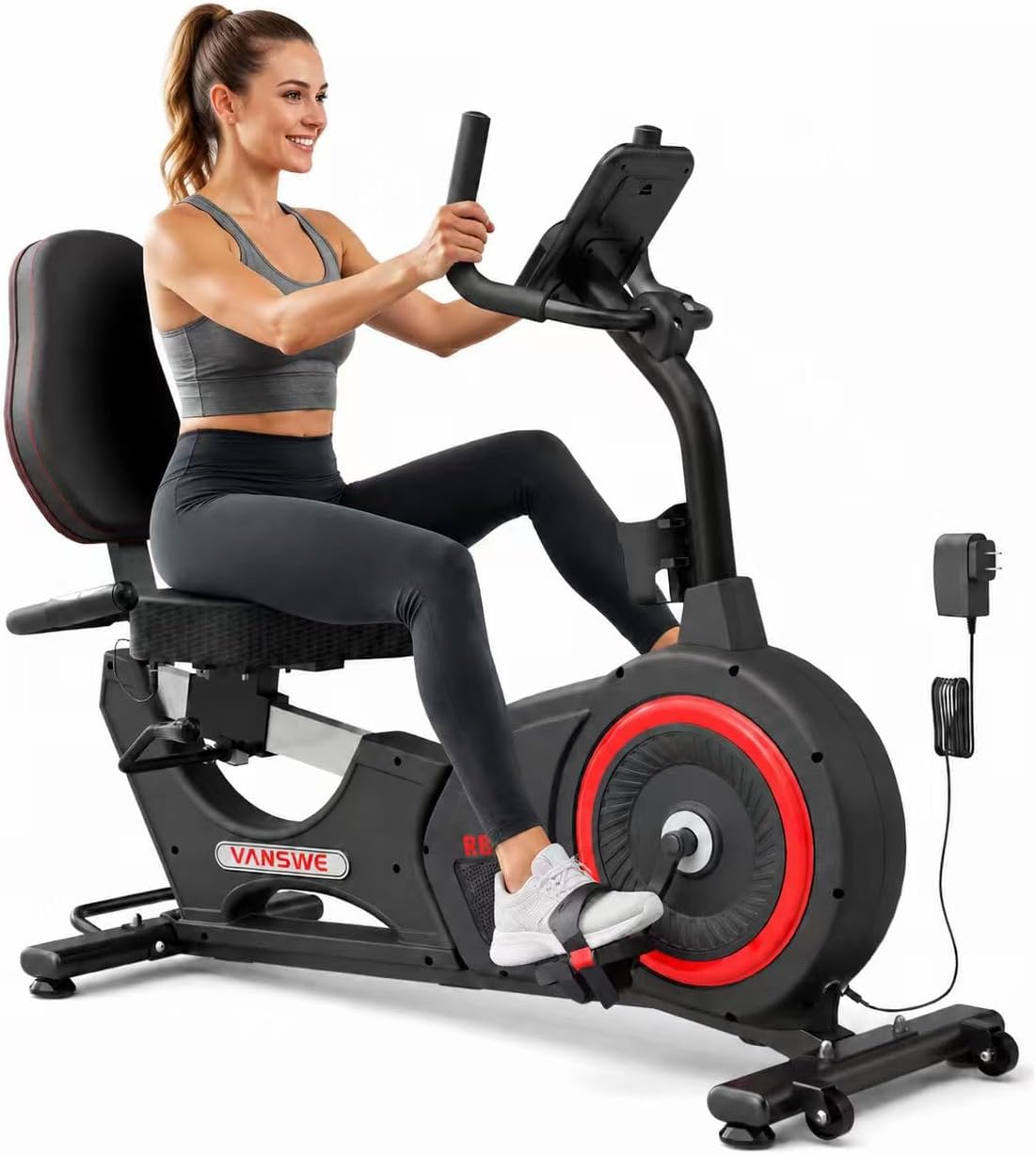
Higher-capacity option: Vanswe RB607 Recumbent Exercise Bike — consider if you want a model advertised with a 450-pound maximum user weight.
Full-body workout option: Vanswe RB505 Recumbent Bike — designed with moving arm handles in addition to leg pedaling.
Alternative for riders within a 330-pound limit: Schwinn 590R Recumbent Bike — a feature-rich option with a published 330-pound maximum user weight.
Important: Confirm the exact model, current manufacturer specifications, availability and return terms before ordering. Never exceed a bike’s published maximum user weight.
Best Recumbent Exercise Bikes for Heavy People: Comparison
The models below cover different needs rather than representing a laboratory-tested ranking. Capacity figures are based on manufacturer information available during research and should be checked against the exact version being sold.
| Model | Published max. user weight | Best for |
|---|---|---|
| Vanswe RB607 | 450 lb, verify exact version | Higher capacity and electronic resistance |
| Vanswe RB505 | 450 lb, verify exact version | Upper- and lower-body movement |
| Vanswe RB408 | 400 lb, verify exact version | A recumbent bike with moving arms |
| Schwinn 590R | 330 lb | Riders who fit within its limit and want connected training features |
1. Vanswe RB607: A Higher-Capacity Recumbent Bike
Best for: Riders who need a higher published weight limit and prefer electronic resistance adjustments.
The Vanswe RB607 is worth considering if many standard exercise bikes do not provide enough weight capacity. Manufacturer information lists a maximum user weight of 450 pounds for this model. It is designed for home cardio, with electronically controlled magnetic resistance and built-in workout programs.
Rather than selecting a bike based only on its weight limit, check whether the seat position, pedal reach and entry arrangement work for your body. These details can affect how practical the bike feels during everyday use.
- Capacity: Manufacturer-listed maximum of 450 pounds; confirm the exact version.
- Resistance: Electronic magnetic resistance, with multiple adjustment levels.
- Workout features: Built-in programs and a display for workout feedback.
- Consider before buying: Confirm seat dimensions, inseam fit, console features and assembly requirements.
Potential drawback: Electronic controls and workout programs may be unnecessary if you simply want to pedal at a steady pace. Compare the cost with a simpler model before deciding.
2. Vanswe RB505: A Recumbent Bike with Moving Arms
Best for: People who want to combine seated leg pedaling with upper-body movement.
The Vanswe RB505 adds moving arm handles to the conventional recumbent-bike layout. This may appeal to users who want more upper-body involvement during a seated workout rather than focusing on the legs alone.
The manufacturer lists a 450-pound maximum user weight for the RB505. Its moving-arm design is a useful distinction, but it also means you should check the arm motion, reach and clearance around the machine before purchasing.
- Capacity: Listed at up to 450 pounds; verify the exact product version.
- Workout style: Moving arms and leg pedaling for combined upper- and lower-body activity.
- Comfort: Check backrest support, seat fit and adjustment range against your needs.
- Best reason to choose it: You specifically want moving arm handles as part of your routine.
Potential drawback: If you only want to pedal, the moving arms may add complexity without providing much value. Compare the price and seat fit with a traditional recumbent model.
3. Vanswe RB408: A Full-Body Option with a 400-Pound Limit
Best for: Riders who want moving arm handles and whose weight falls within the model’s verified limit.
The Vanswe RB408 is another option to investigate if you want a recumbent bike that includes arm exercise handles. Manufacturer product information lists a 400-pound maximum user weight for this model.
It may be worth comparing with the RB505 if you want full-body movement but do not need the higher capacity listed for the RB505. However, a lower price or a smaller capacity does not automatically make a bike the better choice: the machine must fit your body and provide an appropriate margin below its maximum limit.
- Capacity: Listed at 400 pounds; verify before purchase.
- Workout style: Seated cycling with moving arm handles.
- What to compare: Seat dimensions, adjustment range, resistance controls and warranty.
- Best reason to choose it: You want a combined arm-and-leg workout and do not require a 450-pound rating.
Potential drawback: Riders near the maximum limit should consider whether a higher-capacity model would provide a more suitable margin. Never use the bike above its rated limit.
4. Schwinn 590R: A Mainstream Alternative for Riders Within 330 Pounds
Best for: Riders who fall comfortably within the manufacturer’s weight limit and value connected workout features.
The Schwinn 590R Recumbent Bike is a mainstream alternative for shoppers who do not need a 400- or 450-pound capacity. Schwinn lists a maximum user weight of 330 pounds, along with 25 levels of magnetic resistance and compatibility with selected fitness apps.
The adjustable seat and backrest are important features to evaluate in person or through detailed product information. Check the assembled dimensions as well, since a recumbent bike can take up considerable floor space.
- Maximum user weight: 330 pounds according to Schwinn’s published specifications.
- Resistance: 25 magnetic resistance levels.
- Connectivity: Compatible with selected training apps; some services may require separate subscriptions.
- Before ordering: Confirm the exact model number, warranty, return terms and available accessories.
Potential drawback: The 330-pound limit makes it unsuitable for anyone who exceeds that rating. If you need a higher-capacity bike, compare the Vanswe models above instead.
What to Look for in a Recumbent Exercise Bike for Heavy People
1. Maximum User Weight
Start with the manufacturer’s stated maximum user weight. Do not rely on a product title that says “heavy duty” unless the specifications provide a clear limit.
Choose a bike whose rating is higher than your current weight, rather than one that barely meets it. If your weight is close to the limit, check the manufacturer’s guidance and consider a model with more capacity. Never exceed the published maximum user weight.
2. Seat Width and Backrest Support
A recumbent bike’s seat and backrest can make a major difference to comfort. Look for a seat that supports your body without pressure at the sides, and a backrest that allows you to maintain a comfortable position.
Do not assume that every recumbent bike has an extra-wide seat. Compare the actual seat measurements where available, and check whether the seat and backrest can be adjusted to suit your posture.
3. Seat Adjustment and Leg Length
Your knees should remain slightly bent when the pedal is at its farthest point. If the seat is too close, your knees may bend excessively; if it is too far away, you may have to reach uncomfortably for the pedals.
Check the seat rail’s adjustment range and any published inseam guidance. Height alone is not enough to determine whether a particular bike will fit.
4. Entry and Exit
Getting onto and off the bike matters just as much as the riding position. A low frame or step-through design may be easier to access than a model that requires you to step over a high central bar.
If balance, mobility or bending is a concern, inspect the frame design and the space available around the seat. Moving arm handles can also affect how easily you can get into position.
5. Resistance and Pedaling Smoothness
Magnetic resistance is common on home recumbent bikes. The number of resistance levels is only one consideration: the lowest setting should be manageable, and the adjustment system should be easy for you to operate.
For a beginner, simple controls may be more useful than numerous programs. If you want structured workouts or app connectivity, check whether the features work with your devices and whether subscriptions cost extra.
6. Frame Stability and Floor Space
Look at the frame construction, stabilizers, assembled weight and footprint. Place the bike on a level, firm floor and follow the manufacturer’s assembly and maintenance instructions.
Measure the intended workout area before ordering. Leave enough clearance to get on and off safely, move the seat, and use the pedals and handles without hitting walls or nearby furniture.
7. Warranty, Returns and Replacement Parts
Check the warranty for the frame, mechanical components, electronics and labor. These may have different coverage periods. Also review return conditions, shipping costs and how replacement parts are obtained.
These details are especially important when ordering a large exercise machine online, because returning an assembled bike can be inconvenient or expensive.
Recumbent Bike vs. Upright Exercise Bike for Heavier Riders
Both designs can support indoor cycling, but they differ in body position and ease of access.
| Feature | Recumbent Bike | Upright Bike |
|---|---|---|
| Riding position | Reclined, with a backrest | More upright, like a conventional bicycle |
| Seat style | Usually a larger seat and backrest | Usually a narrower saddle |
| Entry | May be easier, depending on frame design | Requires stepping over or around the frame |
| Space | Often longer front to back | Often has a smaller footprint |
| Best choice | People who prefer supported seated cycling | People who prefer a more upright cycling position |
Neither design is automatically safer or more comfortable for every person. Compare the weight rating, fit, entry design and seating position of the exact model before deciding.
How to Choose the Right Model for Your Weight
A Simple Buying Checklist
✓ First: Confirm that your current weight is within the manufacturer’s limit.
✓ Second: Compare seat width, backrest shape and leg-length adjustment.
✓ Third: Decide whether you want standard pedaling or moving arm handles.
✓ Fourth: Check assembled dimensions and room for entry and exit.
✓ Finally: Verify the exact model, warranty, current price and return policy.
If you are shopping at a higher body weight, prioritize a suitable capacity and comfortable fit before extra technology. A simpler bike that fits well may be more practical than a feature-heavy model that is difficult to get on or adjust.
Frequently Asked Questions
What is the best recumbent exercise bike for a heavy person?
The best model depends on your weight, fit and preferred workout. The Vanswe RB607 and RB505 are worth comparing if you need a higher published capacity, while the Schwinn 590R is an option for riders who fit within its 330-pound limit. Verify the exact model specifications before buying.
Is a 300-pound-capacity exercise bike suitable for someone who weighs 300 pounds?
A 300-pound maximum is the manufacturer’s limit, not a target to exceed. If you weigh close to that figure, consider a model with a higher rating and confirm the manufacturer’s guidance. Never use a bike above its published maximum user weight.
Are recumbent bikes comfortable for larger riders?
Some people prefer the reclined position and backrest, but comfort varies by body shape and model. Check seat width, seat depth, backrest support, leg adjustment and the ease of getting on and off. A “wide seat” label alone does not guarantee a good fit.
Can a recumbent exercise bike be used for low-impact cardio?
Seated cycling is generally a low-impact form of exercise because it avoids the repeated foot-strike impact of running. However, suitability depends on your health, mobility and exercise goals. If you have a medical condition, significant joint symptoms or are returning after surgery, ask a qualified healthcare professional about an appropriate exercise routine.
Should I choose a recumbent bike with moving arms?
Moving arm handles can add upper-body movement to a cycling session. Choose this design if you want that feature and can use the handles comfortably. If your main goal is straightforward leg pedaling, a conventional recumbent bike may be simpler.
What should I measure before ordering?
Measure your inseam, compare it with the bike’s seat adjustment range, and check the usable seat width and depth. Measure your workout space and leave enough clearance to mount and dismount. Confirm the manufacturer’s maximum user weight separately.
Final Verdict
When choosing the best recumbent exercise bike for heavy people, start with the published weight capacity, then compare seat comfort, leg adjustment, frame access and the space available in your home.
The Vanswe RB607 is worth a closer look if you want higher capacity and electronic resistance. The Vanswe RB505 is an option for people who want moving arm handles, while the Vanswe RB408 provides another full-body design to compare. If your weight is within 330 pounds and you want connected training features, the Schwinn 590R may also be worth considering.
Before purchasing, verify the exact model and current specifications with the manufacturer or retailer. The right bike is the one that fits your body, stays within its rated limit, and suits the type of exercise you can comfortably maintain.
Explore More Heavy-Duty Fitness Guides
Browse our Exercise Bikes category for more home cardio options, and visit Recumbent Bikes to compare seated exercise machines.