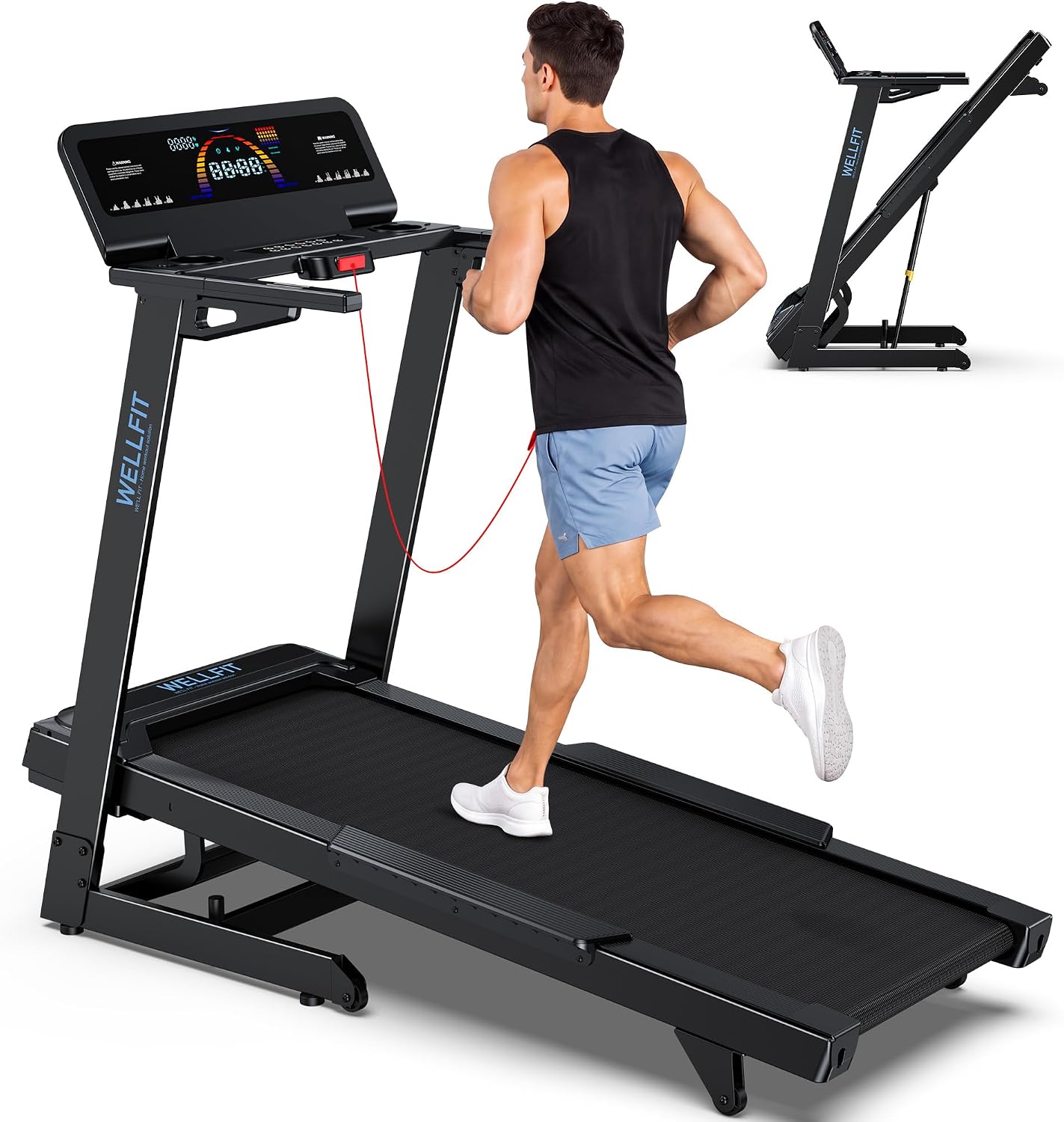
Choosing the best treadmill for heavy people starts with more than the maximum weight printed on the product page. The right machine should provide an appropriate user weight capacity, a stable frame, enough room for your stride, and a running surface suited to the way you exercise.
For larger users, a treadmill designed for walking may be a better choice than a compact running model. If you plan to jog or run regularly, deck length, motor specifications, cushioning, and the manufacturer’s recommended use become especially important.
In this guide, we’ll compare several treadmills worth researching for higher-capacity home workouts, explain what to look for before buying, and help you narrow your choices based on your weight, height, exercise routine, and available space.
Affiliate disclosure: As an Amazon Associate, HeavyDutyChoice may earn from qualifying purchases at no additional cost to you.
Quick Comparison: Best Treadmills for Heavy People
The models below represent different price and usage categories. Published weight limits and product configurations can vary by model and version, so verify the specifications for the exact treadmill before ordering.
| Treadmill | Published capacity to verify | Best for |
|---|---|---|
| WELLFIT TM029 Pro | Up to 500 lb, depending on version | Shoppers prioritizing a high stated capacity |
| SOLE TT8 | 400 lb | Serious home walking and running |
| 3G Cardio Elite Runner | 400 lb | Heavy-duty construction and a long deck |
| Horizon 7.8 AT | 375 lb | Home runners who want a spacious deck |
| LifeSpan TR7000iM | 400 lb | Walking-focused workouts and treadmill-desk use |
These are research candidates, not a claim that every model is the best fit for every buyer. Confirm current availability, the exact model number, official specifications, warranty coverage, and delivery arrangements before purchasing.
1. WELLFIT TM029 Pro — A High-Capacity Option to Investigate
Best for: Buyers who place a high priority on stated weight capacity.
The WELLFIT TM029 Pro is worth researching if you are looking for a home treadmill advertised with a weight capacity of up to 500 pounds. Its higher published limit may make it a candidate for shoppers who find that many conventional home treadmills do not offer enough capacity.
However, a high capacity figure alone does not establish long-term durability. Before choosing this model, check the exact version being sold, the manufacturer’s user-weight limit, the running-belt dimensions, the motor specifications, and the warranty terms. Do not assume that every treadmill sold under a similar WELLFIT model name has identical features.
- Potential advantage: A high advertised weight limit compared with many standard home treadmills.
- Check before buying: Exact model number, deck length and width, return shipping policy, and parts availability.
- Best fit: Buyers whose first screening requirement is a higher published capacity.
Check WELLFIT TM029 Pro on Amazon
2. SOLE TT8 — For Regular Home Walking and Running
Best for: Buyers looking for a substantial treadmill for regular workouts.
The SOLE TT8 is a non-folding treadmill designed for users who want a more substantial machine than a basic compact treadmill. Its published maximum user weight is 400 pounds, and its running deck is approximately 22 inches wide by 60 inches long. Those dimensions can be useful for users who need more lateral room or a longer stride.
The TT8 is worth considering if you intend to alternate between walking, jogging, and running. Its larger footprint, however, means you should measure your workout area carefully and allow for the manufacturer’s recommended clearance around the machine.
- Potential advantage: A wide running surface and a substantial, non-folding design.
- Trade-off: It takes up more permanent floor space than many folding treadmills.
- Best fit: Buyers who want a dedicated home treadmill for more than occasional walking.
Before purchasing, confirm the capacity and warranty for the exact TT8 version available in your market. If your weight is close to the published maximum, consider whether another model offers a more suitable capacity margin.
3. 3G Cardio Elite Runner — For a Spacious Running Deck
Best for: Users who want a long running surface and a more substantial treadmill.
The 3G Cardio Elite Runner is another model to consider when a larger running area is important. It is commonly listed with a 400-pound user capacity and a running surface measuring approximately 22 by 62 inches.
The extra deck length can be helpful for taller users or people who prefer a longer stride. It does not automatically make the treadmill suitable for every tall or heavy user, however. Your height, running style, and preferred speed all affect how much usable belt space you need.
- Potential advantage: A long, wide running surface and a design aimed at demanding workouts.
- Trade-off: This is a substantial machine, so both cost and installation space need consideration.
- Best fit: Buyers prioritizing running comfort and deck space over compact storage.
Check the current manufacturer’s documentation for the exact capacity, motor details, warranty, and service arrangements. Also confirm whether delivery includes bringing the treadmill into the room where it will be used.
Check 3G Cardio Elite Runner on Amazon
4. Horizon 7.8 AT — For Home Fitness and Running Workouts
Best for: Users who want a full-size home treadmill for varied workouts.
The Horizon 7.8 AT is a full-size treadmill that may suit users who want to progress beyond casual walking. It is commonly listed with a maximum user weight of 375 pounds and a running deck around 22 inches wide by 60 inches long.
That combination makes it a possible option for users who fit comfortably within its official weight limit and want room for walking, jogging, or running. It is not the right choice simply because it has a wide deck: the stated capacity must also suit the person who will use it.
- Potential advantage: A spacious running area for home training.
- Trade-off: Its published capacity is lower than that of some higher-capacity alternatives.
- Best fit: Buyers who want a full-size home treadmill and do not need a 400- or 500-pound rating.
If you are close to the maximum user weight, compare this model with higher-capacity alternatives instead of choosing based on workout features alone.
Check Horizon 7.8 AT on Amazon
5. LifeSpan TR7000iM — For Walking-Focused Workouts
Best for: People who primarily walk, including those considering a treadmill-desk setup.
The LifeSpan TR7000iM is a walking-focused treadmill-desk model rather than a conventional high-speed running treadmill. It is commonly listed with a 400-pound user capacity and a long walking surface, making it a different type of option for people whose main goal is steady walking rather than running.
This distinction matters. A treadmill intended for walking while working should not automatically be treated as a substitute for a running treadmill. Check its intended duty cycle, speed range, dimensions, and the manufacturer’s guidance for your planned activity.
- Potential advantage: A design intended for walking and treadmill-desk use.
- Trade-off: It is not the natural choice for users who want regular jogging or running workouts.
- Best fit: Buyers who want to walk during desk work or prioritize low-speed exercise.
Confirm that the exact TR7000iM configuration meets your needs and that any desk or workstation components you require are included separately or in the package.
Check LifeSpan TR7000iM on Amazon
How to Choose a Treadmill for Heavy People
1. Choose an Appropriate Weight Capacity
The first step is to check the manufacturer’s maximum user weight. Do not confuse the machine’s shipping weight or frame weight with its supported user weight.
As a practical screening rule, look for a treadmill rated comfortably above your current body weight rather than shopping right at the limit. For example, someone weighing 300 pounds could compare models rated for 350 or 400 pounds instead of assuming that a 300-pound rating provides adequate headroom.
This is a conservative buying guideline, not a guarantee of longer equipment life. Follow the manufacturer’s stated limit and instructions, and remember that weight capacity alone does not prove that a treadmill is suitable for sustained running.
2. Check the Running Surface
Running-belt dimensions affect how comfortable and secure a treadmill feels. A narrow belt may feel restrictive, while a short deck can limit the stride of taller users.
- Walking: Choose a surface that lets you walk naturally without constantly adjusting your position.
- Jogging: Look for enough length and width to accommodate your normal stride and pace.
- Running: Prioritize a full-size deck and check the manufacturer’s recommendations for your height and workout intensity.
Do not rely on the treadmill’s overall external dimensions as a substitute for the actual belt measurements.
3. Look Beyond Peak Motor Horsepower
Motor specifications can be confusing because listings may emphasize peak horsepower rather than continuous-duty power. These figures are not interchangeable, and a larger advertised peak number does not by itself establish that a treadmill is suitable for frequent workouts by a heavier user.
Check the manufacturer’s motor specifications, intended usage, service requirements, and warranty. If you expect to run regularly, consider a machine explicitly designed for that level of activity rather than choosing solely by its headline horsepower.
4. Consider Stability and Cushioning
A treadmill should feel stable during your intended workout. Look for a well-supported frame, a deck designed for the stated capacity, and a cushioning system that suits your comfort preferences.
Online product descriptions may use phrases such as “heavy duty,” “commercial grade,” or “shock absorption.” Treat these as starting points for research, not proof of performance. Product specifications, warranty coverage, and credible long-term feedback are more useful when comparing alternatives.
5. Measure Your Space and Check Delivery
Higher-capacity treadmills can be heavy and difficult to move. Before ordering, measure the available floor area, ceiling clearance, doorway width, stairways, and the route from the delivery point to your workout space.
Check whether the treadmill arrives assembled, requires substantial assembly, or needs professional installation. Also review return terms carefully: return shipping for a large piece of fitness equipment can be expensive.
6. Review the Warranty and Replacement Parts
For a treadmill that will be used frequently, warranty coverage can be just as important as the purchase price. Read the warranty terms for the frame, motor, parts, and labor separately.
Confirm whether the warranty applies to your intended home use, whether any service restrictions apply, and whether replacement belts, motors, and other parts can be obtained. Keep a copy of the purchase receipt and the exact model number.
What Weight Capacity Should You Look For?
The following ranges can help narrow your initial search. They are shopping filters rather than guarantees of suitability.
| Your body weight | Capacity to investigate |
|---|---|
| Up to 250 lb | Compare models rated above your weight, taking intended use into account. |
| 250–300 lb | Consider 350 lb and 400 lb models, with suitable headroom. |
| 300–350 lb | Focus on verified 400 lb or higher ratings where available. |
| 350–400 lb | Prioritize models with an official rating that exceeds your weight when possible. |
| Over 400 lb | Investigate verified 450–500 lb models and specialist equipment; contact the manufacturer if specifications are unclear. |
If you are close to a machine’s maximum rating, do not assume that a model is suitable just because the number technically covers your weight. Ask the manufacturer whether your intended frequency and type of exercise are appropriate for that model.
Common Mistakes to Avoid
- Buying based on peak horsepower alone: Check the complete motor specifications and intended duty cycle.
- Ignoring stride length: A treadmill can have enough weight capacity but still feel too short for a tall user.
- Assuming every “heavy duty” model is equivalent: Verify the actual capacity, belt dimensions, and warranty.
- Choosing a walking pad for running: Compact walking machines are designed for a different purpose than full-size running treadmills.
- Forgetting installation and service: Large treadmills can be difficult to move, assemble, or return.
- Relying on an outdated listing: Check the exact model and current manufacturer documentation before buying.
Frequently Asked Questions
What is the best treadmill for heavy people?
The best choice depends on your weight, height, workout type, budget, and available space. If capacity is your main concern, start with models that have a verified higher user-weight rating. If you plan to run, also compare belt dimensions, motor specifications, cushioning, and warranty coverage.
Is a 300 lb treadmill suitable for someone who weighs 300 pounds?
A treadmill rated for 300 pounds places the user at its stated limit. A more conservative approach is to compare machines with a higher rating and follow the manufacturer’s intended-use instructions. A higher capacity provides more headroom, but it does not independently guarantee durability.
Are folding treadmills suitable for heavier users?
Some folding treadmills have higher weight ratings, but folding construction alone does not determine stability or suitability. Check the official weight limit, running surface, frame design, and warranty for the exact model.
What is more important: weight capacity or belt size?
Both matter, but they answer different questions. Weight capacity indicates the manufacturer’s stated user limit, while belt size affects how comfortably you can walk or run. Choose a model that meets both requirements for your body and intended workout.
Can a heavy person use a walking pad?
Possibly, if the specific walking pad has an official user-weight rating that is appropriate and its dimensions and speed range suit the intended activity. Many walking pads have shorter or narrower belts than full-size treadmills, so they may not be appropriate for every user or workout.
Should I buy a treadmill with a 500 lb capacity if I weigh 350 pounds?
A verified 500-pound rating may provide more capacity headroom than a 400-pound model, but you should also compare build quality, dimensions, motor specifications, warranty, price, and the manufacturer’s recommendations. A higher rating alone is not enough to determine which treadmill is best.
Final Verdict
The best treadmill for heavy people is one that matches the user’s weight, stride, exercise routine, and home setup—not simply the one with the largest advertised horsepower or lowest price.
Start by checking the official weight limit, then compare the running surface, intended workout type, warranty, and service availability. The WELLFIT TM029 Pro is worth investigating if you need a higher advertised capacity; the SOLE TT8 and 3G Cardio Elite Runner are alternatives to research for full-size running workouts; and the LifeSpan TR7000iM is more relevant to walking-focused use.
Before making a final decision, verify the exact model specifications and current availability. That extra step can help you avoid buying a treadmill that technically meets one requirement but does not suit your everyday workouts.