Quick Answer
An elliptical is often worth considering if you prefer a lower-impact cardio motion, while a treadmill may suit you better if walking is your preferred exercise. For either machine, choose a model rated for your weight and check comfort, stability, and available space before buying.
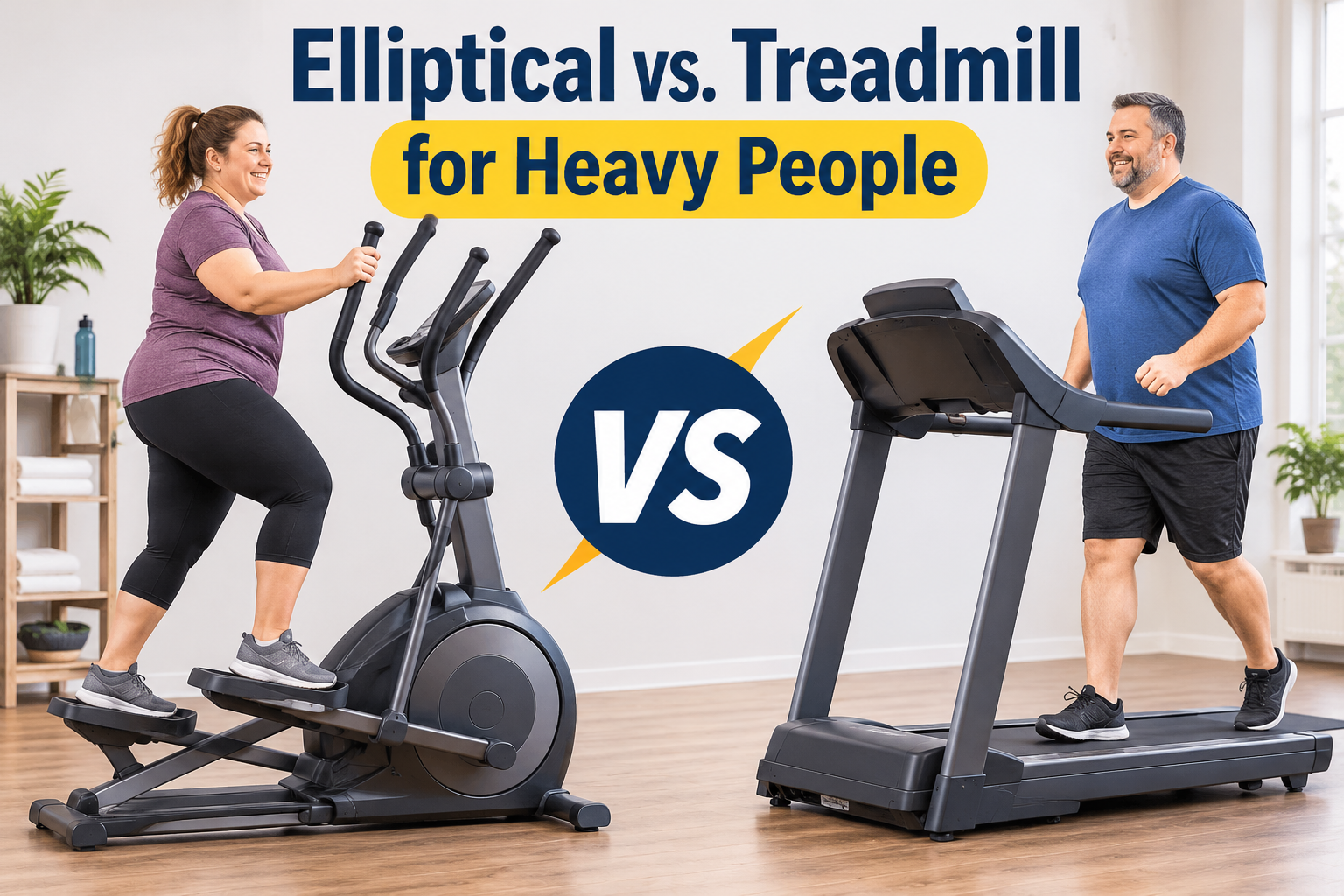
When comparing an elliptical vs. treadmill for heavy people, the best choice depends on how you want to exercise, what feels comfortable, and which machine fits your home. Both can support cardio workouts, but they create different movement patterns and have different space and setup requirements.
Weight capacity is an essential first check—not the only one. A machine should meet the manufacturer’s user-weight limit and feel comfortable during use. If you have a health condition or are unsure which activity is appropriate, ask a qualified healthcare professional for guidance before starting a new exercise routine.
Elliptical vs. Treadmill: Key Differences
| Factor | Elliptical | Treadmill |
|---|---|---|
| Movement | Feet follow a guided, elliptical path. | Walking or running on a moving belt. |
| Impact | Typically lower impact because the feet remain on the pedals. | Walking and running involve repeated foot contact with the belt. |
| Workout feel | Can involve both arms and legs when moving handlebars are used. | Familiar walking or running motion. |
| Space | Often has a long footprint and needs room around the pedals. | Needs belt clearance and safe access; folding models may help with storage. |
| What to verify | User-weight limit, stride, pedal spacing, and stability. | User-weight limit, belt dimensions, cushioning, and stability. |
When an Elliptical May Be a Better Fit
You prefer a guided, low-impact motion
An elliptical keeps your feet on the pedals throughout the movement, which can make it appealing if you want to avoid the repeated foot strikes associated with walking or running. Individual comfort varies, so try the motion if possible.
You want to involve your arms
Some ellipticals have moving handlebars that let you coordinate upper- and lower-body movement. Check that the handle position and stride feel natural and that the machine has stable handholds for getting on and off.
You want to vary resistance
Many ellipticals allow resistance changes without changing your movement pattern. This can help you adjust workout intensity gradually, provided the machine’s resistance range suits your needs.
When a Treadmill May Be a Better Fit
You prefer walking
A treadmill provides a familiar walking surface and may be easier to understand if you already enjoy walking outdoors. Start at a comfortable pace and use the safety features as directed.
You want a walking-focused workout
A treadmill is designed for walking and running, while an elliptical uses a different movement pattern. If your goal is to practice or maintain a walking routine, a treadmill may be the more direct choice.
You need a storage-friendly design
Some treadmills fold for storage, although folding does not remove the need for safe operating clearance. Compare the folded dimensions, machine weight, and moving requirements before choosing one.
How to Choose Equipment for Your Weight
For either type of machine, start with the manufacturer’s maximum user-weight rating. Choose a model rated above your current weight, and consider additional capacity if you are close to the listed limit. Never exceed the stated rating.
Then compare the details that affect comfort and stability:
- Elliptical: stride length, pedal spacing, frame stability, and the ease of stepping on and off.
- Treadmill: belt width and length, handrail placement, speed controls, and the stability of the frame.
- Both: assembled dimensions, floor requirements, warranty coverage, maintenance, and support.
Do not assume that a higher weight rating guarantees better comfort or durability. Check the exact model specifications and follow the owner’s manual for setup and use.
Which Machine Is Better for a Home Gym?
Think about your preferred activity first. If you enjoy walking and want a familiar movement, compare treadmills. If you prefer a guided pedal motion and want to reduce repeated foot strikes, compare ellipticals. If possible, try both types before making a decision.
Next, measure the workout area. Include room to get on and off safely, space for the machine’s moving parts, and any clearance specified by the manufacturer. A machine that fits the room but leaves no safe access is not a good fit.
Build up gradually
Start with a duration and intensity that feel manageable. Stop if you experience pain, dizziness, or unusual symptoms, and seek appropriate medical advice when needed.
Frequently Asked Questions
Is an elliptical easier on the joints than a treadmill?
An elliptical generally involves less repeated foot impact because the feet stay on the pedals. Comfort varies by person and machine, so it is best to try the movement if possible.
Which machine burns more calories?
There is no universal winner. Energy use depends on workout intensity, duration, body size, and how the equipment is used. Choose the activity you can perform comfortably and consistently.
Can a heavier user use a folding treadmill?
Potentially, if the exact model’s stated user-weight rating is appropriate and the machine fits the user. Verify the rating and dimensions before purchasing; folding design alone does not indicate capacity.
Should I choose the machine with the highest weight capacity?
Choose a machine with a suitable capacity and then compare fit, stability, comfort, space, and warranty. The highest number is not necessarily the best overall match.
Final Verdict
An elliptical may suit people who prefer a guided, lower-impact motion, while a treadmill may be a better fit for those who want to walk or run. For either machine, verify the exact user-weight rating, test comfort when possible, and make sure the equipment fits your home and workout goals.
As an Amazon Associate, HeavyDutyChoice may earn from qualifying purchases. Product specifications and availability can change; verify details on the product page before ordering.