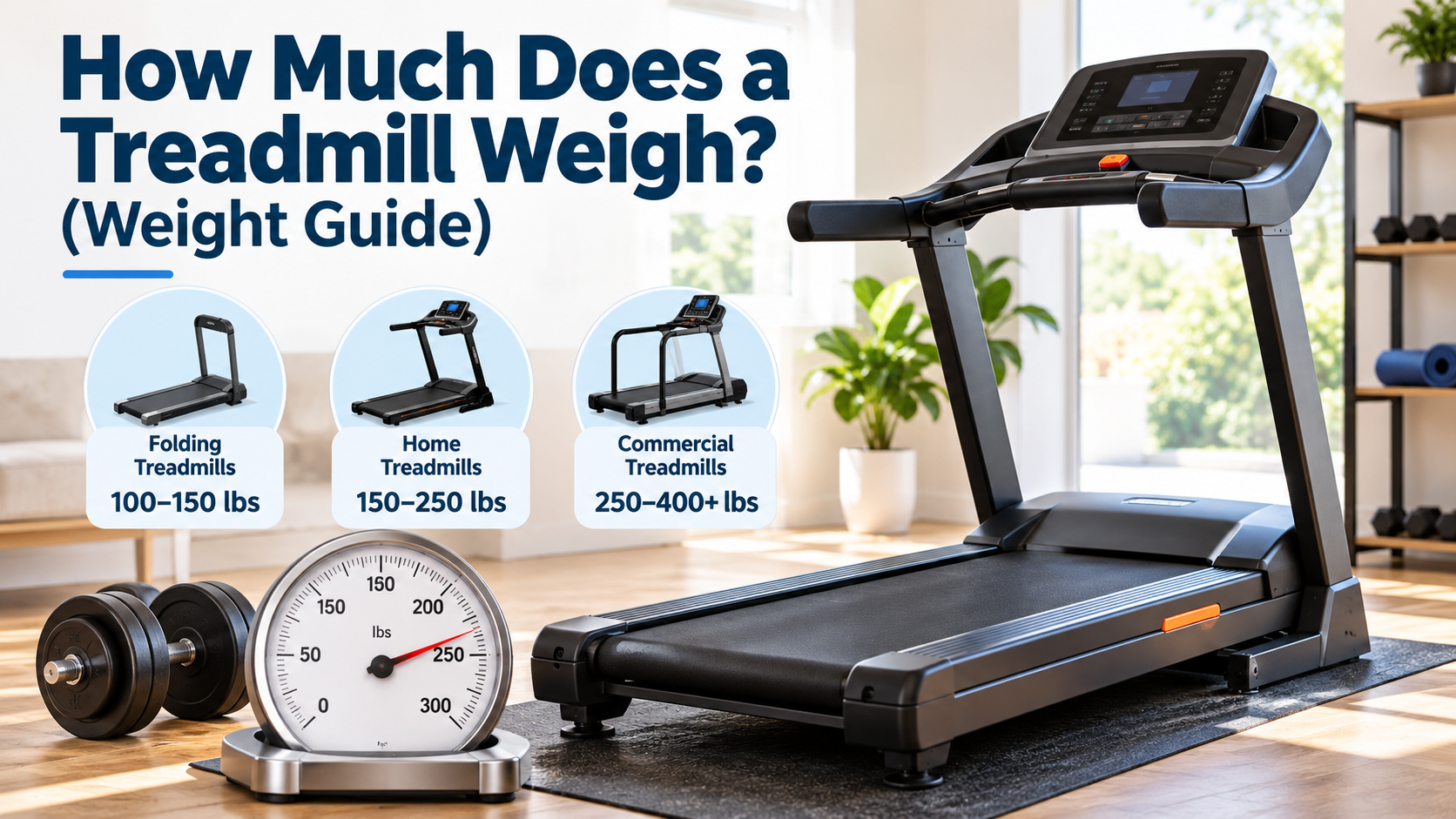
If you’re buying a treadmill for home use, you may wonder how much it weighs and whether you can move it into your workout space. A treadmill’s weight affects delivery, assembly, portability, floor placement, and how easily you can move it when cleaning or rearranging a room.
Most full-size home treadmills weigh roughly 150–300 pounds. Compact walking treadmills and walking pads can be considerably lighter, while some commercial-style machines weigh more. The exact weight depends on the model, frame construction, motor, running deck, and included features.
Quick Answer: How Much Does a Treadmill Weigh?
Most full-size home treadmills weigh approximately 150–300 pounds, while compact walking pads are often much lighter. Commercial-style treadmills can weigh 250–400 pounds or more.
- Walking pads: roughly 30–80 lb
- Basic folding treadmills: roughly 100–180 lb
- Full-size home treadmills: roughly 150–300 lb
- Heavy-duty treadmills: roughly 200–350+ lb
These are general estimates, not specifications for individual models. Check the manufacturer’s listed assembled weight before purchasing or arranging delivery.
This guide explains typical treadmill weight ranges, what makes some treadmills heavier than others, and how to plan for delivery and setup.
How Much Does a Treadmill Weigh on Average?
Treadmill weight varies by design. The following ranges are general estimates for planning purposes, not specifications for any particular product.
| Treadmill Type | Approximate Weight Range |
|---|---|
| Compact walking pad | 30–80 lb |
| Folding walking treadmill | 60–150 lb |
| Basic folding home treadmill | 100–180 lb |
| Full-size home treadmill | 150–300 lb |
| Heavy-duty home treadmill | 200–350+ lb |
| Commercial-style treadmill | 250–400+ lb |
These categories overlap. Some compact models are heavier than expected, and some full-size treadmills are relatively lightweight. Always check the manufacturer’s specifications for the exact machine you plan to buy.
It’s also important to distinguish between the treadmill’s shipping weight and its assembled weight. Shipping weight may include packaging, accessories, and hardware, so it can be higher than the weight of the assembled machine.
What Makes a Treadmill Heavy?
Several components contribute to a treadmill’s overall weight.
1. Frame Construction
The frame supports the treadmill and helps keep it stable during use. A machine with a substantial metal frame may weigh more than a compact model built for light walking.
A heavier frame can contribute to a solid feel, but weight alone does not establish build quality. Look at the manufacturer’s specifications, construction details, and warranty as well.
2. Motor and Drive System
Many full-size treadmills have larger drive systems than compact walking pads. Motor design and associated components can add weight.
However, motor power and treadmill weight are not interchangeable measures. Compare the manufacturer’s motor specifications and intended-use recommendations rather than assuming that the heaviest treadmill is automatically the most powerful.
3. Running Deck and Belt
A full-size treadmill needs a deck and belt that provide sufficient running space. The deck structure, cushioning system, and supporting components all contribute to the machine’s total weight.
A longer or wider running surface can also affect the treadmill’s overall dimensions, which matters when planning a room layout.
4. Incline and Additional Features
Some treadmills include powered incline systems, larger consoles, built-in speakers, accessory trays, or additional cushioning components. These features may increase overall weight.
If you only need a treadmill for walking, a simpler model may be easier to position and move than a feature-heavy machine.
How Heavy Is a Folding Treadmill?
Folding treadmills are not necessarily lightweight. Folding describes how the running deck stores, not how much the machine weighs.
A full-size folding treadmill may weigh well over 150 pounds. Its folding mechanism can reduce the amount of floor space it occupies when stored, but it does not eliminate the need for careful lifting or positioning.
Before purchasing a folding treadmill, check:
- Assembled weight: How heavy is the complete machine?
- Folded dimensions: Will it fit in your planned storage area?
- Transport wheels: Does the model have wheels, and how is it intended to be moved?
- Folding mechanism: Can the deck be raised and lowered safely?
- Clearance: Is there enough room to unfold and use it?
Do not assume that a folding treadmill can be carried easily by one person.
How Much Does a Walking Pad Weigh?
Walking pads are generally lighter and more compact than full-size treadmills. Many models are designed for walking rather than running and may be suitable for smaller rooms, home offices, or under-desk use.
Some walking pads weigh only a few dozen pounds, while larger models can be substantially heavier. Their portability depends on more than weight: carrying handles, transport wheels, folded dimensions, and the location of the motor all matter.
If you plan to store a walking pad under a desk or bed, check its actual height and dimensions. Also verify the manufacturer’s instructions for lifting and storage.
Does a Heavier Treadmill Support More User Weight?
Not necessarily.
Treadmill weight and maximum user weight capacity are two different specifications. A heavy treadmill may have a relatively modest user weight limit, while a lighter model may be designed with a different frame structure and stated capacity.
When choosing a treadmill for a larger user, check these details separately:
- Maximum user weight: The manufacturer’s stated limit for the person using the machine.
- Frame and deck design: Whether the treadmill is intended for the type and frequency of exercise you plan.
- Running surface: Whether the belt dimensions provide sufficient room for comfortable movement.
- Intended use: Whether the model is designed for walking, jogging, or running.
- Warranty terms: Whether the warranty specifies conditions related to user weight or usage.
Do not use the treadmill’s physical weight as a substitute for its rated user capacity. For more options, browse our treadmill buying guides.
How Much Space Do You Need for a Heavy Treadmill?
The machine’s footprint is just as important as its weight. Before ordering, measure the available floor area and account for the treadmill’s full operating dimensions.
- Room dimensions: Measure the intended location, including nearby doors and furniture.
- Ceiling height: Allow enough overhead clearance for your height, the treadmill’s deck, and any incline setting.
- Access route: Measure doorways, hallways, stairways, and tight turns along the delivery path.
- Power access: Check the manufacturer’s electrical requirements and the location of the outlet.
- Ventilation and clearance: Follow the manual’s requirements for space around the machine.
- Floor protection: Consider a suitable treadmill mat if permitted by the manufacturer and appropriate for your flooring.
Do not rely only on the product’s advertised length and width. A treadmill may need additional clearance around it for safe use and maintenance.
How to Move a Heavy Treadmill
Moving a heavy treadmill can be difficult because its weight is concentrated in a large, awkward shape. The safest approach depends on the model, the route, and the manufacturer’s instructions.
1. Read the Manual First
Check whether the treadmill can be folded or tilted for transport. Some models have specific instructions for moving, lifting, or securing the running deck.
Unplug the machine before moving it and follow the manufacturer’s preparation steps.
2. Check the Route
Measure doorways and hallways before moving the treadmill. Look for stairs, narrow corners, thresholds, and uneven flooring.
If the machine must go up or down stairs, professional movers may be the safer choice.
3. Use Appropriate Moving Equipment
Depending on the manufacturer’s instructions, suitable moving equipment may help with a heavy machine. You can compare heavy-duty furniture moving dollies on Amazon or moving straps on Amazon.
These products are not automatically suitable for every treadmill. Check their load ratings, dimensions, and intended use, and never place a treadmill on equipment that cannot securely support it.
4. Get Help When Needed
Do not attempt to lift a heavy treadmill alone if you cannot control its weight safely. Use enough capable helpers or hire professionals, especially when navigating stairs or carrying the machine over obstacles.
Avoid pulling the treadmill by its console, handrails, or other parts that are not designed as lifting points.
5. Recheck the Machine After Moving
Once the treadmill is in place, inspect it according to the manufacturer’s instructions. Confirm that it sits on a suitable, level surface and that any transport locks or folding mechanisms are properly secured before use.
How to Choose a Treadmill That’s Easier to Move
If you expect to rearrange your home gym frequently, consider portability as part of your buying decision.
Choose a Compact Walking Pad If:
- You mainly plan to walk at home or while working at a desk.
- Storage space is limited.
- You need a machine that is easier to position than a full-size treadmill.
Choose a Folding Home Treadmill If:
- You want a more traditional treadmill but need to save floor space.
- You have enough room to unfold and use the machine safely.
- Its assembled weight and transport features suit your setup.
Choose a Heavier-Duty Treadmill If:
- You need a more substantial full-size machine.
- You want a running surface and features suited to your intended workouts.
- You have checked its weight, dimensions, user capacity, and delivery requirements.
Frequently Asked Questions
How much does a treadmill weigh in pounds?
Many full-size home treadmills weigh approximately 150–300 pounds. Compact walking pads may weigh much less, while commercial-style machines can weigh 250–400 pounds or more. These are broad estimates; check the exact model specifications.
Can one person move a treadmill?
Some compact treadmills may be manageable by one person if the manufacturer allows it and the route is safe. Many full-size treadmills are too heavy or awkward to move alone safely. Use the recommended moving method and seek assistance when needed.
Is a 200-pound treadmill heavy?
A 200-pound treadmill is a substantial piece of equipment. Even if it has transport wheels, moving it through tight spaces or over thresholds may require help.
Is shipping weight the same as assembled weight?
No. Shipping weight may include packaging and accessories. Compare the assembled product weight and shipping weight separately when planning installation.
Should I buy a lighter treadmill?
A lighter treadmill may be easier to position and store, but weight should not be your only buying criterion. Consider the intended exercise, running surface, maximum user weight, stability, dimensions, warranty, and the manufacturer’s instructions.
Final Thoughts
Most full-size home treadmills weigh approximately 150–300 pounds, while compact walking pads are often lighter and commercial-style machines can be heavier. The actual weight depends on the design and specifications of the individual model.
Before buying, confirm the assembled weight, shipping weight, dimensions, user weight limit, and delivery requirements. If you need to move the machine through stairs or narrow hallways, plan the route in advance and arrange appropriate assistance.
Choosing a treadmill that fits both your workout needs and your home setup can make delivery, installation, and everyday use much easier.
As an Amazon Associate, HeavyDutyChoice may earn from qualifying purchases.