
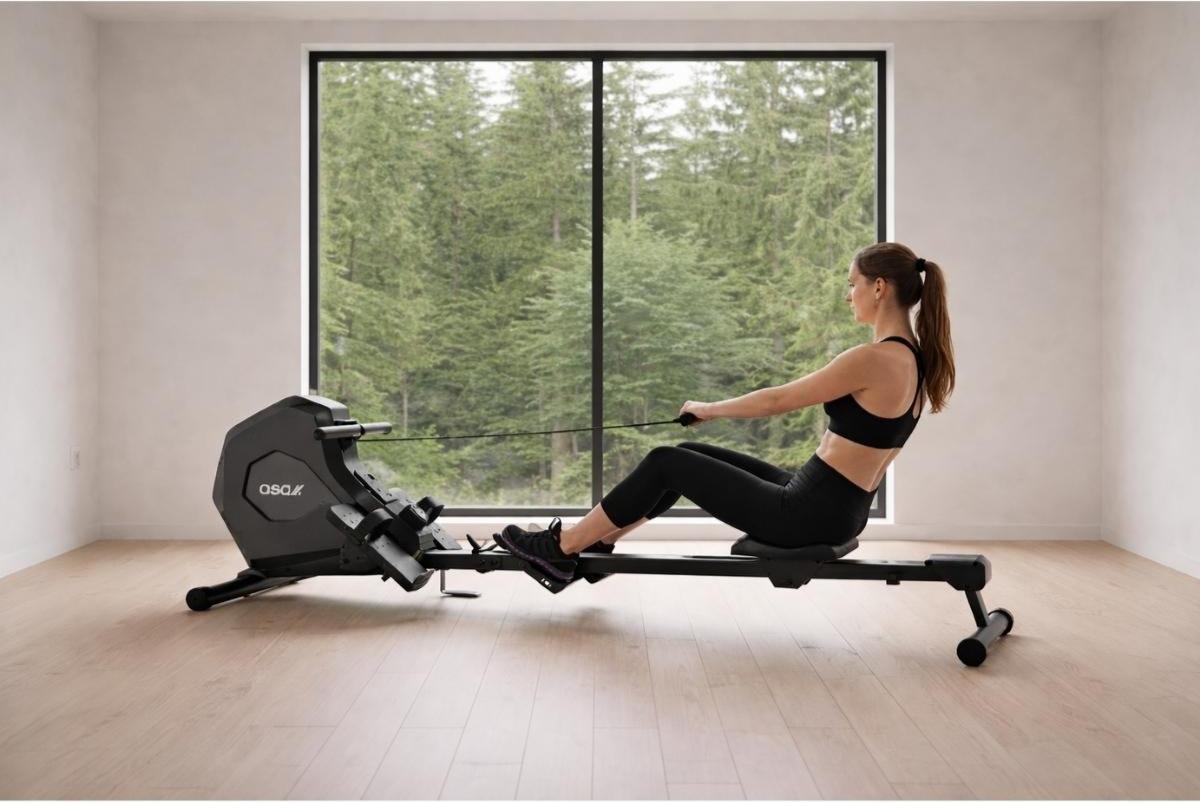
A rowing machine is one of the few cardio machines that engages muscles throughout your entire body. Every stroke combines a powerful leg drive, controlled core movement, and an upper-body pull. But exactly what muscles does a rowing machine work?
From your quadriceps and glutes to your abdominal muscles, back, shoulders, and arms, rowing involves several major muscle groups working together. Understanding how these muscles contribute to each stroke can help you improve your technique and get more from every workout.
Full-Body Muscle Engagement
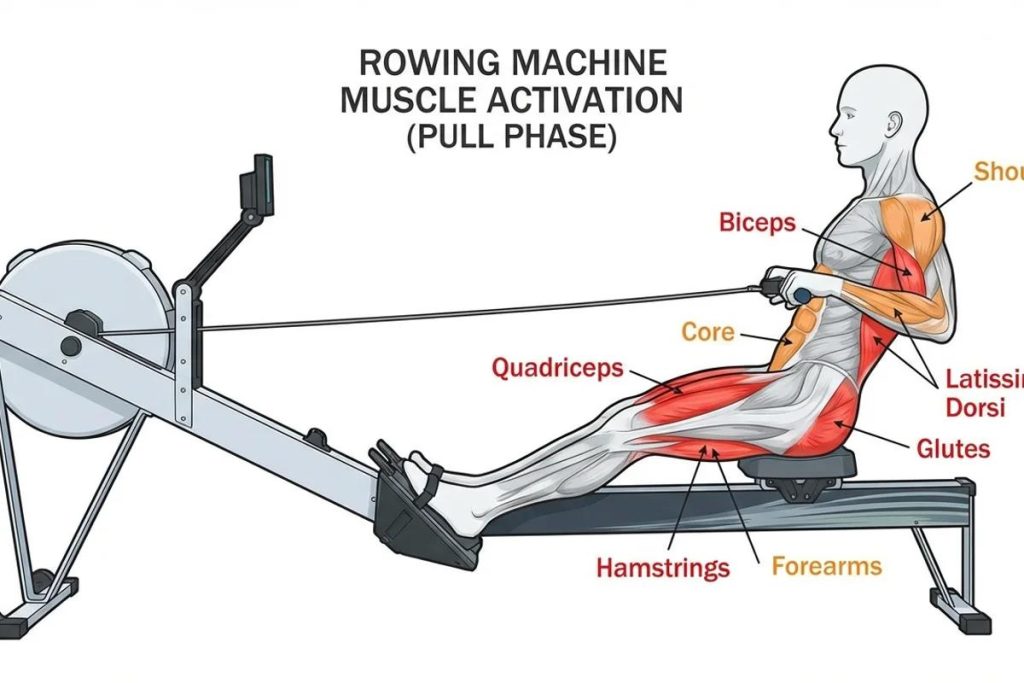
A rowing machine works your legs, glutes, core, back, shoulders, and arms.
Your lower body generates much of the power, your core stabilizes your torso, and your upper body completes the pulling movement.
1. Is a Rowing Machine Really a Full-Body Workout?
Yes. Rowing involves muscles throughout your body, but different muscle groups contribute at different points in the stroke.
Your legs and hips generate much of the force during the drive. Your abdominal and back muscles help stabilize your torso, while your arms finish the pulling movement. During recovery, these muscles work together to return you to the starting position.
Power Generation
Quadriceps, hamstrings, and glutes help push against the footrests and move your body backward.
Stability & Control
Abdominal and trunk muscles help maintain posture and transfer force between your upper and lower body.
Pulling & Coordination
Your back, shoulders, arms, and forearms help control the handle and complete the stroke.
Rowing is therefore a coordinated cardiovascular and muscular activity. It can support muscular endurance and general fitness, but it should not be treated as a complete replacement for resistance training if your main goal is building substantial muscle size or strength.
2. Leg Muscles: The Main Source of Rowing Power
Your legs play a major role in producing force during the drive phase. A common beginner mistake is pulling too much with the arms instead of using the legs to initiate the movement.
Why Your Legs Matter
The rowing stroke starts with a push against the footrests. Your leg muscles help generate this initial force before your torso and arms complete the movement.
Quadriceps
The quadriceps help straighten your knees as you push away from the front of the rowing machine.
Hamstrings
The hamstrings contribute to hip extension and help control movement around the knee and hip.
Glutes
Your gluteal muscles help extend the hips as you move from the compressed starting position toward the finish.
To use your legs effectively, begin each drive by pushing through your feet. Keep your arms extended until your legs have started to straighten. Avoid turning the movement into an arm pull.

3. Core Muscles: Abs and Trunk Stability
Your core muscles help stabilize your torso as your legs and arms move. They are active throughout the rowing stroke, although rowing is not the same as performing targeted abdominal exercises such as crunches or planks.
Rectus Abdominis
The muscle group commonly associated with the visible six-pack area. It contributes to trunk control during rowing.
Obliques
Located along the sides of your abdomen, these muscles help stabilize your torso and control unwanted rotation.
Deep Core Muscles
Deeper abdominal and trunk muscles contribute to stability and help maintain a controlled body position.
Does Rowing Give You Six-Pack Abs?
Rowing engages your core, but using a rowing machine alone does not guarantee visible abs. Abdominal definition depends on several factors, including overall body composition, nutrition, genetics, and training. Rowing can be part of a broader fitness routine, but it is not a spot-reduction exercise.
4. Back Muscles: Upper Back and Posture Control
Your back muscles help maintain posture and control the handle during the pulling phase. They work together with your arms and shoulders rather than operating independently.
Latissimus Dorsi
The large muscles across your back help move your upper arms and contribute to pulling the handle toward your torso.
Rhomboids
These muscles between your shoulder blades help control scapular movement during the stroke.
Trapezius
The trapezius helps control shoulder blade movement and supports upper-back positioning.
Spinal Erectors
These muscles along your spine help maintain trunk position and control your torso during the stroke.
Keep your torso controlled and avoid rounding your lower back. At the finish, pull the handle toward your lower ribs without shrugging your shoulders or leaning excessively backward.
5. Arms and Shoulders: Completing the Pull
Your arms are important, but they should not do all the work. They complete the stroke after your legs have generated force and your torso has moved into position.
Biceps
Help bend your elbows as you draw the handle toward your body. They are involved mainly in the pulling phase.
Forearms and Grip
Help you hold and control the handle. A relaxed but secure grip is generally preferable to excessive squeezing.
Shoulder Muscles
Help position and control your upper arms. Keep your shoulders relaxed instead of shrugging them toward your ears.
6. Which Muscles Work During Each Phase of a Rowing Stroke?
Different muscle groups contribute at different points in the stroke. The following table gives a simplified overview of how the movement is coordinated.
| Stroke Phase | Main Muscle Groups | Main Function | Catch | Legs, core, shoulders | Prepare for the drive | Drive | Quadriceps, glutes, hamstrings | Generate force and extend the legs | Finish | Back, biceps, shoulders, core | Complete the handle pull and stabilize the torso | Recovery | Core, back, legs, arms | Return smoothly to the catch |
|---|
This is a simplified guide. Real rowing involves overlapping muscle activity, and the amount of effort required from each muscle changes with your technique, pace, and resistance.
7. How to Adjust Your Rowing Workout for Different Goals
You cannot completely isolate one muscle group on a rowing machine, but you can adjust your training approach to emphasize different fitness outcomes.
General Fitness
Use a comfortable, steady pace and focus on maintaining consistent technique throughout the session.
Cardiovascular Endurance
Build your session duration gradually while keeping the effort at a level you can sustain.
Higher-Intensity Training
After building a technique foundation, consider short intervals with easier recovery periods between efforts.
Muscle Strength
Combine rowing with a suitable resistance-training program. Rowing alone is not a substitute for progressive strength training.
If you are new to rowing, learn the basic movement before trying high-intensity intervals. Increasing resistance or speed while your technique is inconsistent can make the workout harder without making it more effective.
8. Rowing Machine vs. Other Cardio Machines: Muscle Focus
Different cardio machines involve different movement patterns. A rowing machine combines leg drive and upper-body pulling, while other machines place more emphasis on particular movements.
| Machine | Main Muscle Emphasis | Movement | Rowing Machine | Legs, hips, core, back, arms | Seated pulling and leg drive | Exercise Bike | Quadriceps, glutes, hamstrings, calves | Repeated pedaling | Treadmill | Glutes, quadriceps, hamstrings, calves | Walking or running | Elliptical | Primarily legs, with upper-body involvement on moving-handle models | Standing elliptical motion |
|---|
The best machine depends on your goals and preferences. If you want a cardio workout that combines lower-body movement with upper-body pulling, rowing is a useful option. If you prefer a simpler leg-focused movement, an exercise bike may be more suitable.
9. Frequently Asked Questions
Does a rowing machine work your whole body?
Rowing involves muscles in your legs, hips, core, back, shoulders, and arms. The lower body produces much of the drive, while the core and upper body help coordinate and complete the stroke.
Does rowing work your abs?
Yes. Your abdominal and other trunk muscles help stabilize your body during each stroke. However, rowing does not specifically target abdominal fat or guarantee visible abs.
Does a rowing machine build leg muscle?
Rowing repeatedly engages the quadriceps, hamstrings, and glutes. It can support muscular endurance, but significant muscle growth generally requires an appropriate progressive resistance-training program.
Does rowing work your back?
Yes. Muscles in your upper back help control the handle pull and shoulder blade movement, while muscles along your spine help maintain posture.
Can rowing replace weight training?
Not completely. Rowing is useful for cardiovascular fitness and muscular endurance, but a dedicated resistance-training program is generally more appropriate for developing strength and muscle size.
Will rowing make my arms bigger?
Your arms participate in every stroke, but rowing is primarily a coordinated endurance activity. It should not be relied on as the main method for substantial arm muscle growth.
Is rowing a good low-impact workout?
Rowing is generally considered a low-impact exercise because it does not involve the repeated foot strikes associated with running. However, technique and individual physical limitations still matter.
A Rowing Machine Is More Than an Arm Workout
A rowing machine works more than just your arms or legs. Each stroke combines leg drive, hip movement, core stabilization, and upper-body pulling to create a coordinated full-body exercise.
Your quadriceps, hamstrings, and glutes help generate power. Your core and back stabilize your torso, while your arms and shoulders complete the pull. To get the most from rowing, focus on proper technique and gradually build your training volume.
Explore More Rowing Machine Guides
Continue learning about indoor rowing, proper technique, and effective training routines.