Quick Answer
The best shower chair for a small shower is usually the one with the smallest practical footprint that still provides the support and seat height the user needs. Compact shower stools can be easier to position than full-size chairs, but the seat dimensions alone do not tell you how much floor space the legs occupy.
Before buying, measure the usable shower floor, check the chair’s outside dimensions, and confirm that all feet can sit securely on a flat surface. If the user needs a backrest, armrests, or help transferring, do not sacrifice those features just to save space.
Finding a shower chair for a small shower can be challenging. A full-size shower chair may crowd a narrow stall, interfere with the shower curtain, or leave little room to move. A compact shower stool can take up less space, but not every stool fits every shower or bathtub.
The right choice depends on more than the size of the seat. You also need to consider the leg footprint, adjustable height, drainage, weight capacity, and the user’s ability to sit down and stand up safely.
This guide compares compact shower-seat options and explains how to measure a small shower before ordering. Product specifications can vary by model and retailer, so confirm the exact product number and manufacturer’s instructions before buying.
In This Guide
Compact Shower Chairs to Compare
These options cover different priorities: a small square stool, an adjustable bath stool, and a rotating seat. They are comparison candidates rather than a hands-on ranking. A swivel seat, for example, may help some users move while seated but is not automatically the best option for the tightest shower.
1. Drive Medical Basic Round Shower Stool — RTL12004KD
Best for: Shoppers who want a straightforward, compact stool for a small shower.
The Drive Medical RTL12004KD is a basic adjustable shower stool with a square seat measuring approximately 13 by 13 inches. The model is listed with a 300 lb weight capacity and height-adjustable legs. Its simple design avoids the extra structure of a full chair with a backrest.
A 13-inch seat can be a useful starting point when comparing compact options, but it does not mean the entire stool occupies only 13 by 13 inches. The legs extend beyond the sitting surface, so check the complete footprint before deciding whether it will fit.
Check before buying: Confirm the outside dimensions, seat-height adjustment range, and manufacturer’s assembly instructions for the exact version sold.
2. Medline Guardian Bath Stool — G2-300KRX1
Best for: Buyers who want an adjustable stool from a medical-equipment brand.
The Medline Guardian G2-300KRX1 is a bath stool without a backrest. Medline’s product information lists a 300 lb weight capacity, an adjustable seat-height range of 13.75 to 20.5 inches, and a seat depth of approximately 12.5 inches.
The adjustable legs can help users set the seat to a more appropriate height within the permitted range. Its backless design may also leave more open space around the upper body than a full chair. However, a backless stool is not the right choice for someone who needs a backrest to sit securely.
Check before buying: Confirm the full seat and base dimensions, the exact model number, and whether the seat height suits the user. Do not assume that a compact seat guarantees a compact leg footprint.
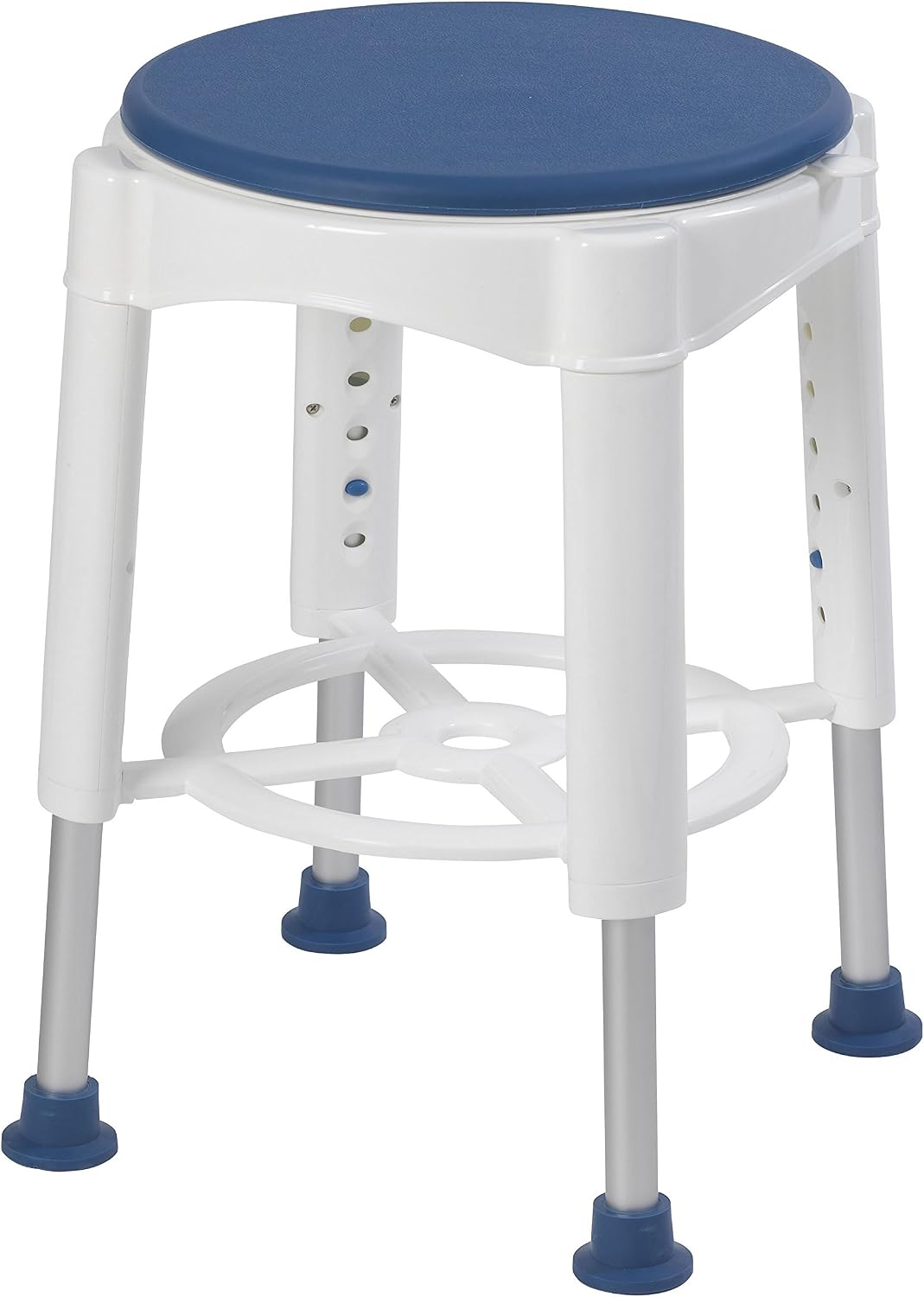
3. Drive Medical Swivel Seat Shower Stool — RTL12061M
Best for: Buyers who want a rotating seat and have enough room for the stool’s base.
The Drive Medical RTL12061M has a rotating seat designed to reduce the need for twisting and reaching while seated. The manufacturer lists a 14 by 14 inch seat, a 300 lb weight capacity, and seat-height adjustment from 16 to 22 inches.
A swivel seat may be useful for some people with limited mobility, but it is not necessarily the smallest or simplest choice for a narrow stall. Check the base dimensions and make sure there is enough clearance for the user to position themselves without bumping into walls or fixtures.
Check before buying: Review the instructions for the rotating mechanism, verify the height range, and ensure that the user can use the stool safely. If rotating could affect the user’s balance, ask a qualified professional for guidance.
How to Interpret These Options
For the tightest shower, start by measuring the available floor area and comparing the full base dimensions of a simple stool. Choose a rotating seat only if its movement feature is useful and the surrounding space allows it. If the user needs back or arm support, prioritize those features over a smaller footprint.
How to Measure a Small Shower Before Buying
One of the most common mistakes is comparing only the seat width. The seat is where the user sits, but the legs determine how much floor space the stool needs. A model can have a small seat and still be too wide for a narrow shower.
Measure the Usable Floor Area
Measure the flat, usable area where all four feet can rest securely. Do not use the shower’s overall wall-to-wall dimensions if a curb, built-in shelf, sloped surface, or other obstruction reduces the available space.
Check the Full Base Width and Depth
Look for the manufacturer’s overall dimensions or footprint. If those measurements are not listed, ask the seller or manufacturer rather than estimating from a product photo. Leave enough room for the user’s feet and for safe movement around the seat.
Consider the Door, Curtain, and Drain
Make sure the stool will not block the shower entrance or push the curtain into an awkward position. Check the drain location and ensure that all feet can sit flat without bridging a drain opening or resting on an uneven surface.
Choose a Suitable Seat Height
Check the minimum and maximum seat height. The correct setting depends on the user’s height, mobility, and ability to sit down and stand up. A stool that fits the shower but is too low or too high may be difficult to use comfortably.
Quick Measuring Checklist
- Usable flat floor width and depth
- Full stool footprint, including legs and feet
- Seat height range
- Clearance around the entrance, curtain, and fixtures
- Space for the user’s feet and safe movement
- Weight capacity and required support features
Shower Stool vs. Shower Chair with a Back
A compact stool is not always the best answer to a small shower. The right design depends on how much support the user needs and how the seat will be positioned.
| Feature | Backless Stool | Chair with Back |
|---|---|---|
| Overall profile | Usually simpler and lower | Taller because of the backrest |
| Back support | None | Available, depending on design |
| Arm support | Model-dependent | Model-dependent |
| Space needed | Must verify leg footprint | Must verify full width and depth |
| Best selection priority | Compactness when back support is not required | Additional support when needed |
If the user needs a backrest or armrests to sit securely, do not choose a backless stool simply because it looks smaller. Compare the actual dimensions of supportive models and look for one that fits the available floor area.
For more options, read our guide to shower chairs without a back or our guide to shower chairs with arms.
Features That Matter in Tight Spaces
A Compact but Stable Base
A smaller base may help a stool fit into a narrow shower, but compactness should not come at the expense of stability. All feet should contact the intended surface securely. Follow the manufacturer’s setup instructions and stop using the stool if it rocks, slips, or has damaged feet.
Adjustable Legs
Height adjustment allows the seat to be configured within the model’s specified range. Check the adjustment increments and make sure the legs can be locked securely at the intended height. Do not use a chair with unevenly adjusted legs unless the manufacturer explicitly permits that setup.
Drainage Holes and Easy Cleaning
Drainage holes or channels can help water run off the seat. Check that the seat is easy to clean and inspect the legs, locking pins, and feet regularly. Follow the manufacturer’s instructions for cleaning and maintenance.
Weight Capacity
Check the stated weight capacity for the exact model. A compact stool is not automatically suitable for a higher-weight user, and seat size does not determine capacity. If you need a higher-capacity option, see our Best Heavy-Duty Shower Chairs guide.
Backrests and Armrests When Needed
Support needs should guide the decision. A backrest can provide additional support, while armrests may help some users position their hands when sitting or standing. These features also affect overall dimensions, so compare the full product measurements before ordering.
Choosing a Shower Chair for a Small Bathtub
A chair that fits a walk-in shower may not be suitable for a bathtub. The tub’s interior width, sloped sides, floor shape, and height can affect where the chair’s feet rest. Measure the inside of the tub at the level where the seat’s feet will sit, not just the outside width of the bathtub.
- Check the tub’s inside dimensions: Compare the stool’s full footprint with the usable flat area inside the tub.
- Check the base against the tub floor: Do not assume the feet will fit securely on a curved or sloped surface.
- Consider entry and exit: The chair should not obstruct the user’s path or make transfers more difficult.
- Assess the user’s support needs: If the user needs help transferring over the tub wall, a shower stool may not be the right type of equipment.
- Consider a transfer bench when appropriate: A transfer bench is designed for a different purpose than a small shower stool. Confirm that the model suits the tub and the user’s mobility needs.
If the main challenge is safely getting over the bathtub wall, compare a transfer bench rather than trying to solve every access problem with a smaller stool.
Safety Reminder
A shower stool is not a substitute for assistance when a user cannot sit or transfer safely. If balance, weakness, or limited mobility makes bathing difficult, ask a qualified healthcare professional or occupational therapist to help assess the appropriate equipment and setup.
Frequently Asked Questions
What is the best shower chair for a small shower?
The best option is the smallest suitable model that fits the usable floor area and meets the user’s support needs. A basic shower stool can be a good starting point, but compare its complete footprint, seat height, and capacity before purchasing.
Will a 13-inch shower stool fit in a small shower?
Not necessarily. A 13-inch seat measurement describes the sitting surface, not the full width or depth of the stool. The legs and feet may extend farther out. Check the manufacturer’s overall dimensions and compare them with the available floor area.
Can I use a shower stool inside a bathtub?
Only if the particular model is suitable for the tub and all its feet can rest securely on the intended surface. Measure the tub’s interior and follow the manufacturer’s instructions. A stool that fits a flat shower floor may not fit a bathtub with sloped sides.
Is a backless shower stool better for a small bathroom?
It may have a simpler profile and can be easier to position, but the overall footprint varies by model. A backless stool also provides no back support. Choose based on the available space and the user’s ability to sit safely, not appearance alone.
Are shower stools with adjustable legs worth considering?
Yes, when the seat-height range matches the user’s needs. Check the minimum and maximum heights, adjustment increments, and locking mechanism. Height adjustment does not guarantee that the stool will fit a small shower, so measure the base separately.
What if I need a shower chair with arms or a backrest?
Look for a compact supportive model and compare its overall dimensions. Do not remove a backrest or armrests unless the manufacturer specifically permits that configuration. Our shower chairs with arms guide can help you compare support features.
Final Verdict
The best shower chair for a small shower is not necessarily the one with the smallest seat. It is the model that fits the available floor area, sits securely, adjusts to a suitable height, and provides the support the user needs.
Start by measuring the usable space and comparing the complete base dimensions. The Drive Medical RTL12004KD is worth comparing if you want a simple compact stool. The Medline Guardian G2-300KRX1 is another adjustable backless option, while the Drive Medical RTL12061M may suit users who specifically want a rotating seat and have enough room for its base.
For more options, visit our Shower Chairs hub, compare shower chairs without a back, or explore heavy-duty shower chairs if weight capacity is a priority.
Affiliate Disclosure
As an Amazon Associate, HeavyDutyChoice earns from qualifying purchases. Product availability, prices, dimensions, and specifications may change. Confirm the current product listing and manufacturer’s information before purchasing.