
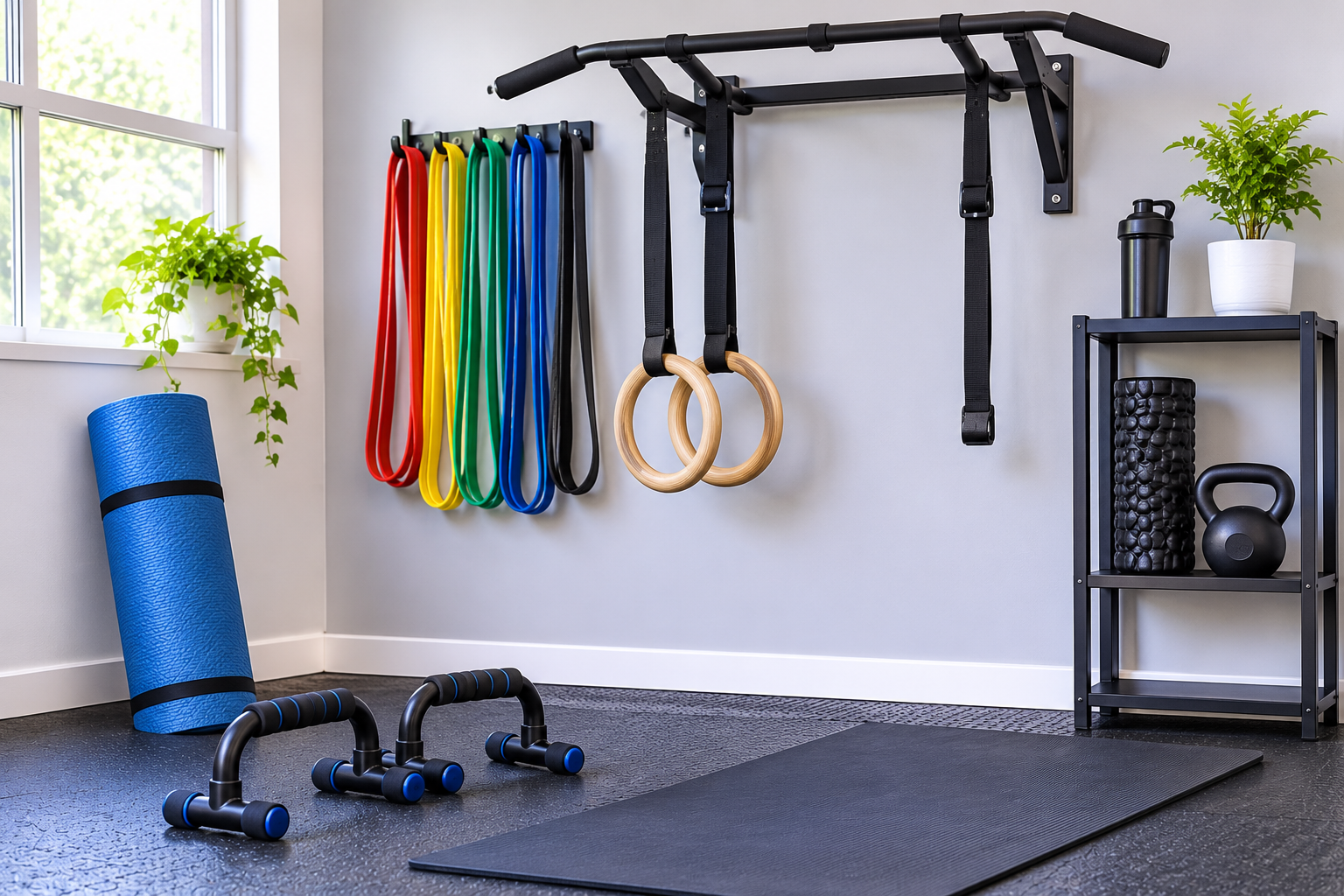
Bodyweight training is one of the most practical ways to build strength at home. You can train your chest, back, shoulders, arms, legs, and core without investing in a large collection of weight machines. However, the right bodyweight gym equipment can make workouts more versatile, help you progress to harder exercises, and provide better support during training.
The goal is not to buy every piece of equipment available. A pull-up bar, resistance bands, a stable workout surface, and a few carefully selected accessories can create a surprisingly capable home training space.
For most home workouts, start with a pull-up bar, resistance bands, exercise mat, and push-up handles. Add gymnastic rings or a dip station if you want more exercise options. Choose equipment based on your available space, current strength, and the exercises you plan to perform.
Best Bodyweight Gym Equipment for Home Workouts
1. Pull-Up Bar
A pull-up bar is one of the most useful pieces of bodyweight training equipment. It allows you to perform pull-ups, chin-ups, hanging knee raises, and other upper-body exercises that are difficult to replicate without dedicated equipment.
There are several common styles:
- Doorway pull-up bars: Compact options for people who want equipment that takes up little floor space.
- Wall-mounted pull-up bars: Fixed installations that can provide a more permanent training station when properly mounted.
- Power tower pull-up stations: Freestanding equipment that may also include dip handles and vertical knee-raise supports.
Check the manufacturer’s installation instructions, doorway or wall compatibility, and stated weight capacity. Never assume a doorway bar is suitable for every door frame.
2. Resistance Bands
Resistance bands are inexpensive, portable, and useful for both beginners and experienced exercisers. They can make certain bodyweight movements easier while adding resistance to exercises that have become too easy.
Common uses include:
- Assisted pull-ups and chin-ups.
- Band-assisted squats and mobility exercises.
- Glute bridges and lateral walks.
- Shoulder and upper-back accessory exercises.
- Progressive resistance for push-ups and other movements.
Consider a set with multiple resistance levels rather than relying on a single band. Inspect bands for cracks, tears, or signs of wear before each workout.
Shop Resistance Bands on Amazon
3. Exercise Mat
An exercise mat provides a more comfortable surface for floor-based movements. It is especially useful for planks, sit-ups, stretching, glute bridges, and mobility work.
When comparing mats, consider:
- Thickness: A thicker mat may provide more cushioning for floor exercises, while a thinner mat can offer a firmer feel.
- Grip: A surface that stays stable helps reduce unwanted movement during workouts.
- Size: Make sure the mat provides enough room for your normal exercise positions.
- Cleaning: Choose a material that is easy to wipe down and maintain.
4. Push-Up Handles
Push-up handles elevate your hands above the floor and provide a neutral-grip option for push-ups. They can also allow a greater range of motion for some users, depending on their mobility and technique.
Look for handles with a stable base, comfortable grips, and non-slip contact points. If you have wrist discomfort, handles may feel more comfortable than placing your palms flat on the floor, but they are not a substitute for addressing persistent pain.
Shop Push-Up Handles on Amazon
5. Gymnastic Rings
Gymnastic rings add variety to bodyweight workouts. They can be used for ring rows, assisted dips, push-ups, and more advanced movements as strength and control improve.
Because the rings move freely, exercises often require additional balance and stabilization. Beginners should start with easier variations and keep the rings at a height that allows controlled movement.
Before buying, check the strap adjustment system, attachment method, grip material, and stated load limits. Install them only on a suitable support structure.
Shop Gymnastic Rings on Amazon
6. Dip Station or Power Tower
A dip station or power tower can expand your upper-body training options. Depending on its design, it may support dips, knee raises, pull-ups, and other movements.
These products take up more space than resistance bands or push-up handles, so measure your training area before purchasing. Pay particular attention to the base footprint, stability, handle spacing, and maximum user weight.
For heavier users, stability and a clearly stated weight capacity should be priorities. Avoid choosing a station based only on its appearance or advertised exercise count.
7. Suspension Trainer
A suspension trainer uses adjustable straps and body positioning to change exercise difficulty. It can support rows, chest presses, squats, lunges, and core exercises.
Its main advantage is versatility: changing your body angle can make many movements easier or harder without adding traditional weights.
However, the anchor point matters. Follow the manufacturer’s instructions and use only a suitable, secure attachment point. Do not attach suspension equipment to an unverified door, railing, or weak support.
Shop Suspension Trainers on Amazon
8. Ab Wheel
An ab wheel is a compact tool for challenging the abdominal and core muscles. It is best suited to people who can maintain good trunk control during the movement.
Start with short, controlled rollouts from a kneeling position. Avoid extending farther than you can control, and do not allow your lower back to sag.
Bodyweight Gym Equipment Comparison
| Equipment | Best For | Space Needs | Priority |
| Pull-up bar | Back and upper body | Low to moderate | High |
| Resistance bands | Assistance and added resistance | Very low | High |
| Exercise mat | Floor exercises | Low when stored | High |
| Push-up handles | Push-ups and wrist positioning | Very low | Medium |
| Gymnastic rings | Rows and advanced variations | Low storage, anchor needed | Medium |
| Power tower | Pull-ups, dips, knee raises | High | Optional |
| Suspension trainer | Full-body adjustable workouts | Very low storage, anchor needed | Medium |
| Ab wheel | Core training | Very low | Optional |
Priority is a general buying guide, not a ranking of product quality. Your exercise goals and available space may change what you need.
How to Choose Bodyweight Training Equipment
Beginners may get more value from bands, a mat, and basic push-up equipment. Advanced users may benefit from rings, pull-up stations, and more challenging progressions.
Measure the floor area and available ceiling height. Also account for movement clearance around pull-up bars, rings, and freestanding stations.
For equipment that supports your body, verify the stated capacity and installation requirements. Leave an appropriate safety margin rather than buying at the limit.
Bands, mats, and rings are easy to store. Power towers and dip stations require dedicated floor space and a stable setup.
A Simple Bodyweight Gym Setup by Budget
Basic Setup: Start with the Essentials
- Resistance band set.
- Exercise mat.
- Push-up handles (optional).
This setup is suitable for basic floor exercises, squats, lunges, planks, and band-assisted movements. It is a practical starting point if you are not sure how much equipment you will use.
Intermediate Setup: Add Upper-Body Training
- Everything in the basic setup.
- A suitable pull-up bar.
- Gymnastic rings or a suspension trainer.
This combination offers more pulling exercises and additional ways to adjust exercise difficulty.
Advanced Setup: Build a Dedicated Training Station
- Pull-up and dip station or power tower.
- Gymnastic rings or suspension trainer.
- Resistance bands with multiple levels.
- Exercise mat and core-training accessories.
A larger setup makes sense when you have sufficient room and already follow a consistent training routine. Buy equipment gradually instead of filling your room with products you may rarely use.
Sample Full-Body Bodyweight Workout
The following is a simple example of how basic equipment can support a full-body session. Adjust the exercises and repetitions to your current ability, and prioritize controlled technique.
1. Bodyweight squats
2–3 sets of 8–15 repetitions
2. Incline or standard push-ups
2–3 sets of 6–12 repetitions
3. Resistance band rows
2–3 sets of 10–15 repetitions
4. Glute bridges
2–3 sets of 10–15 repetitions
5. Plank
2–3 sets of 15–30 seconds
6. Assisted pull-ups
2 sets of controlled repetitions, if you have a suitable pull-up bar and can perform the movement safely
Rest as needed between sets. These repetitions are examples rather than a personalized training prescription. Stop if an exercise causes pain, and choose an easier variation when you cannot maintain good form.
Common Bodyweight Equipment Buying Mistakes
- Buying too much too soon: Start with a few versatile items and expand when you know what your routine requires.
- Ignoring installation requirements: Pull-up bars, rings, and suspension trainers depend on secure and compatible attachment points.
- Overlooking weight limits: Check the stated capacity of equipment that supports your body, especially freestanding stations and handles.
- Choosing equipment that is too advanced: More challenging equipment is not automatically better for beginners.
- Forgetting workout clearance: A product may fit in a room but still leave insufficient space to use it safely.
Frequently Asked Questions
Resistance bands and an exercise mat are practical starting points. A pull-up bar can be a useful addition if it can be installed safely and matches your training needs.
Yes. Bodyweight exercises can support muscle development when the exercises provide an appropriate challenge and you gradually increase difficulty, volume, or resistance over time.
A pull-up bar provides useful upper-body pulling options, but it does not cover every movement pattern. Adding resistance bands and floor exercises creates a more balanced setup.
Resistance bands, an exercise mat, push-up handles, and a compact suspension trainer are space-efficient choices. Check whether you have a safe attachment point before buying equipment that hangs from a door or ceiling.
No. A power tower is useful for people who regularly perform pull-ups, dips, and knee raises, but many effective bodyweight workouts can be done with much simpler equipment.
It can be, but exercise selection and equipment capacity matter. Start with movements that match your current ability, use stable support where needed, and check the manufacturer’s weight limits before using pull-up bars, rings, or freestanding stations.
Final Verdict: Build Your Bodyweight Gym One Piece at a Time
The best bodyweight gym equipment is the equipment you can use consistently and safely. For most people, resistance bands, an exercise mat, and a suitable pull-up bar provide a strong foundation. Push-up handles, rings, suspension trainers, and power towers can expand your options as your training develops.
Rather than buying a complete setup immediately, start with the exercises you want to perform, measure your available space, and choose equipment that supports your next stage of progress.
As an Amazon Associate, HeavyDutyChoice earns from qualifying purchases.