Toilet Seat Measuring Guide
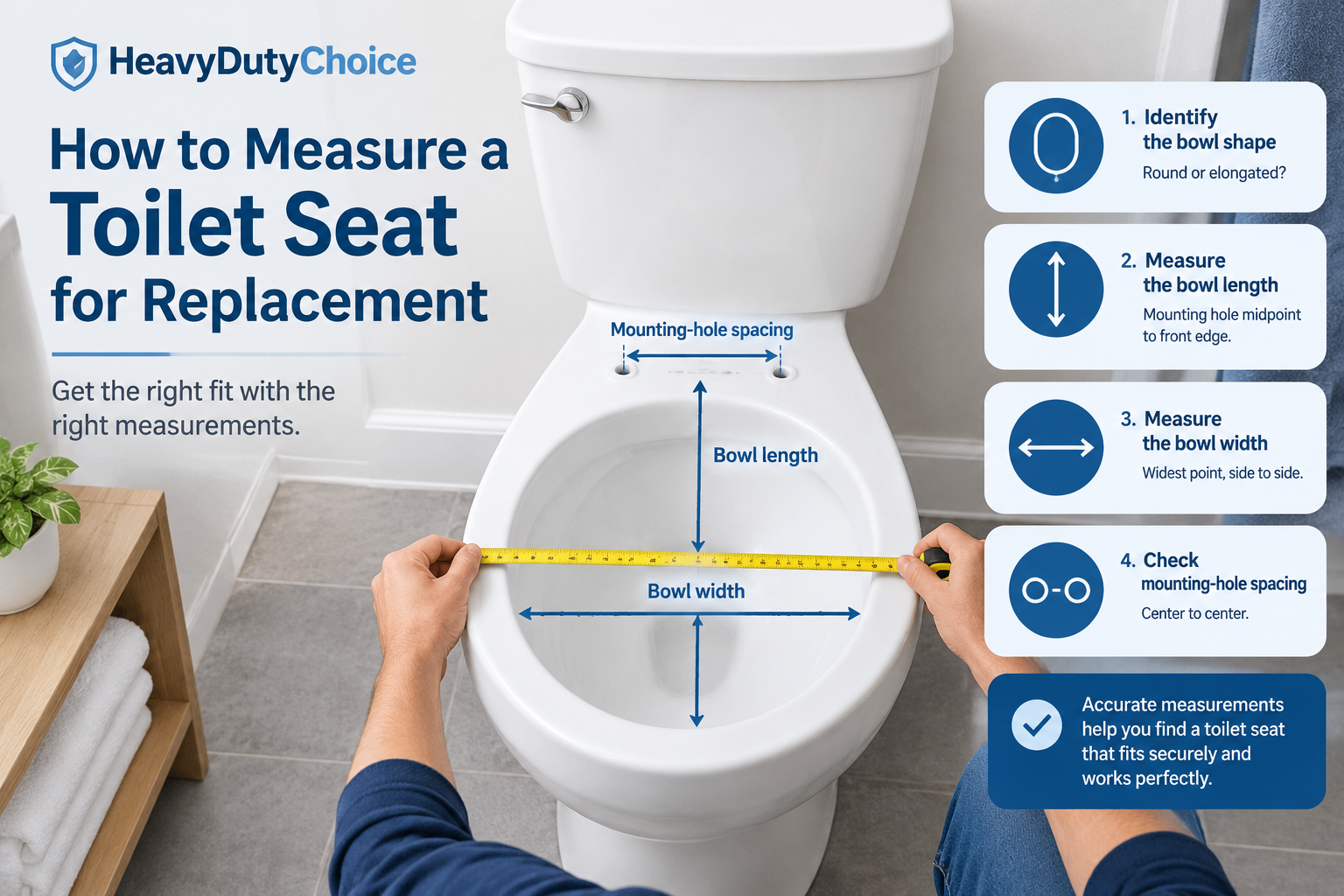
To measure a toilet seat for replacement, identify the bowl shape, measure from the mounting-hole area to the front edge, check the bowl’s width, and measure the distance between the mounting holes. These measurements help you find a seat that fits securely without guessing from product photos.
How to Measure a Toilet Seat: Quick Steps
- Raise or remove the existing seat if it makes the mounting holes difficult to access.
- Identify whether the toilet bowl is round or elongated.
- Measure from the center of the mounting holes to the front edge of the bowl.
- Measure the bowl’s widest point from side to side.
- Measure the distance between the centers of the two mounting holes.
- Compare your measurements with the replacement seat manufacturer’s fit guide.
Use a tape measure or ruler and record the measurements in inches or millimeters. Keep the units consistent when comparing products.
Before You Start
- Tape measure or ruler
- Paper or phone to record measurements
- Good lighting around the mounting area
- The toilet or seat manufacturer’s compatibility information, if available
Step 1: Identify Round vs. Elongated Toilet Bowls
The first step is to determine the general shape of your toilet bowl. Most residential toilet seats are designed for either round or elongated bowls, although some toilets use proprietary or model-specific shapes.
Round Toilet Bowl
A round bowl has a more compact front-to-back profile. It is common in bathrooms where saving space is useful. Measure the actual bowl rather than assuming its dimensions from appearance.
Elongated Toilet Bowl
An elongated bowl extends farther toward the front. It typically uses a longer seat than a round bowl. Confirm the fit using measurements and the manufacturer’s compatibility guide.
Important: Round and elongated seats are not automatically interchangeable. A seat with the wrong shape may overhang the bowl, leave part of the rim exposed, or fail to align correctly with the mounting points.
Step 2: Measure the Bowl Length
For the most useful length measurement, locate the centers of the two seat-mounting holes near the back of the bowl. Measure in a straight line from the midpoint between those holes to the frontmost edge of the ceramic bowl.
- Find the two mounting holes at the back of the bowl.
- Identify the midpoint between the centers of the holes.
- Extend the tape measure from that midpoint to the front edge of the bowl.
- Record the measurement and the unit used.
Use the ceramic bowl’s front edge as the reference point—not the front edge of the existing seat, which may not fit correctly or may have a different profile.
Measuring tip: Product listings sometimes publish seat length rather than bowl length. These measurements may use different reference points. Compare your measurement with the diagram or fit instructions provided by the manufacturer instead of relying on a single generic number.
Step 3: Measure the Bowl Width
Measure across the widest part of the ceramic bowl, from the outside edge on one side to the outside edge on the other. Keep the tape measure straight and level across the bowl.
Use this measurement as a compatibility check. The width of the ceramic bowl is not necessarily identical to the overall width of the seat, so check the product drawing for the exact dimensions the manufacturer publishes.
For unusual bowl shapes, check the toilet manufacturer’s model number and recommended replacement seats. A seat that is close in width may still have the wrong contour or hinge position.
Step 4: Measure the Mounting-Hole Spacing
Mounting-hole spacing is the distance between the centers of the two holes where the seat attaches to the toilet. This measurement helps determine whether the seat’s hinges and mounting hardware can align with your toilet.
- Locate both mounting holes.
- Measure from the center of one hole to the center of the other.
- Record the result, including whether you measured in inches or millimeters.
- Compare it with the seat manufacturer’s mounting range or compatibility details.
Some replacement seats use adjustable mounting hardware, but adjustment ranges vary. Do not assume that a seat will fit just because its length and width appear correct.
Step 5: Check the Hinge and Mounting Area
Before ordering, inspect the back of the toilet bowl and the existing seat hardware. Look for limited clearance, unusual mounting arrangements, concealed fasteners, or a shape that may require a model-specific replacement.
- Check whether the existing seat uses top-mounted or other specialized hardware.
- Look for the toilet manufacturer’s name and model number if available.
- Review the new seat’s installation instructions and included hardware.
- Check whether the seat can open fully without hitting a wall, tank, or nearby fixture.
If you are replacing a seat because the hinges are loose or the seat shifts, inspect the mounting points and ceramic bowl for damage. A new seat cannot correct damaged toilet mounting points.
Toilet Seat Measurement Checklist
- ☐ Bowl shape: round, elongated, or model-specific
- ☐ Bowl length: mounting-hole midpoint to front edge
- ☐ Bowl width: widest point from side to side
- ☐ Mounting-hole spacing: center to center
- ☐ Mounting hardware and hinge clearance
- ☐ Manufacturer’s compatibility and installation instructions
How to Choose a Replacement Toilet Seat After Measuring
For a Heavy-Duty Toilet Seat
If you need a seat designed for a higher weight capacity, do not rely on dimensions alone. Verify the manufacturer’s published rating for the exact model, the mounting hardware, and any restrictions on compatible toilets.
Start with our best heavy-duty toilet seats guide to compare the key factors before buying.
For a Padded Toilet Seat
After confirming the bowl shape and measurements, compare the cushion material, covering, cleaning instructions, and mounting stability. Padding can change the seat’s profile, so inspect the product dimensions carefully.
See our padded toilet seats guide for more selection tips.
For a Soft-Close Toilet Seat
Confirm the bowl fit first, then check whether the exact model includes a soft-close mechanism. Also review the hinge design, installation instructions, and any model-specific compatibility requirements.
Read our best soft-close toilet seats guide for more details.
For a Raised Toilet Seat with Handles
Raised seats and support frames require additional checks beyond standard seat measurements. Review the product’s toilet compatibility, attachment method, height, stability, and published weight rating. If you are selecting equipment for someone with mobility limitations, prioritize a suitable and secure support design.
Explore our raised toilet seats with handles guide.
Common Toilet Seat Measuring Mistakes
- Measuring the old seat instead of the bowl: The old seat may be the wrong size or shape.
- Measuring length from the wrong point: Use the mounting-hole midpoint as the reference and compare it with the manufacturer’s diagram.
- Measuring hole spacing from edge to edge: The relevant measurement is normally center to center.
- Assuming every elongated seat fits: Hinge positions, contours, and mounting ranges can differ.
- Ignoring the toilet model: Some toilets require a specifically compatible seat.
- Assuming dimensions establish weight capacity: Load ratings must come from the manufacturer’s documentation.
Frequently Asked Questions
How do I know if my toilet seat is round or elongated?
Look at the bowl’s overall shape and measure from the midpoint between the mounting holes to the front edge of the ceramic bowl. Compare the result with the toilet or replacement seat manufacturer’s fit guide. If the bowl has an unusual shape, use the toilet model number to confirm compatibility.
What measurements do I need to replace a toilet seat?
Start with bowl length, widest bowl width, and mounting-hole spacing measured center to center. Also identify the bowl shape and check the mounting hardware. The replacement manufacturer’s compatibility guide determines which measurements are relevant for that model.
Are toilet seat sizes universal?
No. Although many seats follow common round or elongated designs, dimensions, hinge positions, and mounting systems vary. Always verify compatibility before purchasing a replacement.
Should I measure the old seat or the toilet bowl?
Measure the ceramic bowl and mounting points. An old seat can be useful for identifying the general style, but it may be worn, incorrectly sized, or designed for a different toilet.
Can I install a replacement seat if the mounting holes are loose or damaged?
First inspect the mounting hardware and ceramic around the holes. Replace worn hardware only if the toilet and seat instructions allow it. If the ceramic is cracked or damaged, do not rely on tightening the seat to solve the problem; have the toilet assessed before use.
Final Checklist Before Ordering
Before buying a replacement toilet seat, make sure you have identified the bowl shape, measured the bowl length and width, checked the mounting-hole spacing, and confirmed hardware compatibility. Then compare the features you actually need, such as padding, soft-close hinges, or a higher published weight rating.
For more options, visit our Toilet Seats buying guide.
Affiliate disclosure: As an Amazon Associate, this site may earn from qualifying purchases. Product compatibility and specifications can vary by model. Verify the manufacturer’s measurements and installation instructions before purchasing.