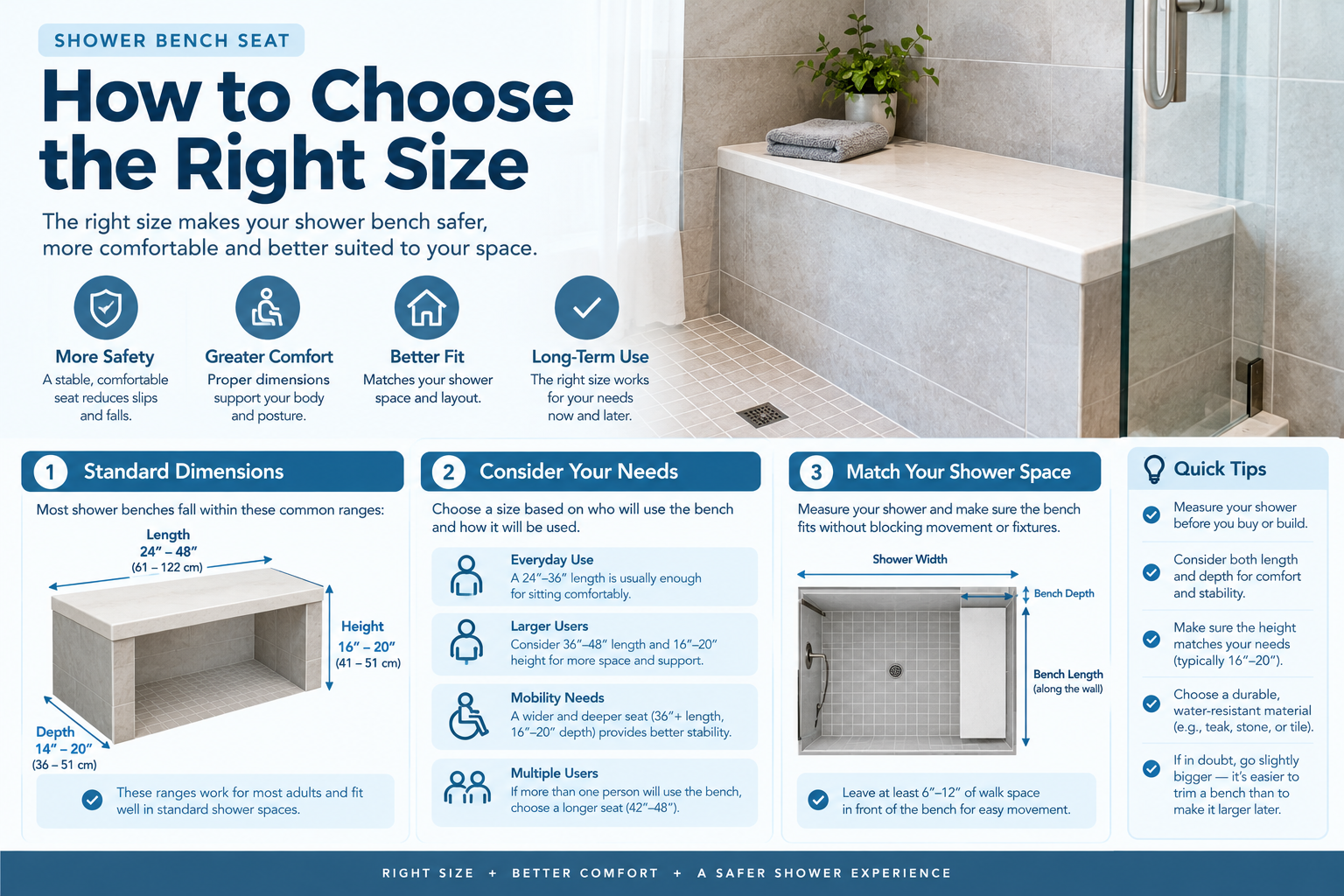
Shower Bench Size Guide
Choose a Shower Bench Seat That Fits Your Space
Choosing a shower bench seat involves more than finding a product that fits inside your shower. The seat needs enough room for comfortable sitting, an appropriate height for the intended user, and a footprint that does not obstruct entry or movement.
This guide explains how to measure your bathroom, compare seat width and depth, choose a suitable height, and decide whether a rectangular bench, corner seat, or transfer bench is the better option.
Quick Navigation
How to Measure Your Shower Before Buying a Bench
Start by measuring the usable space where you intend to place the bench. Do not rely solely on the advertised width of the shower enclosure. The drain, shower door, controls, fixtures, and entry path can all affect where a bench can safely sit.
Measure These Four Areas
- Available width: Measure the usable distance between walls or other obstructions.
- Available depth: Determine how far the bench can extend into the shower without blocking movement.
- Entry clearance: Check the door opening and the space needed to enter and exit.
- Floor conditions: Identify sloped areas, uneven surfaces, and the location of the drain.
Next, compare your measurements with the product’s full dimensions. The overall footprint may be larger than the sitting surface because of the legs, frame, arms, backrest, or lower shelf.
A useful practical step is to mark the proposed footprint on the floor with removable tape. Check whether the marked area leaves enough room to move and operate the shower normally. This is a planning aid, not a substitute for checking the bench’s stability and suitability.
Shower Bench Seat Width and Depth
Seat dimensions affect comfort, usable space, and how easily someone can sit down or stand up. When comparing a shower bench seat, look for the actual sitting-surface measurements rather than relying only on the product’s overall width and depth.
Seat Width
Seat width determines how much horizontal room is available for sitting. A narrow seat may take up less shower space, but it may not offer enough room for the intended user. A wider seat can provide more space, yet its frame may make it difficult to fit in a compact enclosure.
Before buying, confirm whether the listed width refers to the seat itself or the entire bench. If the product has arms, check the usable width between them as well.
Seat Depth
Seat depth is the distance from the front of the sitting surface to the back. A deeper seat may provide more sitting area, but it also occupies more space in the shower. A shallow seat can preserve clearance but may not suit every user.
Consider the user’s sitting posture, the location of the backrest if present, and whether the seat leaves adequate room for getting on and off. Do not choose depth based on the shower dimensions alone.
Overall Footprint
The footprint includes all parts of the bench that occupy floor space. Legs may extend beyond the seat, and shelves or frames may project outward. For a corner bench, compare both sides of the corner and the actual shape of the base.
For a wood seat, see our Best Teak Shower Benches guide to compare compact, corner, and longer designs.
How to Choose the Right Shower Bench Seat Height
Seat height affects how easily a person can sit down and stand up. A seat that is too low may make standing difficult, while a seat that is too high may prevent the feet from resting securely on the floor.
Consider these factors when choosing height:
- User height and leg length: Different users may need different seat heights.
- Foot support: Consider whether the user’s feet can rest securely on the floor while seated.
- Ability to stand: The user’s mobility and balance can affect the appropriate seat height.
- Adjustment range: For adjustable benches, check the minimum and maximum seat height and how securely each setting locks.
- Measurement method: Confirm whether the manufacturer’s listed height refers to the seat surface or the overall product.
There is no single seat height that is ideal for every person. Measure the actual product and consider the intended user’s needs before purchasing.
For a more detailed discussion, read How High Should a Shower Bench Be?
Which Shower Bench Shape Fits Your Bathroom?
Rectangular Shower Benches
A rectangular bench provides a conventional sitting surface and is available in different lengths and depths. It may be suitable for a walk-in shower with enough clear floor space along a wall. Check that the legs sit securely and that the bench does not obstruct entry or access to the controls.
Corner Shower Benches
A corner bench is designed to fit into a shower corner. This layout can preserve some of the central floor area, but the corner’s dimensions must match the seat. Check both the seat shape and the space occupied by the legs or supporting frame.
Fold-Down or Built-In Benches
A fold-down bench may free up floor space when folded away, while a built-in bench is incorporated into the shower structure. These designs require careful attention to mounting, support, waterproofing, and the manufacturer’s installation requirements. Do not assume a wall or shower panel can support a seat without suitable structural reinforcement.
Shower Transfer Benches
A transfer bench serves a different purpose from a regular shower bench. It is designed to extend across the side of a bathtub to assist with entering and exiting. If you need this type of equipment, compare the bathtub’s width and wall configuration with the transfer bench’s specified dimensions.
Read our Best Shower Transfer Benches guide for more information.
Do You Need a Backrest or Armrests?
A backrest or armrests may provide additional support, depending on the user’s needs and the product design. These features also increase the bench’s overall dimensions and can affect how a person gets onto or off the seat.
- Backrest: Consider whether the user needs support behind the back while seated.
- Armrests: Check whether they help the user sit down or stand up and whether they leave sufficient room for access.
- Open-sided designs: These may provide easier access from the side, but suitability depends on the user’s mobility and the bench’s intended use.
- Structural support: Verify the manufacturer’s instructions and weight capacity rather than assuming a backrest or arms make the bench safer.
If the bench is intended for someone with significant balance or mobility difficulties, consider seeking advice from an occupational therapist or another appropriate healthcare professional before choosing equipment.
Shower Bench Seat Buying Checklist
Before ordering, use this checklist to compare the product listing with your measurements and requirements.
- Measure the available shower width and depth.
- Check the seat width and depth, not just the overall dimensions.
- Confirm the seat height and adjustment range, if applicable.
- Verify the manufacturer’s published weight capacity.
- Check the feet, frame, fasteners, and stability features.
- Make sure the bench does not block the door, drain, controls, or normal movement.
- Review cleaning, drying, assembly, and maintenance instructions.
- Confirm the return policy in case the product does not fit as expected.
Safety reminder
A bench that fits the shower is not necessarily suitable for every user. Always follow the manufacturer’s instructions, confirm the weight rating, and check that the bench is stable before use. A standard shower bench should not be used as a transfer aid unless it is specifically designed for that purpose.
Frequently Asked Questions
How wide should a shower bench seat be?
The appropriate width depends on the user’s needs and the space available. Compare the actual sitting-surface width with the overall footprint, and check the usable space between the arms if the bench has them. There is no universal width that fits every person and shower.
How deep should a shower bench seat be?
Choose a depth that provides suitable sitting space without obstructing movement in the shower. Consider the user’s sitting posture and whether the bench has a backrest. Always compare the seat depth and overall product depth separately.
Can I use a regular shower bench in a bathtub?
Only if the product is designed for that placement and can be positioned securely according to its instructions. A standard freestanding bench is not automatically suitable for sitting inside a bathtub or spanning its walls. For bathtub entry and exit, consider a purpose-built transfer bench.
Is a corner shower bench better for a small shower?
A corner design may preserve more central floor space, but it still needs adequate room for sitting and safe access. Measure the corner and the product’s complete footprint before buying.
Should I choose an adjustable shower bench?
An adjustable model can help accommodate different seat-height requirements. Check its adjustment range, locking mechanism, stability, and weight capacity. Adjustability does not automatically mean that the bench is suitable for every user.
Final Thoughts
Choosing the right shower bench seat starts with accurate measurements. Compare the available space with the seat width, depth, overall footprint, and height. Then consider whether a rectangular, corner, fold-down, built-in, or transfer design best matches your bathroom and intended use.
Before purchasing, verify the exact product dimensions, published weight capacity, stability features, and care instructions. Taking a few minutes to measure and compare can help you avoid buying a bench that is too large, too small, or unsuitable for your needs.
Explore More Shower Bench Guides
Disclosure: As an Amazon Associate, HeavyDutyChoice may earn from qualifying purchases. Product specifications and availability may change. Always check the manufacturer’s current dimensions, weight capacity, and instructions before purchasing.