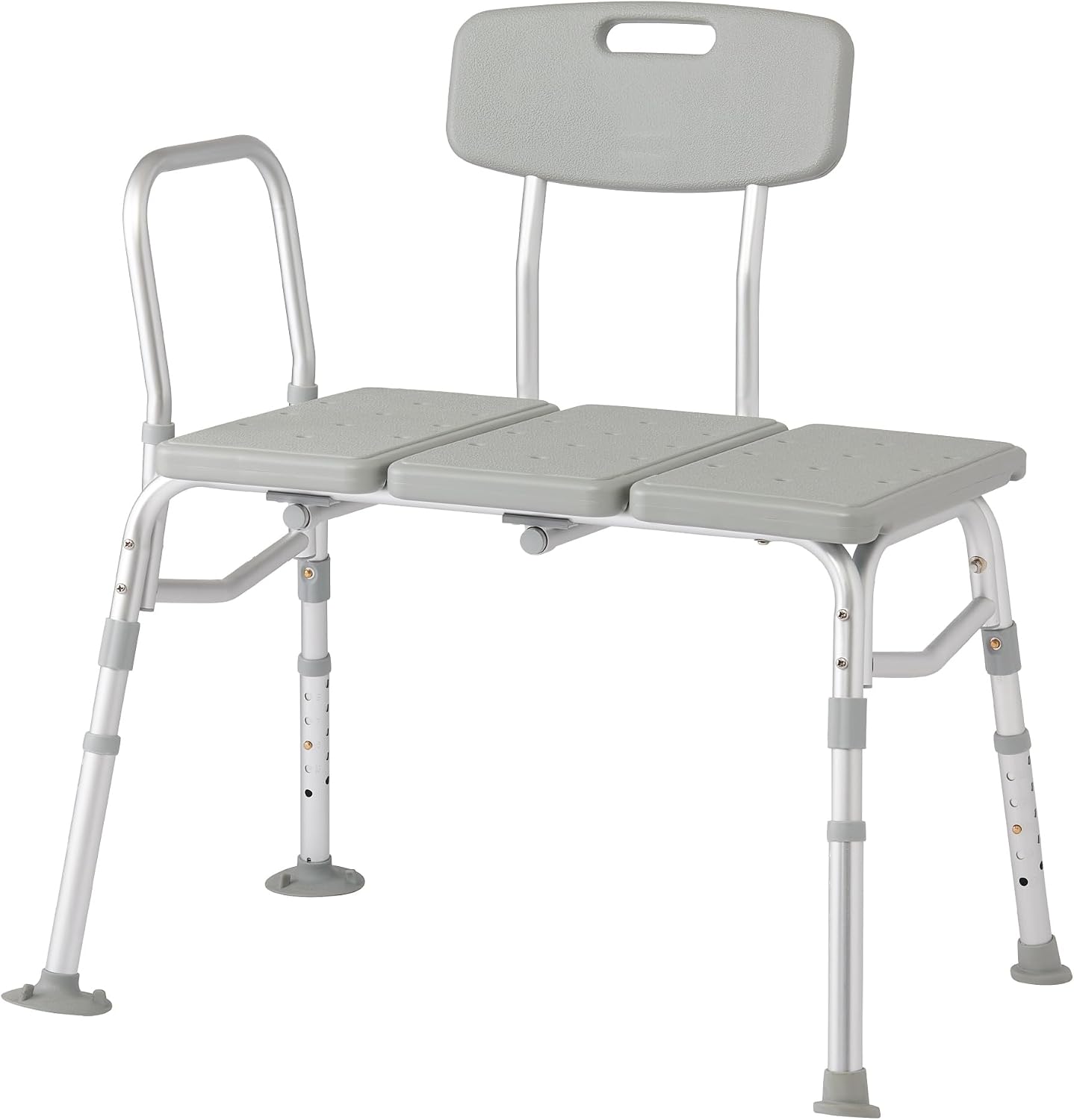
Shower Transfer Bench Buying Guide
A shower transfer bench can help make bathtub entry easier by allowing the user to sit down first and move across the tub edge while seated.
The best shower transfer bench for your bathroom depends on the tub’s dimensions, the user’s mobility, the seat height, and the required weight capacity. Compare the frame, feet, seat design, and installation requirements before choosing a model.
A traditional shower chair sits entirely inside the shower or bathtub. A transfer bench is different: part of the seat remains outside the tub, allowing the user to sit down before moving across the tub wall. This design may be useful for people who have difficulty stepping over the edge of a bathtub.
However, not every transfer bench fits every tub, and a bench alone does not eliminate fall risk. This guide compares five shower transfer bench options and explains what to measure before buying.
Before you buy
- Measure the tub’s inside width, outside width, height, and flat bottom area.
- Check the bench’s seat-height range and overall footprint.
- Choose a published weight capacity appropriate for the intended user.
- Confirm whether the backrest and armrest can be installed on the required side.
- Follow the manufacturer’s assembly and safety instructions before use.
Best Shower Transfer Benches to Compare
The options below cover different needs, including a standard adjustable bench, a heavy-duty design, and a sliding bench for users who need additional help moving across the tub edge. These are comparison candidates, not hands-on test rankings.
1. HOMLAND BC4 Classic Tub Transfer Bench
Best for: Shoppers comparing an adjustable transfer bench with a reversible backrest.
The HOMLAND BC4 is designed to span the bathtub edge. Its adjustable legs and reversible backrest can help accommodate different bathroom layouts, subject to the model’s dimensions and the tub’s available space.
- Published weight capacity: 400 lb
- Seat height adjustment: 17.5–22.5 inches, according to the manufacturer’s product information
- Seat dimensions: Confirm the current listing and manual before purchase; the manufacturer page contains differing dimension descriptions in its product content.
- What to check: Minimum flat tub-bottom width, leg placement, backrest direction, and secure assembly.
Measure the tub carefully. A bench that spans the tub may still be unsuitable if its legs cannot rest on stable surfaces.
2. Drive Medical Transfer Tub Bench — Model 12011KD-2
Best for: Shoppers looking for a conventional transfer bench with adjustable legs.
Drive Medical’s standard transfer bench uses an A-frame design and a plastic seat and backrest. The manufacturer’s catalog lists tool-free assembly, reversible setup, and height adjustment in half-inch increments.
- Published weight capacity: 400 lb
- Published seat-height range: 17.5–22.5 inches for the standard transfer-bench configuration listed in the manufacturer’s catalog
- Design: Plastic seat and backrest with adjustable legs
- What to check: Exact model number, tub fit, leg adjustment, and the current listing’s included components.
Drive Medical sells multiple transfer-bench configurations. Confirm that the model number on the product page matches the specifications you need.
3. Drive Medical Bariatric Transfer Bench — Model 12025KD-1
Best for: Shoppers who need a higher published weight capacity.
This heavy-duty model is designed for users who need a transfer bench rated for a higher load than many standard models. The manufacturer lists an A-frame structure, reversible design, adjustable legs, and large locking suction cups on two legs.
- Published weight capacity: 500 lb
- Seat dimensions: 26.5 × 16.5 inches
- Published seat-height range: 18.5–23.5 inches, as listed for the manufacturer’s retail model
- What to check: Tub width, leg placement, floor stability, and the exact model’s height range.
A higher weight rating does not automatically mean a better fit. Confirm the user’s needs and the bathroom’s dimensions, and never exceed the stated capacity.
4. Drive Medical Folding Universal Sliding Transfer Bench
Best for: Shoppers who want a sliding seat and a bench that folds for storage.
Unlike a conventional fixed-seat transfer bench, this model slides along its frame to help the user move across the tub edge while seated. The manufacturer also lists a folding design, seat belt, removable soap dish, and a safety net for dropped items.
- Published weight capacity: 300 lb
- Published seat-height range: 21–25 inches
- Published seat dimensions: 22.5 × 18.5 inches
- What to check: Overall frame length, clearance around the tub, sliding mechanism, and storage space.
Sliding features can help with some transfers, but the user must still be able to follow the device’s operating instructions safely. A caregiver or professional may need to assess suitability.
5. Drive Medical Padded Transfer Bench — Model 12005KD-1
Best for: Shoppers who prefer a padded seat surface.
Drive Medical’s padded transfer-bench option is an alternative to a hard plastic seat. It may be worth comparing for users who prioritize the feel of the seating surface, provided the padding and seat dimensions suit the intended bathroom and cleaning routine.
- Published weight capacity: 400 lb in the manufacturer’s transfer-bench comparison chart
- Published seat dimensions: 24 × 16 inches in the comparison chart
- Published seat-height range: 17.75–21.75 inches in the comparison chart
- What to check: Current model availability, padded surface care, seat-height range, and exact dimensions.
Verify the model number and specifications on the current seller page before purchasing; similar-looking models may have different dimensions or components.
Product specifications are based on manufacturer product pages and catalogs where available. Listings, model configurations, and availability may change. Verify the current product details before purchasing. This article does not claim hands-on testing.
How to Choose the Right Shower Transfer Bench
1. Measure the bathtub first
A transfer bench must span the tub edge while allowing its legs to rest securely on appropriate surfaces. Measure the tub’s height, inside width, outside width, and flat bottom area. Also check whether the tub surround, sliding doors, glass panels, or nearby fixtures interfere with the frame.
Do not assume that a product advertised as universal will fit every bathtub. Follow the manufacturer’s minimum clearance and installation requirements.
2. Check the seat-height range
Adjustable legs can help match the bench to the user’s needs and the tub’s layout. Compare the actual seat-height range with the user’s sitting position, and make sure every leg can be set and locked as instructed.
For a more detailed explanation of seat measurements, see our Shower Bench Height Guide.
3. Choose an appropriate weight capacity
Compare the stated capacity of the exact model with the intended user’s needs. Do not use a product above its rated capacity or assume that a wider seat necessarily supports more weight.
If a user needs additional space, compare the usable seat dimensions as well as the published capacity. A suitable fit requires both.
4. Decide whether a sliding seat is necessary
A standard transfer bench provides a stationary seat across the tub edge. A sliding model moves along a frame and may help some users who have difficulty repositioning themselves while seated.
Sliding mechanisms introduce additional parts and operating steps. Consider whether the user can operate the mechanism safely and whether assistance is required.
5. Look at the feet, frame, and assembly
Inspect the frame design, leg locks, rubber feet, suction components, and joints. Suction cups only help when used as instructed on suitable surfaces; they should not be treated as a substitute for proper assembly and stable placement.
Follow the manufacturer’s instructions for positioning the bench and checking its stability. Do not use a bench that rocks, slides, or has damaged components.
6. Consider backrests and armrests
A backrest can provide support while sitting, while armrests may assist some users with repositioning. However, these features can affect the bench’s overall width, transfer method, and fit around the tub.
Confirm which components are included and whether they can be positioned appropriately for the bathroom. Do not assume that all models offer the same configuration.
Shower Transfer Bench vs. Shower Chair
A standard shower chair is designed to sit within the shower area. A transfer bench extends across the tub edge, so the user can sit before moving into the bathing area.
A shower chair may be worth considering when:
- The shower is a walk-in design with no high tub wall to cross.
- The user can enter the bathing area safely using their established method.
- The chair fits securely within the shower footprint.
A transfer bench may be worth considering when:
- The bathroom has a bathtub with a side wall that is difficult to step over.
- Sitting down before moving across the tub edge is more practical for the user.
- The tub and bathroom have enough clearance for the full bench frame.
For a more detailed comparison, read Shower Chair vs. Transfer Bench: Which Do You Need?.
Safety Checklist Before Use
- Confirm that the bench is assembled according to the manual.
- Set all legs to the required height and verify that adjustment pins or locks are secure.
- Make sure the feet rest on stable surfaces and that the bench is not rocking.
- Check that the seat and frame are within the manufacturer’s weight and use limits.
- Keep soap, towels, and shower controls within appropriate reach to reduce unsafe leaning.
- Use the prescribed transfer method and get assistance when necessary.
- Stop using the bench if it becomes unstable, cracked, or damaged.
A transfer bench is not a guarantee against falls. If the intended user has significant balance problems, difficulty following transfer steps, or needs physical assistance, ask a qualified healthcare professional or occupational therapist to assess the bathroom setup and appropriate transfer equipment.
Frequently Asked Questions
What is the difference between a transfer bench and a transfer chair?
Terminology varies by manufacturer. A transfer bench generally spans the tub edge and provides a seat for moving into or out of the tub while seated. Check the product’s actual design and instructions rather than relying on its name alone.
Will a transfer bench fit any bathtub?
No. Tub height, width, bottom surface, doors, and nearby fixtures can all affect fit. Measure the bathroom and compare those measurements with the manufacturer’s specifications before ordering.
Are shower transfer benches adjustable?
Many standard models have adjustable legs, while some sliding models have their own height ranges. Verify the exact product’s seat-height specifications and adjustment instructions.
Is a sliding transfer bench safer than a standard bench?
Not for every user. A sliding model may make certain movements easier, but suitability depends on the user’s abilities, the tub layout, and the correct use of the mechanism. Professional assessment may be appropriate when transfers are difficult.
What weight capacity should I choose?
Choose a model whose stated capacity is suitable for the intended user and follow all manufacturer limits. Also check seat width, frame dimensions, and the bathroom fit rather than selecting by capacity alone.
Explore More Shower Bench Guides
Compare sizes, materials, and bathroom layouts to find a suitable bathing seat.
Affiliate disclosure: As an Amazon Associate, this site may earn from qualifying purchases. Product specifications and availability can change, so confirm the current listing and manufacturer’s instructions before buying. This guide is informational and is not a substitute for an individualized safety assessment.