Choosing a Shower Chair for Assisted Bathing
A handicap shower chair can make bathing more manageable for people who have difficulty standing, maintaining balance, or moving safely in a wet bathroom. The right chair may provide a seated bathing position, back support, armrests, adjustable height, and non-slip feet.
However, not every shower chair is suitable for every mobility need. This guide compares accessible bathing seats by support features, weight capacity, seat dimensions, adjustability, and transfer requirements so you can narrow down the options before buying.
Safety note: A shower chair can provide a place to sit, but it does not automatically make a bathroom safe for every person. If the user cannot sit securely, needs substantial assistance to transfer, or cannot follow the chair’s instructions, consider an appropriate transfer bench or specialized bathing equipment and seek individualized guidance.
What Is a Handicap Shower Chair?
The term “handicap shower chair” is commonly used when searching for seating that helps people with disabilities or limited mobility bathe while seated. Products range from simple height-adjustable stools to chairs with backrests and armrests, as well as specialized wheeled shower chairs.
The best choice depends on the user’s needs rather than the product label. Someone who can walk into a shower but struggles to stand for several minutes may need a different chair from someone who requires help moving across a bathtub edge.
Back Support
A backrest may provide support while seated, depending on the user’s balance and positioning needs.
Armrests
Armrests can provide a place to hold when sitting down or standing up, when appropriate for the user.
Adjustable Height
Adjustable legs help match the seat to the user’s needs and the bathroom layout.
Non-Slip Feet
Suitable feet help the chair remain in place when installed correctly on a compatible surface.
For a broader overview of standard bathing seats, visit our Shower Chairs buying guide. This article focuses more specifically on support and accessibility considerations.
Handicap Shower Chairs Worth Comparing
The following products offer different combinations of seat support, adjustability, and frame design. They are comparison candidates, not products ranked through hands-on testing. Confirm the exact model, current specifications, and bathroom compatibility before buying.
1. Drive Medical Shower Chair with Back and Removable Padded Arms (12445KD-1)
Published weight capacity: 350 lb
Published width between arms: 18.5 inches
This model combines a backrest with removable padded armrests. The molded seat and back include drainage features, while the aluminum frame is designed to be lightweight and corrosion-resistant. Leg height adjusts in 1-inch increments.
The removable arms can be useful when evaluating different support preferences, but the correct configuration depends on the user’s ability to sit and transfer. Removing the armrests should not be treated as a substitute for a transfer aid when one is needed.
Consider it if: You want a conventional shower chair with a backrest, removable padded armrests, and a published 350 lb capacity.
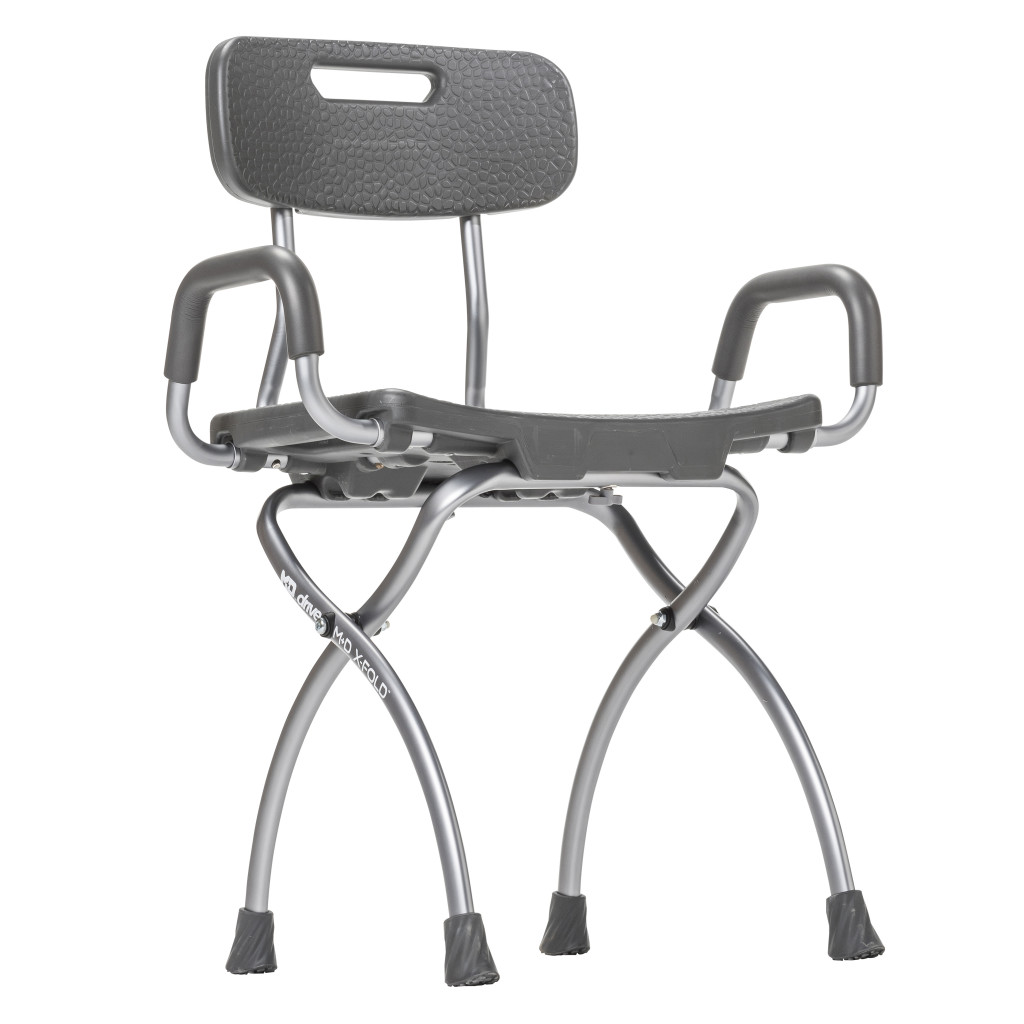
2. Drive Medical MD by Drive X-Fold Shower Chair (MD50100GR)
Published weight capacity: 300 lb
Published seat width: 19.7 inches
Seat-height settings: 18, 20, and 21 inches
The X-Fold is a configurable design that can be used as a stool, bench, or full chair with a removable backrest and armrests. Its wide seat may be worth considering for users who want more seating room than some conventional compact shower chairs provide.
The manufacturer describes angled anti-slip feet with water-dispersing treads and a tool-free height-adjustment mechanism. Its three preset heights are not the same as a continuously adjustable seat, so check whether one of the available settings fits the user’s needs.
Consider it if: You want a configurable shower seat with a wider seat and three preset height options.
3. Drive Medical Premium Series Shower Chair with Back and Arms (RTL12505)
Published seat dimensions: 21.75 inches wide × 16.5 inches deep
Published weight capacity: 350 lb
This chair has a wider molded seat, a backrest, and removable arms. Its legs, back, and arms can be removed without tools according to the manufacturer, and the height can be adjusted in half-inch increments.
The larger seat may be useful for shoppers who need to compare seating dimensions carefully. However, a wider seat also requires enough room in the shower, and the user’s weight must remain within the product’s published limit.
Consider it if: You want a conventional chair with back and arm support, a wide seat, and finer height adjustments.
4. Medline Shower Chair with Arms
Published weight capacity: 350 lb for listed models
Published seat-height range: 16–21 inches for the listed MDS89745RAH model
Medline offers shower chair models with armrests and height-adjustable legs. The listed MDS89745RAH model provides another conventional chair configuration to compare against Drive Medical products.
Medline has several shower chair variants with different seat dimensions, colors, and features. Confirm the exact item number and its current specification sheet rather than assuming that every model shares the same capacity or adjustment range.
Consider it if: You want to compare a conventional adjustable shower chair with armrests from another established bath-safety supplier.
Product note: Specifications above refer to the named models or listed variants. Retail listings may contain similar names for different versions. Verify the exact item number, current manufacturer documentation, and fit before purchasing.
How to Choose a Shower Chair for Limited Mobility
1. Decide Whether the User Needs a Chair or a Transfer Bench
This is the most important first step. A shower chair provides a seated place to bathe inside the shower or tub. A transfer bench spans the side of a bathtub so a person can sit outside the tub and move across the seat, instead of stepping over the tub wall while standing.
If getting into or out of the bathtub is the main difficulty, a standard shower chair may not solve the problem. Read our Best Shower Transfer Benches guide to compare transfer-focused options.
2. Compare Armrests and Back Support
Armrests can provide a place to hold when sitting down or standing up, while a backrest may provide support when seated. Their usefulness depends on the user’s strength, balance, movement, and transfer technique.
Check whether the arms are fixed, padded, removable, or designed to move out of the way. Also confirm the usable width between the armrests, because the overall seat width does not tell you how much room is available between them.
For a closer comparison of armrest configurations, see our Best Shower Chairs with Arms guide.
3. Check the Weight Capacity
The chair’s stated weight capacity must meet the user’s needs. Do not assume that a chair with thicker legs or a wider seat automatically supports more weight.
For example, the Drive Medical 12445KD-1 and RTL12505 models are listed at 350 lb, while the MD by Drive X-Fold is listed at 300 lb. These ratings apply to those specific models and should not be generalized to other chairs from the same manufacturer.
If you need a higher weight rating, review our Best Heavy-Duty Shower Chairs guide. Verify the exact capacity before ordering.
4. Look for Suitable Non-Slip Feet
Rubber or other manufacturer-specified non-slip feet can help the chair remain in place on compatible surfaces. The feet must contact the floor correctly, and the frame should not rock or shift during a stability check before use.
- Check that all feet are present, undamaged, and fitted correctly.
- Confirm the chair is suitable for the floor and tub surface where it will be used.
- Follow the manufacturer’s instructions for assembly and height adjustment.
- Stop using the chair if a leg, foot, or frame component becomes loose or damaged.
5. Choose the Right Seat Height
A seat that is too high or too low may make sitting down and standing up more difficult. Compare the user’s needs with the chair’s published seat-height range and the bathroom’s dimensions.
Adjust all legs evenly and secure each adjustment as instructed. Some chairs offer small incremental adjustments, while others use preset heights. A chair’s maximum height alone does not determine whether it is suitable.
6. Measure the Seat and Bathroom
Measure the available shower or bathtub floor, doorway, and space around the chair. Compare these measurements with the seat width, seat depth, overall footprint, and any armrests or backrest.
Make sure the chair does not obstruct the shower door or prevent the user or caregiver from moving safely. A wider seat may improve usable seating space but can be unsuitable for a narrow shower.
When Is a Specialized Shower Chair Needed?
A conventional shower chair may be enough for someone who can sit down, remain stable, and transfer into the shower safely. Other users may need a more specialized design.
- Difficulty stepping over a bathtub wall: Consider a transfer bench designed to span the tub edge.
- Need for a higher weight capacity: Compare models with an explicitly documented capacity appropriate for the user.
- Need for wheeled mobility: A specialized shower or shower-commode chair may be relevant, but verify whether it is intended for shower use and whether its wheels lock as required.
- Difficulty maintaining a seated position: The user may need additional support or a more specialized bathing system.
- Need for caregiver assistance: Check whether the selected equipment and bathroom layout allow the necessary assistance safely.
Do not assume a standard shower chair can replace a wheelchair, transfer aid, or specialized bathing system. If the user needs substantial physical assistance, equipment selection should account for the actual transfer method and caregiver requirements.
Common Buying Mistakes to Avoid
- Choosing by keyword or label alone: A product called a handicap shower chair may not provide the support the user needs.
- Ignoring transfer requirements: A stationary chair does not help a person move across a bathtub edge in the same way as a transfer bench.
- Overlooking the space between armrests: Check the usable seat area, not just the overall width.
- Assuming all chairs have the same capacity: Verify the exact model and variant.
- Skipping an installation check: Confirm that all legs are adjusted and locked, and that the chair sits securely on the intended surface.
- Assuming a chair prevents falls: No shower chair eliminates all bathing risks. Consider the user’s needs, bathroom layout, and appropriate assistance.
Frequently Asked Questions
What is the best shower chair for a disabled person?
The right chair depends on the person’s balance, strength, transfer ability, body size, and bathroom layout. Compare armrests, back support, seat dimensions, height adjustment, and published weight capacity. Someone who cannot transfer safely into a shower may need a transfer bench or specialized equipment instead.
Should a handicap shower chair have arms and a back?
Armrests and a backrest may be useful for users who need support while seated or during certain sitting and standing movements. However, the correct design depends on the person’s abilities. Removable arms can provide configuration flexibility, but should not replace a transfer aid when one is needed.
Are adjustable shower chairs safer?
Adjustability helps match the seat height to the user and bathroom, but it does not automatically make a chair safer. The chair must be assembled correctly, adjusted within its approved range, and placed on a compatible surface.
How much weight can a handicap shower chair hold?
It varies by model. The Drive Medical 12445KD-1 and RTL12505 are listed at 350 lb, while the MD by Drive X-Fold is listed at 300 lb. Check the exact manufacturer’s current specifications before buying.
Is a shower chair the same as a transfer bench?
No. A shower chair provides a place to sit inside the bathing area. A transfer bench spans the side of a bathtub and is designed to help a person move across the tub edge while seated. Choose according to the user’s transfer needs.
Can a shower chair be used in any bathtub or shower?
No. Seat and frame dimensions, floor shape, tub configuration, and door clearance all matter. Measure the available space and check the manufacturer’s compatibility and setup instructions before use.
Final Buying Advice
Start by identifying what makes bathing difficult: standing for long periods, maintaining balance while seated, getting into a bathtub, or finding a suitable seat height. Then compare support features, seat dimensions, non-slip feet, weight capacity, and transfer requirements.
For a conventional chair with removable padded arms, compare the Drive Medical 12445KD-1. For a configurable seat with a wider seating area, review the MD by Drive X-Fold. If the main difficulty is entering or leaving a bathtub, start with our Shower Transfer Benches guide instead.
Disclosure: This article contains Amazon affiliate links. As an Amazon Associate, the site may earn from qualifying purchases. Product details are based on manufacturer information where available and should be verified against the exact model before purchase. This guide is informational and does not replace individualized accessibility or transfer advice.